
A Flight of Firsts: The Piccard Stratosphere Ascension
Share
share
In October 1934, Jean and Jeannette Piccard set a new altitude record, ascending 10.9 miles in a metal gondola carried by a hydrogen balloon. Jeannette -- the first American woman licensed as a balloonist -- piloted, while Jean gathered scientific data. On this historic flight, Jeannette became the first woman to reach the stratosphere.
THF267391
After the Stratosphere Balloon Flight by Auguste Piccard and Max Cosyns, "A Great Adventure," August 18, 1932
Earlier flights had been completed as stunts, but in the 1930s, scientists began conducting experiments from new heights in balloons. This article highlighted a record-breaking 1932 ascension launched in Switzerland by Auguste Piccard (Jean's brother) and Max Cosyns.
View ArtifactTHF231335
Ford V-8 Truck Hauling Balloon Gondola for the Piccard-Compton Stratosphere Ascension, June 6, 1933
At the Chicago World's Fair in August 1933, Jean Piccard attempted a stratosphere balloon flight with pilot Lt. Commander "Tex" Settle. The magnesium gondola crashed soon after launch due to an open valve, but was salvaged.
View ArtifactTHF231529
Francis Jehl with Balloonists Jeannette and Jean Piccard at Menlo Park Laboratory, November 1933
A few months after the unsuccessful launch, Jean and his wife Jeannette toured Henry Ford’s Greenfield Village in Dearborn, Michigan. They were already planning a new scientific flight in the undamaged gondola, this time with Jeannette as pilot.
View ArtifactTHF267495
Letter from Jeannette Piccard to Edsel Ford regarding the Upcoming Stratosphere Balloon Flight, July 21, 1934
That summer, Ford granted Jean and Jeannette use of the facilities at Ford Airport for their stratosphere flight.
View ArtifactTHF155562
Antenna Used in the Piccards' Stratospheric Balloon Ascension, 1934
To maintain ground communication during the flight, William Duckwitz and Ford employee William Gassett built custom, lightweight shortwave radio equipment.
View ArtifactTHF155560
Radio Receiver Used in the Piccards' Stratospheric Balloon Ascension, 1934
The Piccards carried a stripped-down transceiver and antenna in the gondola, and Duckwitz and Gasset installed the same equipment in a "radio car" that trailed the balloon from below.
View ArtifactTHF231499
Group from Edison Institute Schools Visit the Piccard Stratosphere Flight Balloon at Ford Airport, September 1934
Jean and Jeannette stayed in Dearborn while they prepared for the flight, sometimes entertaining visitors from Ford's Edison Institute Schools.
View ArtifactTHF230902
Invitation Packet for the Piccard Stratosphere Balloon Flight from Ford Airport, Sent to Henry Ford in September 1934
In September, with final plans in place, several hundred special invitations went out to people associated with the flight. Jeannette Piccard sent this packet to Henry Ford.
View ArtifactTHF231306
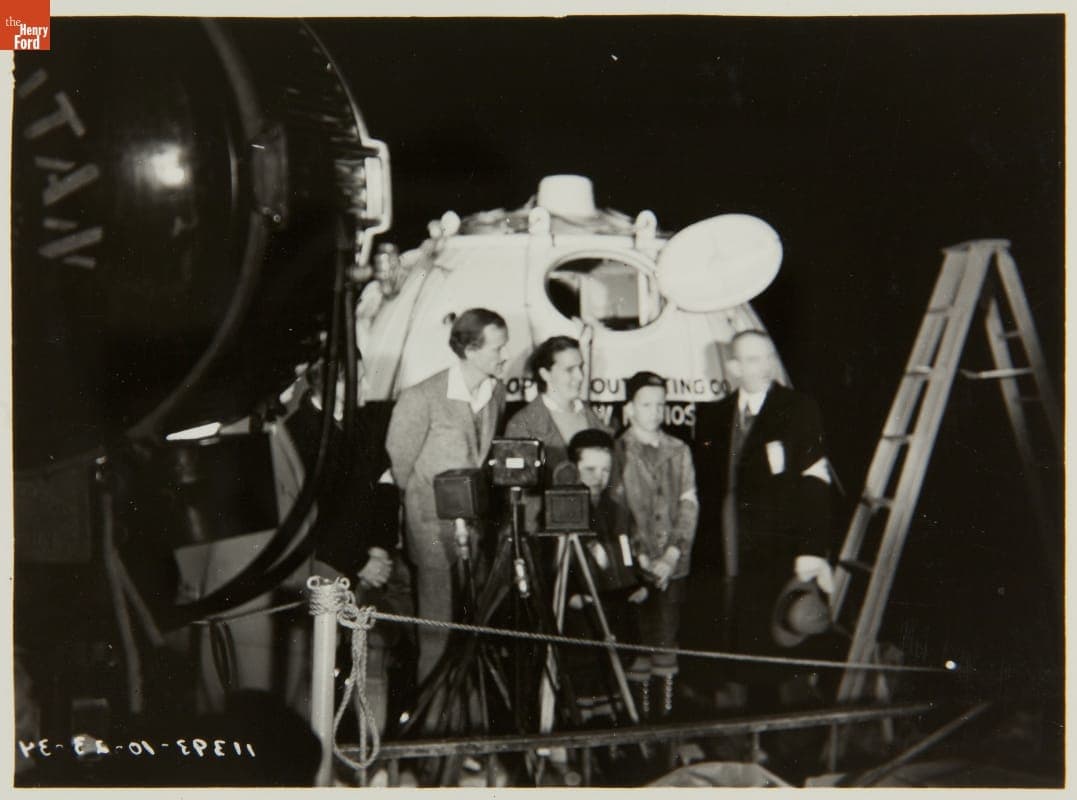
Jean and Jeannette Piccard and Others with Balloon Gondola before the Stratosphere Flight, Ford Airport, October 23, 1934
45,000 spectators gathered on October 23rd to watch the Piccards ascend in their lightweight, pressurized gondola.
View ArtifactTHF231517
Piccard Stratosphere Balloon Ready to Launch from Ford Airport, October 23, 1934
It took hours to fill the balloon, which held 500,000 cubic feet of hydrogen.
View ArtifactTHF230928
View of Balloon from Gondola during Piccard Stratosphere Flight, Altitude 15,000 Feet, October 23, 1934
When inflated, the balloon was 175 feet tall and measured 33 feet in diameter.
View ArtifactTHF230936
View of Piccard Balloon from Airplane during the Stratosphere Flight, Altitude 16,000 Feet, October 23, 1934
While Jeannette piloted, Jean used hundreds of scientific instruments to gather data that contributed to the study of cosmic rays.
View ArtifactTHF230938
Clouds below Balloon during Piccard Stratosphere Flight at Highest Altitude, October 23, 1934
During the flight, Jeannette became the first woman to reach the stratosphere. The Piccards ascended to 57,579 feet (about 10.9 miles), setting a new altitude record.
View ArtifactTHF230932
View of Balloon from Gondola during Piccard Stratosphere Flight, Descending at Altitude 9,000 Feet, October 23, 1934
Jeannette maintained control of the balloon throughout the 8-hour flight, at speeds of about 90 miles per hour.
View ArtifactTHF230934
Gondola Landing after Piccard Stratosphere Balloon Flight, Cadiz, Ohio, October 23, 1934
Winds carried the Piccards 400 miles over Lake Erie to Cadiz, Ohio, where they touched down in a controlled crash landing.
View ArtifactTHF267393
Historical Marker Dedication Program Commemorating the 1934 Piccard Stratosphere Flight from Ford Airport
In 1965, a historical marker commemorating the Piccards’ flight was placed at the former site of Ford Airport. This dedication program notes the critical role and accomplishments of Jeannette Piccard, who went on to become an educator and a consultant for NASA.
View Artifact

