
Railroad Crossings
Share
share
Railroad crossings can be dangerous places. Rail companies first protected their busiest crossings with employees who waved flags or lanterns, or lowered gates, when trains came through. Later, automated lights and gates, operated by electrical relays wired to the track, alerted people of approaching trains. The X-shaped crossbuck, which marks public railroad crossings in the United States, is now a universally recognized warning sign.
THF286484
Car Stopped by Guard at Railroad Crossing, August 1939
Before automated signals became common, the busiest railroad crossings were protected by railroad employees. A person was stationed at the crossing and, when necessary, manually activated a signal or a gate, or perhaps simply waved a flag, a sign or a lantern, to warn approaching road traffic. A small booth protected the signal person from inclement weather.
View ArtifactRailroad Crossing, Detroit, Toledo & Ironton Railroad, Oak Street, Wyandotte, Michigan, June 1926
Apart from eliminating it altogether, the safest way to protect a railroad crossing is with movable gates. The earliest gates, introduced around 1870, were hand-operated by an employee stationed at the crossing. Automated gates first appeared in the 1930s. Four-quadrant gates completely block off the road, while more common two-quadrant gates block each lane only in the direction of travel.
View ArtifactRailroad Crossing Signal, September 1924
Wigwag railroad crossing signals, named for the way they swung back and forth when activated, first appeared around 1914. Their waving action simulated the motion of a lantern being swung back and forth -- long a signal for "stop" on American railroads. Typically, wigwags were driven by a pair of electromagnets that alternately pulled and released the pendulum.
View ArtifactRailroad Crossing Warning Signal, Detroit, Toledo & Ironton Railroad, July 1926
The first automated, flashing red light railroad crossing signal appeared around 1913. The flashing lights mimicked the motion of a lantern being swung back and forth -- long a signal for "stop" on American railroads. The X-shaped crossbuck sign, in wide use by 1900, was inspired by the skull and crossbones -- a universal symbol for danger.
View ArtifactRailroad Crossing Signal Light Control Box, Detroit, Toledo & Ironton Railroad, November 1926
Automatic railroad crossing signals are controlled through an electrical relay in the railroad track. A low-voltage electric current is sent between the two rails via a series of relays like the ones in this photo. When a train approaches, the current runs through the train's metal wheels and axles instead of the relays. This "short circuit" activates the crossing signal.
View ArtifactRailroad Crossing Signal Lights, Detroit, Toledo & Ironton Railroad, November 1926
Blind curves -- whether on the railroad, the road, or both -- added another element of danger to a railroad crossing. Crossings like this were some of the first to be protected with automated warning devices. The lights and bells on these signs were activated whenever an approaching train tripped an electrical relay wired to the track.
View ArtifactAutomobile Waiting at Railroad Crossing for Train to Cross the Road, December 1927
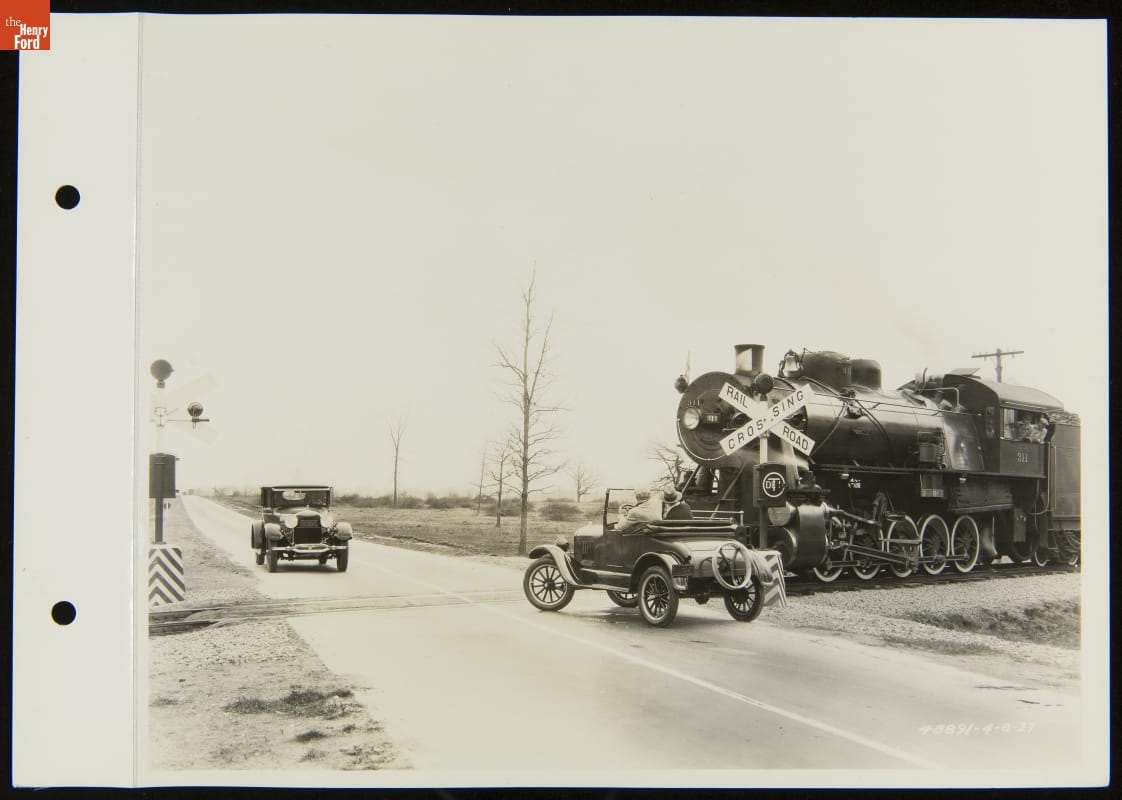
The automobile's growing popularity in the early 20th century brought an increase in railroad crossing accidents. A car-train collision put the auto's occupants at serious risk, but it could also be hazardous to railroad crews and passengers if the heavy car derailed the train. Railroads and highway departments sponsored public safety campaigns warning motorists of the danger.
View ArtifactRailroad Crossing, Detroit, Toledo & Ironton Railroad, April 1927
For as long as trains and automobiles have coexisted, some motorists have felt the need to "race" a train to the crossing. Some early magazine advertisements encouraged the practice, showing daring drivers outrunning speeding express trains. Few habits are so dangerous. A speeding train can take more than a mile to stop. Even in a tie, the motorist loses.
View ArtifactRailroad Crossing Warning Sign, March 1925
Grade crossings between railroads and public roadways in the United States are generally marked in two locations. The crossing itself is marked by the X-shaped "Railroad Crossing" sign, sometimes supplemented by flashing lights or gates. An advance warning sign, like this one, is placed anywhere from 225 to 1,350 feet ahead of the crossing, depending on the road's speed limit.
View ArtifactRailroad Crossing Flash Signal, Detroit, Toledo & Ironton Railroad, March 1925
In the United States, locomotive engineers must sound a specific sequence of horn or whistle blasts when approaching most road crossings: two long blasts, one short, and one more long. Railroads frequently placed a whistle post, like this one, along the track about one-quarter mile before a crossing to notify the engineer when to use the horn.
View ArtifactAutomobile Crossing Tracks Behind a Cleveland, Cincinnati, Chicago, and St. Louis Railway Freight Car, April 1927
The driver of a Ford Model T waits for a loaded hopper car to clear a railroad crossing in this 1927 photograph. The brakeman, riding on the hopper, is blowing a whistle to warn the motorist. Lightly used spur tracks like this often lacked railroad crossing signs, lights or gates. Railroad crews and drivers both had to be cautious.
View ArtifactDetroit, Toledo & Ironton Railroad Overpass, 1926
One way to make a railroad crossing safer was to eliminate it altogether. Overpasses separated trains from automobiles, but they were expensive to build and required extensive regrading of either the railroad or the roadway -- and sometimes both. As a result, overpasses tended to be built only at the busiest crossings.
View Artifact

