
Featured on The Henry Ford's Innovation Nation: Season 5
Share
share
These key artifacts appeared on the fourth season of The Henry Ford’s Innovation Nation. For episode information, please visit https://www.thehenryford.org/explore/innovation-nation/episodes.
THF811625
Wright Home
Though the Wright family moved around, brothers Wilbur and Orville always thought of this house, originally located at 7 Hawthorn Street in Dayton, Ohio, as home. Orville was born here in 1871, and Wilbur died here in 1912. It was also here that the brothers began their serious studies in aviation -- work that led to their successful 1903 Wright Flyer.
View ArtifactRadio Receiver, Used by Amateur Radio Station W6DQZ, circa 1930
Hamid (Charlie) Durmisevich, call sign W6DQZ, connected to the world from his ham radio station in Los Angeles. Amateur radio operators use two-way radios to talk to global networks of other "hams" about technology, weather, emergency preparedness and daily life. This ham, who emigrated from Eastern Europe in 1920, was active in amateur radio communities from the 1930s to 1990s.
View ArtifactCotswold Cottage
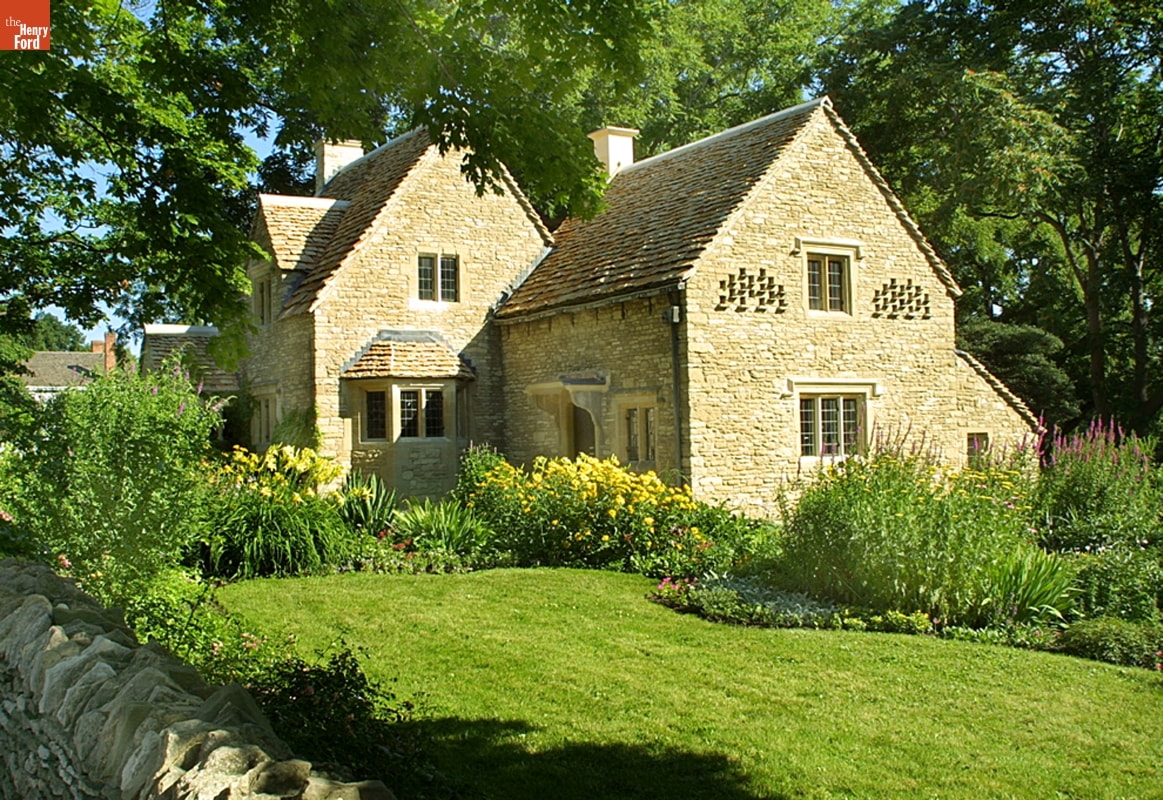
Cotswold Cottage is from the Cotswold Hills in southwest England. The Fords were attracted to the distinctive character of Cotswold buildings, which are characterized by the yellow-brown stone, tall gables, steeply pitched roofs, and stone ornamentation around windows and doors. Several decorative additions were made to the house in England, before dismantling and re-erecting it in Greenfield Village.
View ArtifactNoyes Piano Box Buggy, circa 1910
Factory-built buggies made the pleasures of carriage ownership affordable for a new group of people. Whether in town or on the farm, people loved these inexpensive, lightweight vehicles. The piano box buggy -- named for its resemblance to 19th-century square pianos -- was the most popular of all. Buggy owners quickly became accustomed to the freedom and control offered by personal vehicles.
View ArtifactSholes & Glidden Desk Typewriter, Model No. 1, 1873-1876
Developed by Christopher Glidden in the 1860s and manufactured by the Remington arms company beginning in 1873, the Sholes & Glidden was the first commercially successful typewriter. Its adoption by large corporations kickstarted the typewriter industry and contributed to the speedup of American work life. The innovations of the Sholes & Glidden, particularly its keyboard layout, were widely adopted. This typewriter is why your computer keyboard reads QWERTYUIOP.
View Artifact1950 Nash Rambler Convertible
This 1950 Nash Rambler convertible was an attempt to market a small automobile to the American public. Other independent automobile manufacturers had produced small vehicles, but none to the success of the Rambler. The compact Rambler was attractive, well equipped, and sensibly priced. But in the 1950s, big cars ruled. Only by 1960 did the larger "Big Three" auto companies produce an "in-between-sized" car.
View ArtifactWashington Press, Used at the Cranbrook Academy of Art
The Washington Press established two innovations in printing history: a lightened metal frame for easier transport, and a toggle-joint mechanism to create impressions. Over 6000 of these rugged hand presses were sold between 1835-1902; many specialist printers continue to use them today. This press was donated by George Booth, Detroit News publisher and founder of the Cranbrook Educational Community.
View ArtifactDraisine, circa 1818
German Karl Drais invented the draisine in 1817. Operators of this human-powered vehicle sat astride the wooden rail and pushed off with their feet. The early velocipede caught the public's attention, but its novelty soon wore off. A number of substantial improvements, made many years later, were needed before this running machine would evolve into the modern bicycle.
View ArtifactPrinting Office & Tin Shop
The Printing Office was built in Greenfield Village in 1933. For decades, the building served as a utilitarian print shop for Greenfield Village. At one time, the building housed a recreated 19th-century small town newspaper print shop and tinsmithing studio. Now, only the print shop remains.
View ArtifactNodin Noiseless Desk Typewriter, 1900-1910
This solidly made side-strike keyboard typewriter is called Nodin to indicate its noiselessness ("no din.") Noiseless typewriters altered the usual platens and type-strike mechanisms to soften the loud typewriter clattering of many early twentieth century workplaces. It appears that The Henry Ford's two Nodins are the only ones that survive.
View ArtifactSchwinn Sting-Ray Lemon Peeler Bicycle, 1968
After seeing kids in southern California customize their bicycles with "longhorn" handlebars and "banana" seats, Schwinn introduced its Sting-Ray line in 1963. The sporty bikes were a smash, selling two million copies by 1968. Drag racing funny cars inspired this Lemon Peeler Sting-Ray with its small front tire, front drum brake, springer suspension fork, and five-speed stick shift.
View ArtifactLa-Z-Boy Chair Company Sales Model "Reclina Rocker" Chair, 1961
The first to combine a built-in ottoman with a rocking feature, this model dramatically increased La-Z-Boy's sales in the early 1960s. Middle class Americans eagerly adopted the chair for use in dens, family and living rooms. This chair served as William M. Clary's La-Z-Boy salesman sample, traveling the country from dealer to dealer.
View ArtifactFord Model 9N Prototype Tractor, 1939
This is the first prototype of the Model 9N tractor. This tractor marked the first practical hydraulic three-point hitch on a tractor, a feature standard on all tractors today. Henry Ford helped debut this machine when he demonstrated its versatility on April 1, 1939 at a media event on the property of his Dearborn home.
View ArtifactDetroit Toledo & Ironton Railroad Caboose, 1925
The caboose was the conductor's office, the crew's quarters, and the observation platform from which to spot problems with the train. It could also be dangerous. "Slack action" -- sudden movement when slack ran in and out of a moving train -- could toss riders about. Computerized record keeping, trackside defect detectors, and smaller crews made the caboose obsolete by the 1980s.
View ArtifactEdison Talking Doll, 1889-1890
Thomas Edison's 1878 patent for a "phonographic" doll resulted in the production of about 100 "talking" dolls between 1889 and 1890. This doll "talked" by means of a scaled-down phonograph inside its body, which played nursery rhymes like "Mary Had a Little Lamb." Only made for a short time, the doll's mechanism was unreliable and the recorded voices scared children.
View ArtifactLogan County Courthouse
Between 1840 and 1847, Abraham Lincoln tried cases here as a traveling lawyer. Visiting once or twice a year, he worked mostly on cases resolving neighbors' disagreements over land, contracts, and debts. As Lincoln traveled, people got to know him because he always took time to talk to them. This helped him earn votes later when he went into politics.
View ArtifactReclining Chair, 1876-1900
Victorian Americans enjoyed reclining in adjustable chairs like this one, popular during the late 19th century. These innovative mass-produced chairs featured functionality over style. This type of furniture appealed most to a growing middle class and would have served as a novelty piece in a parlor or sitting room.
View ArtifactGeneral Electric "Monitor-Top" Refrigerator, circa 1934
The big news in the kitchen during the 1920s? Reliable, affordable electric refrigeration. As more homes had access to electric power, people replaced their messy wooden iceboxes with stylish, low maintenance, enameled porcelain electric refrigerators. In 1930, 10% of households had them -- by 1940, 56% did. General Electric's distinctive "Monitor Top" refrigerator was a big seller in the late 1920s and early 1930s.
View ArtifactWrist Watch, 1958
When this watch came to the Museum in 1959, the Hamilton Watch Company was America's leading watchmaker. The company created the first electric watch, the Ventura, whose movement was powered by a battery, instead of a wound spring. Its design was as revolutionary as the mechanism--the lozenge-shaped case reflected postwar American industrial design. This watch has the Ventura's watchband but the features of its successor, the Pacer.
View ArtifactEstate Stove Company Toaster, 1925
Mercury Light Bulb Display Board, Displayed at General Electric's Nela Park Laboratory, circa 1975
Whirlpool Microwave Oven, 1957
Robot, First Unimate Robot Ever Installed on an Assembly Line, 1961
Unimate robots were the world's first successful industrial robots. The units, designed by Unimation Inc., could perform tasks in manufacturing facilities that were difficult, dangerous, or monotonous for human workers. This is the first Unimate ever used on an assembly line. It was installed at the General Motors plant in Trenton, New Jersey, in 1961 to unload a die-casting press.
View Artifact1927 Blue Bird School Bus
This 1927 Blue Bird is the oldest surviving school bus in America. Albert Luce, Sr., built his first bus in 1925 by mounting a purchased wood body to a Ford truck frame. The body could not withstand the Georgia roads. Luce, convinced he could make a better bus, applied a steel framework under the wood body. His success led him to make school buses full time.
View Artifact"The Walking Office" Wearable Computer Prototype, 1984
The Walking Office Wearable Computer is a prototype model created by the design group Salotto Dinamico. This proposed device subverted where (and when) the office could be, turning the human body into a mobile workstation. A keyboard, display arc, and cassette recorder became personal adornment--also capable of pairing with an acoustic modem to exchange data through telephone lines.
View ArtifactWhite Treadle Sewing Machine, 1885-1890
Sewing machines made sewing much faster---creating consistent, even stiches better than could be done by hand. Most clothing was still made at home during the late 19th century--sewing machines made this task easier. In the 1880s, the White Sewing Machine Company manufactured about 60,000 sewing machines annually--and its machines won awards both in America and abroad.
View Artifact

