
American Arts and Crafts Movement
Share
share
The Arts and Crafts movement emerged in the 1860s and 1870s in England, then the most industrialized country in the world. Theorists and designers promoted a return to an idealized past where artists and craftsmen collaborated to create beautiful and useful objects. Many of the movement's ideas spread to the United States by 1900. Here is a representative group of objects from our collection, featuring high-end to mass-market examples.
THF156362
Sideboard, Designed by Sydney R. Burleigh, 1885-1895
Artist Sydney Burleigh, a leading member of the Arts and Crafts movement in Rhode Island, created this remarkably elegant sideboard in the late 1800s. Its simple lines, flush surfaces, painted panels, and handcrafted construction contrasted with the overly ornate and machine-made furniture of the period. Burleigh used this sideboard in his Providence, Rhode Island, studio.
View ArtifactTHF174999
Table Cover, 1890-1910
Textiles were an integral part of the Arts and Crafts interior. Designers emphasized the use of stylized botanical motifs, such as the roses seen here, which harmonized with furniture, ceramics, and artwork. The ideal was to create a unified interior environment, which was a reaction against "fussy" Victorian interiors.
View ArtifactTHF176917
Vase, 1897-1910
The Grueby Faience Company was based in Revere, Massachusetts, and specialized in matte finish pottery and tiles. They were known for their unique cucumber green colored vases, like this one, and their most famous shape was this leaf-form tall vase. Grueby also collaborated with other Arts and Crafts design firms like Gustav Stickley's, who sold Grueby wares through his catalogue.
View ArtifactTHF166128
Jam Dish and Spoon, 1900-1910
The Arts and Crafts movement encouraged the participation of women. Silversmith Mary Winlock was a member of the Boston Society of the Arts and Crafts and joined the Handicraft Shop -- an artists' cooperative -- where she sold her distinctive enameled silver and jewelry. She created this charming jam dish and spoon around 1905.
View ArtifactTHF176913
Vase, 1902-1907
The Weller pottery, located in Zanesville, Ohio, was America's largest art pottery maker in the early 20th century. The Sicard line, produced from 1902 -- 1907 and named after its creator, French artist Jacques Sicard, is considered Weller's most beautiful. The metallic, iridescent glaze was created by Sicard was expensive to make. Sicard stayed at Weller for five years and returned to France in 1907, taking the glaze formula with him.
View ArtifactTHF176737
Vase, 1903-1904
This vase was made by Charles Binns, the first director of ceramics at the renowned Alfred University in New York. Binns argued that the potter should create functional objects that were unique works of art, from start to finish -- an idea derived from the writings of the English designer and philosopher William Morris, a founder of the Arts and Crafts movement.
View ArtifactTHF159607
Limbert Library Table, 1905-1915
Charles Limbert's was one of the most successful of mid-level Arts and Crafts furniture firms, in terms of sales and design. This oak library table, a staple form of the Arts and Crafts movement, is simple, yet elegant. It features a writing surface that pulls out and retracts from the long side of the table and contains a drawer for storage.
View ArtifactTHF373740
Sugar Cube Tray and Tongs, 1905-1930
This tray and tongs are a great example of how the Art and Crafts aesthetic diffused through popular culture. Retailed by department store Marshall Field and Company, the surfaces of the tray and tongs show hammer marks, emphasizing their hand craftsmanship, a tenet of the Arts and Crafts movement. Ironically, these were made in a factory -- the hammer marks for show only.
View ArtifactTHF176936
Tile, 1905-1920
The Grueby Faience Company was based in Revere, Massachusetts, and specialized in matte finish pottery and tiles. This tile was intended to be a part of a larger composition, perhaps lining a fireplace, where the turtles would follow in a line from head to tail. The effect was intended to harmonize with an Arts and Crafts interior environment.
View ArtifactTHF184149
Drapery Panel, circa 1910
Textiles were an integral part of the Arts and Crafts interior. Designers emphasized the use of stylized geometrical motifs to harmonize with furniture, ceramics, and artwork. The ideal was to create a simple, yet unified interior environment, which was a reaction against "fussy" Victorian interiors.
View ArtifactTHF110273
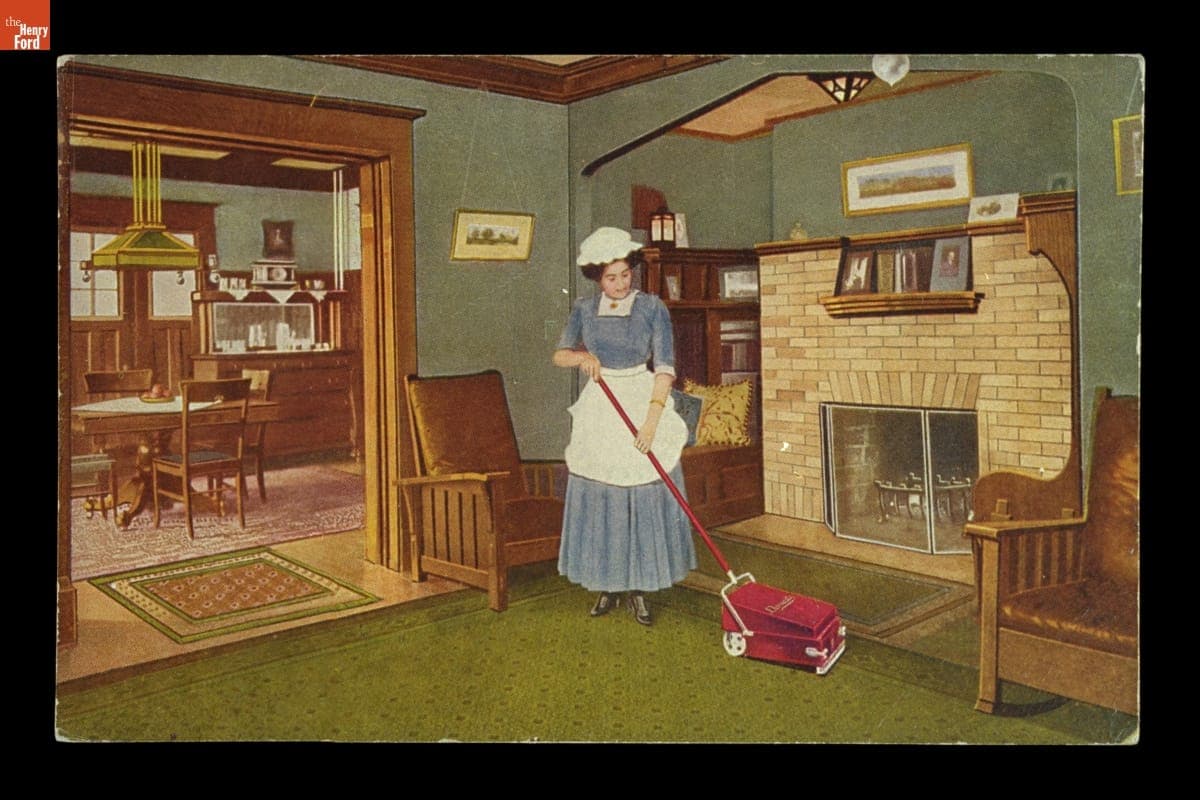
Postcard Advertising the Domestic Vacuum Sweeper Company of Peoria, Illinois, circa 1910
This card advertising a carpet sweeper shows the most modern interior in 1910 America. All of the furnishings represent the Arts and Crafts style, from the reclining or Morris chair behind the maid, to the rocker next to the fireplace, with its cozy corner, or inglenook. Even the lighting fixtures are as up to date as possible.
View ArtifactTHF176870
Vase, 1908
The Rookwood Pottery was founded in Cincinnati in 1880 by Maria Longworth Nichols. She hired many talented potters and decorators, making the firm a leader among art potteries by the 1890s. Producing ceramics in all the popular styles, here is an excellent example of their Arts and Crafts work, featuring a simple shape, matte green glaze, and stylized floral decoration.
View ArtifactTHF709
Player Piano, 1910-1920
Made by Chicago-based J.P. Seeburg in the Arts and Crafts style, this player piano combines the use of oak for the case with stained glass panels depicting a marine scene. Player pianos were very popular for use in homes in America from the 1890s through the 1920s, but this piano, a coin-operated machine, was made for use in a public place.
View ArtifactTHF160411
Side Chair, 1910-1920
The style of this chair is known as Prairie, a subset of the Arts and Crafts. Prairie Style works centered around Chicago, Illinois, and are often associated with the work of Frank Lloyd Wright and his contemporaries. Although the maker is unknown, according to the donor it was purchased and used in Chicago and paired with the Stickley Brothers desk, seen below.
View ArtifactTHF160413
Slant-Front Desk, 1910-1920
The Stickley Brothers Company of Grand Rapids was one of the most financially successful of mid-level Arts and Crafts furniture manufacturers. Slant-front desks in a variety of forms were a staple of their production, along with living and dining room furniture. This oak desk, featuring hand-wrought looking hinges and drawer pulls, appealed to style-conscious customers in department and furniture stores.
View ArtifactTHF159902
Morris Chair, 1912-1916
A Morris chair is a reclining chair that functions with a moveable bar supporting the backrest in a variety of positions, and named for its inventor, William Morris, the English designer, philosopher, and co-founder of the Arts and Crafts movement. This chair was made by Gustav Stickley and is considered the quintessential example of an American Arts and Crafts chair.
View ArtifactTHF177116
Planter, 1912-1920
Peters and Reed pottery from Zanesville, Ohio, was known for their unique glazes and glaze treatments. This piece, from their Moss Aztec line, was made by spraying the molded designs in relief with green coloring, then wiping the top of the piece to create a "moss" effect. The natural coloring would have fit perfectly in a typical Arts and Crafts home.
View ArtifactTHF166153
Child's Plate, circa 1914
Founded in Chicago in 1900 by female graduates of the school at the Art Institute, the Kalo Shop grew into the most important American Arts and Crafts silver studio in the United States. Initially producing leather goods and other crafts, by 1910 they turned their attention to jewelry and silver. This elegant bowl reflects their motto, "beautiful, useful, and enduring."
View ArtifactTHF176722
Vase, 1916-1920
The Roseville Pottery was one of the three major Ohio art potteries along with Rookwood and Weller. Like Weller, it was located near Zanesville in southeastern Ohio. Roseville, like the other art potteries produced many lines of art pottery. This piece represents the Mostique line, introduced around 1916, showcasing its version of the Arts and Crafts style.
View ArtifactTHF177115
Candlestick, 1917-1921
Jugtown Pottery was founded by artists Jacques and Juliana Busbee to help save local craft traditions in North Carolina. The Busbees made their wares for sale in a shop in Greenwich Village, New York. This rough, salt glaze candlestick is typical of their early pieces, appearing very much like a survivor of the 18th or 19th century. Although it has changed hands, Jugtown Pottery still exists, producing a wide variety of serving pieces.
View ArtifactTHF176918
Vase, 1917
The Rookwood Pottery was founded in Cincinnati, Ohio, in 1880 by Maria Longworth Nichols. She hired a number of talented potters and decorators, making the firm a leader among art potteries by the 1890s. The vellum technique was invented in 1904 and consists of a light-colored matte background with floral or landscape decoration.
View ArtifactTHF176898
Vase, 1903-1907
Detroit's Pewabic Pottery was founded by artist Mary Chase Perry in 1903 as part of the American Arts and Crafts movement. The pottery is known for its iridescent glazes on tiles and vessels. This vase was carefully modeled to represent naturalistic leaves in high relief from the surface of the vase. The green matte glaze is typical of Pewabic and Arts and Crafts pottery in general.
View Artifact

