
Frontline Workers: An Historic Appreciation
Share
share
At the one-year anniversary of the start of closures and lockdowns in the United States related to the 2020-21 COVID-19 pandemic, we, as so many others, are reflecting on those who kept our society running while our day-to-day life radically changed. These artifacts show how much we have always depended on the "essential workers" covered here (and many others not covered), while a pandemic year brought that dependence into sharper relief.
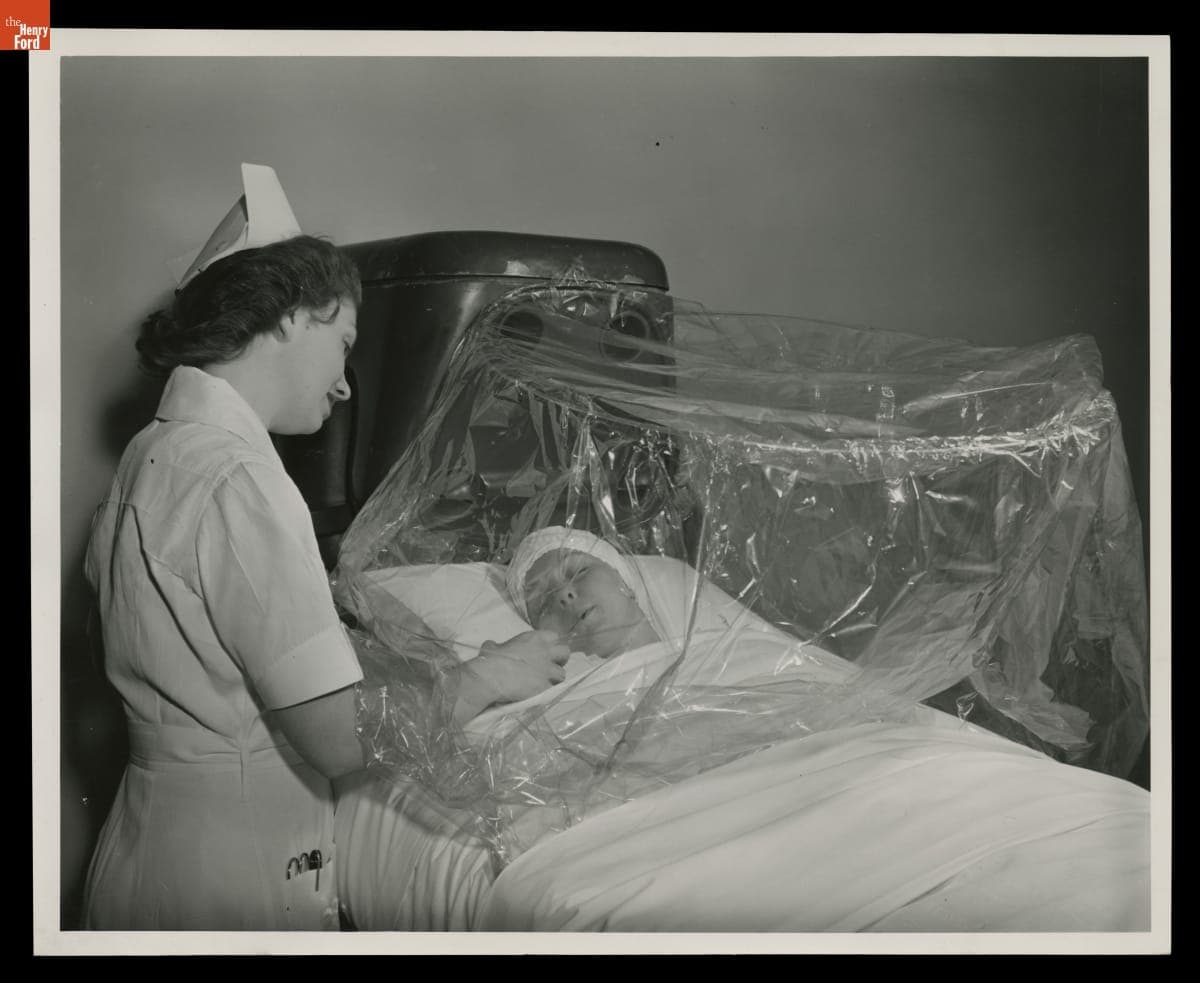
THF117533
Nurse Attending Patient in Oxygen Tent at Henry Ford Hospital, Detroit, Michigan, June 1946
In 2020, nurses were on the frontlines of the COVID-19 pandemic in emergency rooms and intensive care departments--and were sometimes the only people able to be with dying patients. Here, a nurse at Henry Ford Hospital treats a patient in an oxygen tent in 1946.
View ArtifactTHF136137
Doctor Holton and Patient in Medical Clinic, Richmond Hill, Georgia, circa 1940
Like nurses, doctors put their own physical and mental health in jeopardy during 2020, caring for COVID-19 patients, even as personal protective equipment was in short supply. This doctor examines a patient in Richmond Hill, Georgia, just southwest of Savannah.
View ArtifactTHF130656
Frontier Nursing Service, "The Nurse on Her Rounds," 1931
Emergency medical technicians (EMTs) and paramedics responded throughout the pandemic to both COVID-related and non-COVID-related emergency medical situations at people's homes and workplaces. This photo shows a nurse from the Frontier Nursing Service making a housecall at a Kentucky home.
View ArtifactTHF117502
Man Examining X-Ray Radiographs at Henry Ford Hospital, Detroit, Michigan, January 1939
Throughout the pandemic, medical researchers and doctors studied the coronavirus, continually expanding and improving available treatments--with resulting improvements in outcomes. This Henry Ford Hospital staff member examines x-rays.
View ArtifactTHF117451
Laboratory at Henry Ford Hospital, Detroit, Michigan, June 1931
A vast network of specialized medical researchers focused their investigations on the development of effective vaccines to protect people against contracting COVID-19. This man works in a laboratory at Henry Ford Hospital in 1931.
View ArtifactTHF252058
Workers Harvesting Tomatoes at a Heinz Tomato Farm, 1908
Many of the pandemic's essential workers helped ensure our food supply remained constant. Farmworkers continued to plant, tend, harvest, and deliver produce, as well as dairy products and meat, to supply end-consumers. These men and women pick tomatoes in 1908.
View ArtifactTHF123787
Slaven's Grocery, Tawas City, Michigan, 1935-1950
Grocery store workers put themselves at risk during the pandemic to ensure that their communities maintained access to meat, dairy, produce, and prepared foods. Here, workers pose for a picture at a Michigan grocery store.
View ArtifactTHF38079
Delivery Wagon, Fehrenbach Table Luxuries, 1890-1915
Grocery delivery services also boomed during 2020, as many people opted to have food brought to their homes as they "socially distanced." Here, men make home deliveries of "luxury" grocery items more than a century ago.
View ArtifactTHF142037
Mail Delivery Using a Ford Model T Touring Car, Painting by Barse Miller, 1925
Mail carriers continued to deliver letters, bills, and packages to homes throughout the pandemic, despite sometimes sky-high rates of postal employees out sick or under quarantine for COVID-19 . This postman delivers mail in the 1920s using his trusty Model T.
View ArtifactTHF256624
Delivery of Packages, Express Service by Air to Boston, 1926
Beyond the U.S. Postal Service, a wide array of doorstep deliveries boomed during 2020, as consumers ordered items over the Internet in lieu of visiting stores. Here, men sort packages destined for air express service in the 1920s.
View ArtifactTHF98661
Teacher and First Grade Students at George Washington Carver School, Richmond Hill, Georgia, circa 1940
Teachers faced extraordinary working conditions during the pandemic--in various areas at various times, schools were suspended, taught entirely virtually, or taught in a hybrid virtual-onsite model. Here a teacher works with a first-grade class.
View ArtifactTHF204405
Women Workers in a Shoe Factory, Boston, Massachusetts, circa 1903
Behind the scenes, factories across the country and the world continued to produce goods, to ensure these were available to consumers when they needed them. These women make shoes in Boston at the turn of the 20th century.
View ArtifactTHF203585
Lake Merritt B.A.R.T. Station, Oakland, California, circa 1972
Many workers who could do their work from home stopped commuting in March 2020--and as of March 2021, many continue to work from home. Still, essential workers had to physically report to their workplaces throughout the pandemic. Train, subway, rapid transit, and bus drivers, along with the workers who support these transportation systems, have been critical. This postcard commemorates the opening of a new rapid transit station in Oakland.
View Artifact

