
Barney Korn: Tether Car Craftsman
Share
share
Tether cars, gas-powered model race cars, were popular in the 1930s and 1940s. Few tether car makers matched the skill of Barney Korn. His remarkably detailed and largely hand-built models stood apart from mass produced units by larger manufacturers. Korn's models weren't big sellers – they were too slow for serious racers and too expensive for amateurs – but modern collectors value them for their beauty and rarity.
THF160778
Overhead Valve Engine, Built by B.B. Korn for a High School Shop Project, circa 1920
Bernard Barney Korn was born in Los Angeles, California, in 1903. His talents were evident from an early age. Korn built this elaborate water-cooled model engine while in his high school shop class. The engine features overhead valves operated by a chain-driven camshaft.
View ArtifactTHF159677
Korn "Meteor" Gas-Powered Racing Tether Car, 1939-1940
Korn honed his skills partly by working as a machinist for aviation innovator Howard Hughes, whose organization he joined in 1924. As tether cars became more popular, Korn formed B.B. Korn Specialty Manufacturing Company in 1939. The "Meteor" was Korn's first – and rarest – production model. Only 18 examples are believed to have been made.
View ArtifactTHF159749
Dynamometer, Built by B.B. Korn, 1938
Korn built this working dynamometer to test his models. Essentially, it was a treadmill for engines that allowed a car's drive wheels to spin while the car itself remained stationary. Korn's dynamometer measured the power and torque of the .60-cubic-inch engine as delivered to the drive wheels. The machine was adjustable for rear or front-wheel-drive models.
View ArtifactTHF157103
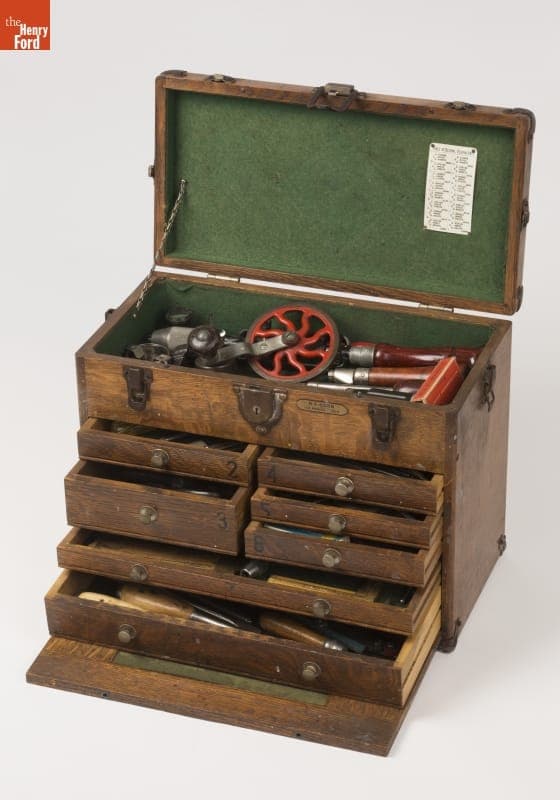
Tool Chest Used by B.B. Korn, 1926-1940
The craftsmanship was obvious in each of Barney Korn's models. Even the dashboards were detailed, with instrument gauges carefully replicated and applied. Korn used this tool chest, and the tools inside, to create some of his meticulous models.
View ArtifactTHF157111
Micrometer Set Used by B.B. Korn, circa 1940
This micrometer set speaks to the precision with which Korn worked. The micrometer's calipers and scale allowed him to take accurate measurements of even the smallest parts.
View ArtifactTHF157080
Korn "Liberty Special" Indianapolis Gas-Powered Racing Tether Car, 1940-1941
Barney Korn began producing his "Indianapolis" model in 1940. Handsome and well proportioned, the "Indianapolis" was based on real Indianapolis 500 race cars of the time. It was a big model, with a 13-inch wheelbase and an overall length that topped 20 inches. This example has an aluminum body and a working compass in its dashboard.
View ArtifactTHF157064
Korn "Indianapolis" Gas-Powered Racing Tether Car, 1940-1941
Korn is believed to have produced just 66 "Indianapolis" cars in total. Most featured rear-wheel drivetrains, and most used aluminum bodies. About 10 of Korn's "Indianapolis" cars were built with lightweight magnesium bodies, frames, and axles instead. When materials became scarce during World War II, Korn mixed and matched aluminum and magnesium components as needed.
View ArtifactTHF162925
Wood Patterns for B.B. Korn's "Indianapolis" Gas-Powered Racing Tether Car, 1940-1941
Barney Korn hand-carved these wood bucks to cast molds for the frames, drivetrains, and bodies used in production of his company's "Indianapolis" models.
View ArtifactTHF157106
"Indianapolis" Tether Car Mold Used by B.B. Korn, 1940-1941
This is one of the molds that Korn produced from wood bucks like those seen above. It shaped the front cowling, cockpit area, and rear end of an "Indianapolis" model's body.
View ArtifactTHF159732
Korn "Indianapolis 29" Gas-Powered Racing Tether Car, 1948
Budget-conscious tether car customers might choose one of Korn's "Indianapolis 29" models instead. Everything about the "29" series was smaller: the .29-cubic-inch engines (hence the name), the dimensions, and the price tags.
View ArtifactTHF162911
Korn "Indianapolis 29" Gas-Powered Racing Tether Car Kit, 1948
The buyer could save more money by purchasing an unassembled "Indianapolis 29" kit instead of a fully assembled car. It was up to the buyer to finish the rough edges of the balsa wood body – and to purchase the engine separately.
View ArtifactTHF162868
Korn "Indianapolis" Tether Car, Promotional Model Race Car, circa 1945
Most tether car owners raced their models – either against the clock while tethered to a central pivot, or against each other on a scaled-down track. Large size and superb detail – qualities evident in Barney Korn's "Indianapolis" models – weren’t necessarily compatible with high speeds. This promotional model wasn’t meant for racing in any event – it lacks an engine and drivetrain.
View ArtifactTHF146974
Assembly Instructions for the Korn "Indianapolis 29" Gas Powered Racing Tether Car Kit, 1948
Korn's cars weren't just slower, they were more expensive. They often cost twice as much as comparable models from other manufacturers. Poor sales made the B.B. Korn Manufacturing Company unsustainable, and it closed just a few years after its founding.
View ArtifactTHF163450
Tool Chest Used by B.B. Korn, 1939-1950
Barney Korn went on to make special effects models for films like To Please a Lady – a 1950 racing movie starring Clark Gable. He even built some improved versions of his original tether cars in the early 1980s. Korn died in 1996, but his craftsmanship survives. Replica Korn cars are readily available today, and originals are highly prized by collectors.
View Artifact

