
Richard Byrd’s North Pole Flight
Share
share
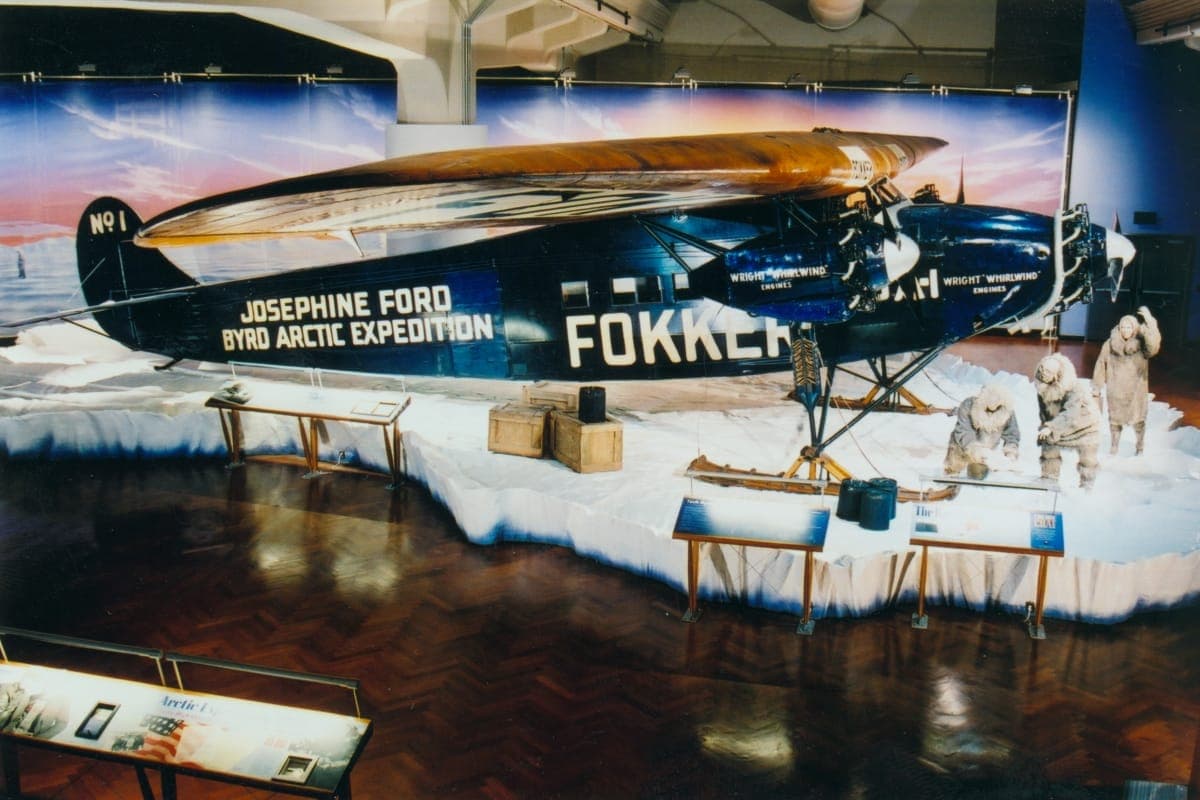
On May 9, 1926, explorer Richard Byrd and pilot Floyd Bennett took off from Norway on a round-trip flight to the North Pole in their Fokker Tri-Motor airplane Josephine Ford. Though Byrd is generally credited with reaching the pole, controversy remains over whether he could have made the 1,350-mile journey in the 16 hours he and Bennett spent aloft. Whatever doubts remain today, Byrd was celebrated as a leading polar explorer of his time.
THF123645
Richard E. Byrd Using a Sextant, circa 1927
Born in 1888, Richard Evelyn Byrd, Jr., was defined by determination. When he injured his right ankle while attending the U.S. Naval Academy, Byrd shifted his focus from the sea to the sky. He enrolled in the Navy’s new aviation school and trained as a pilot and navigator. From boyhood, Byrd dreamed of one day exploring the North Pole.
View ArtifactTHF98779
Edsel Ford, Richard E. Byrd and Henry Ford with 1926 Ford Tri-Motor 4-AT-1
Above all else, Byrd needed money. A mutual acquaintance connected him with Henry Ford and Edsel Ford in 1925. Ford Motor Company had recently joined the aviation industry, and Byrd's anticipated North Pole flight promised to boost commercial aviation. Edsel Ford was particularly impressed with Byrd's grand plans. In January 1926, he contributed $20,000 to the expedition.
View ArtifactTHF39665
1925 Fokker F.VII Tri-Motor Airplane, "Josephine Ford," Flown Over the North Pole by Richard Byrd
Byrd intended to use a Ford Tri-Motor on his Arctic flight, but a factory fire in January 1926 prevented it. Instead, Byrd acquired a Fokker F.VII Tri-Motor. Manufacturer Anthony Fokker insisted on prominent "FOKKER" markings – lest it be confused with a Ford airplane – but Byrd acknowledged his patron by naming the plane for Edsel Ford's daughter: Josephine Ford.
View ArtifactTHF701876
John D. Rockefeller, Jr. and Rear Admiral Richard E. Byrd Shaking Hands before the Byrd Arctic Expedition, 1926
Edsel Ford persuaded oil magnate John D. Rockefeller, Jr., to make his own $20,000 contribution to the Byrd expedition. Private funding was essential. Congress had supported several expeditions, via the Army and Navy, in the early 1920s, but those monies were exhausted by the time of Byrd's trek.
View ArtifactTHF701953
The Fokker Airplane "Josephine Ford" during the Byrd Arctic Expedition, 1926
Richard Byrd, his airplane, and his 50-person crew boarded the ship Chantier and departed from New York on April 5, 1926. They sailed for Spitzbergen, Norway, which would be their base of operations. The island lay north of the Norwegian mainland between the Norwegian Sea and the Arctic Ocean -- some 675 miles from the North Pole.
View ArtifactTHF255245
Special Short Wave Radio Equipment for the Byrd Arctic Expedition, 1926
Byrd had seen first-hand the benefits of shortwave radio communication during the 1925 MacMillan expedition. He arranged for the Chantier to be equipped with a 500-watt transmitter, and for the Josephine Ford to have a 50-watt unit. These radios allowed direct voice communication between the ship and the airplane.
View ArtifactTHF701959
Floyd Bennett with the Fokker Airplane, "Josephine Ford," during the Arctic Expedition, 1926
Byrd would fly to the pole with pilot Floyd Bennett. They met at the Navy's flight school in Pensacola, Florida, and they later worked together on the MacMillan expedition. Bennett was calm and confident, but not cocky -- ideal qualities for a pilot on a difficult mission. Byrd was impressed with Bennett's character and abilities, and the two became close friends.
View ArtifactTHF701951
The Fokker Airplane "Josephine Ford" Flown in the Byrd Arctic Expedition, 1926
Byrd's arrival in Spitzbergen did not go smoothly. The harbor's single pier was occupied by a disabled ship, and Byrd couldn’t unload the Josephine Ford directly on land. Undaunted, Byrd ordered his crew to build a raft from several small boats. It was risky, but the team expertly moved the airplane ashore with their makeshift ferry.
View ArtifactTHF621193
Roald Amundsen and Lincoln Ellsworth greet Richard Byrd and Floyd Bennett before the North Pole Flight, May 1926
When Byrd's team arrived in Spitzbergen, Norwegian explorer Roald Amundsen was already there. He had his own crew, including Italian aviator Umberto Nobile and American adventurer Lincoln Ellsworth, and his own polar ambitions. Having failed to reach the North Pole by airplane in 1923 and 1925, Amundsen selected a lighter-than-air craft for his 1926 attempt.
View ArtifactTHF621183
Airship "Norge," Designed and Piloted by Umberto Nobile, before Departure to the North Pole, May 1926
Amundsen intended to fly over the North Pole in the airship Norge, which Nobile had designed. Byrd and Amundsen treated each other's efforts with a blend of competition and cooperation. They shared advice and equipment as they prepared for their flights. But they also kept close watch on the calendar -- each man eager to be first to reach the pole.
View ArtifactTHF701945
Members of the Byrd Arctic Expedition Crew with the Fokker Airplane, "Josephine Ford," 1926
Byrd and Bennett initially struggled to get the Josephine Ford into the air. The plane moved too slowly on its wooden skis. Bernt Balchen, a crewmember on the Norge, recommended that the fragile skis be reinforced and greased with pine tar and resin, and that Byrd and Bennett take off at night when hard-frozen snow provided a smoother surface.
View ArtifactTHF701934
Crew Member Adding Fuel to the "Josephine Ford," the Fokker Airplane Flown on the Byrd Arctic Expedition, 1926
Byrd's team took 615 gallons of gasoline on their expedition. The tanks in the wings of the Josephine Ford held 420 gallons. The rest of the fuel was carried in five-gallon cans that were used to refill the tanks during the flight. Byrd and Bennett used an average of 28 gallons an hour on their North Pole flight.
View ArtifactTHF701955
The Fokker Airplane "Josephine Ford" during the Byrd Arctic Expedition, 1926
The additional fuel gave the Josephine Ford a range of nearly 2,200 miles. From the start, Byrd wanted to make his flight in a tri-motor airplane. Three engines provided a good safety margin if something went wrong -- indeed, one engine developed an oil leak during the polar flight -- and an emergency landing on Arctic ice was a last resort.
View ArtifactTHF621191
Roald Amundsen Watches as Richard Byrd Takes Off in the Fokker F. VII Tri-Motor Airplane "Josephine Ford," May 1926
The Josephine Ford lifted off at 12:37 a.m. on May 9, 1926, and then climbed to 2,000 feet and accelerated to a reported 90 mph. Bennett operated the controls while Byrd navigated. Throughout the flight, Byrd kept a detailed flight log of times, speeds, and locations. That log would be the only proof of success.
View ArtifactTHF701957
Richard E. Byrd with the Fokker Airplane, "Josephine Ford," during the Arctic Expedition, 1926
At 9:02 a.m., Byrd's navigational instruments showed that they'd reached the North Pole. Byrd and Bennett exchanged a congratulatory handshake, circled the site, and then returned south with help from a tailwind that boosted them to a reported 100 mph. The two men took turns piloting and napping as a combination of excitement and exhaustion overwhelmed them.
View ArtifactTHF701963
Richard E. Byrd, Floyd Bennett, and Others Celebrate the Arctic Expedition beside the Fokker Airplane, the "Josephine Ford," June 2, 1926
When the Josephine Ford arrived back at Spitzbergen at 4:34 p.m., both Byrd's and Amundsen's teams cheered its return. The Norwegians played "The Star-Spangled Banner," and Amundsen greeted Byrd with a warm embrace. The Norge -- with Amundsen, Ellsworth, Nobile, and a crew of 13 others -- completed its own successful flight over the North Pole three days later.
View ArtifactTHF701885
Commander Richard E. Byrd: Telling His Own Story of the First Flight to the North Pole, June 25, 1926
Upon returning to New York on June 23, 1926, Byrd immediately set out to share his story through lectures, newspaper stories, and magazine articles. Many of these efforts were made under an agreement that had given Byrd a $5,000 advance -- used to help fund the expedition -- in exchange for exclusive rights to news and photos from his North Pole flight.
View ArtifactTHF701939
Aerial View of Kings Bay, Svalbard, Norway during Richard E. Byrd's Arctic Expedition, 1926
Questions about Byrd's flight soon appeared. Could he have flown 1,350 desolate miles in 16 hours? If the Josephine Ford had a top speed of 100 mph, and if Byrd had a favorable tailwind, then yes. But later flights suggested the plane's top speed was closer to 70 mph, and area weather charts for May 9, 1926, recorded calm winds.
View ArtifactTHF138680
The "Josephine Ford" 1925 Fokker Tri-Motor Airplane in Henry Ford Museum, 1938
Following the expedition, the Josephine Ford made a promotional tour across the United States. It soon found a permanent home. Edsel Ford purchased the Fokker airplane for $30,000. It was the first aircraft acquired for Henry Ford’s emerging museum in Dearborn, Michigan. The Josephine Ford was -- and remains -- the most significant artifact from Byrd's North Pole flight.
View ArtifactTHF701870
Richard E. Byrd in a Lifeboat, 1927
In the summer of 1927, Byrd flew across the Atlantic Ocean nonstop with crewmates Bernt Balchen, Bert Acosta, and George Noville. They intended to land their Fokker Tri-Motor America in Paris, but poor weather forced them to land in shallow water off the Normandy coast. Byrd recreated his unplanned arrival -- in a rubber lifeboat -- for this photograph.
View ArtifactTHF298827
"Fitzmaurice, von Huenefeld and Koehl," Dedicated to the Crew of the Bremen, 1928
Floyd Bennett made journeys of his own. In April 1928, Hermann Kohl, Ehrenfried Guenther von Huenefeld, and James Fitzmaurice made the first east-to-west nonstop transatlantic flight -- more difficult against prevailing winds. They damaged their airplane Bremen while landing on Canada's remote Greenly Island. Bennett, suffering from pneumonia, joined a team sent to retrieve the Bremen crew.
View ArtifactTHF701914
Richard E. Byrd Boarding a Train to Visit Floyd Bennett in a Quebec Hospital, 1928
Bennett's heroic effort aggravated his illness, and he was taken to a Quebec City hospital. When Byrd learned of Bennett's condition, he rushed from Boston to see his friend. Byrd arrived too late to say goodbye. Floyd Bennett passed away on April 25, 1928. He was buried with honors at Arlington National Cemetery.
View ArtifactTHF99003
Aviator Floyd Bennett and Explorer Richard Byrd with Edsel Ford at Ford Airport, Dearborn, Michigan, 1926
Richard Byrd already had plans to fly to the South Pole, again with considerable financial support from Edsel Ford. Byrd intended to have Floyd Bennett join him as pilot, but Bennett's death forced a change. Bernt Balchen, who'd helped Byrd and Bennett at Spitzbergen in 1926 and flown the Atlantic with Byrd in 1927, ultimately piloted Byrd's South Pole flight.
View ArtifactTHF98767
Ford Tri-Motor Airplane NX4542 in March 1928, Later Flown by Admiral Byrd Over the South Pole
On November 28-29, 1929, Byrd, Balchen, and two crewmates became the first people to fly over the South Pole. Their airplane, a 1928 Ford Tri-Motor, was named Floyd Bennett to honor Byrd's fallen friend. Byrd also dropped a stone, taken from Bennett's grave, down to the pole during the historic flight.
View ArtifactTHF123649
Portrait of Richard Byrd, 1928
Regardless of whether Richard Byrd reached the actual North Pole, no one can question the difficulty or determination of his 1926 effort -- and there is no doubt about the validity of his 1929 South Pole flight. Byrd made four further trips to Antarctica, with the last completed just a year before his death in 1957.
View Artifact

