
Abe Lincoln, 1860
Share
share
By 1860, Abraham Lincoln’s charisma and powerful speeches had won him political support. Lincoln successfully campaigned for the Republican Party’s presidential nomination in May, and on November 6, he was elected the 16th U.S. president.
THF154151
Lincoln Campaign Flag, 1860-1865
This flag was handmade by Lucinda McGrath of Fayette County, Indiana. Her husband, John, carried it in parades supporting Republican candidates Abraham Lincoln and Hannibal Hamlin in the 1860 presidential election. In 1865, McGrath--carrying this flag--led a group of mourners to meet Lincoln's funeral train as it passed through Indiana en route to its final stop in Springfield, Illinois.
View ArtifactTHF155738
Political Lantern, 1860-1880
Late-nineteenth-century political parties rallied their supporters by holding torchlight parades. In the evening, marchers lit up the street carrying torches, lamps and lanterns. Inexpensive paper lanterns glowed with the image or name of the party's candidate or other patriotic imagery. This accordion-pleated lantern is decorated simply with stars and stripes.
View ArtifactTHF118582
Portrait of Abraham Lincoln, 1860
On Sunday June 3, 1860, Alexander Hesler made this photograph of Abraham Lincoln. It was shortly after Lincoln's nomination as the Republican Party's candidate for president, at their convention held May 16-18, 1860 in Chicago. Lincoln was back in Springfield, Illinois attending to his law practice when Republican Party officials asked Hesler of Chicago to make several election campaign photographs.
View ArtifactTHF6760
Lithograph, "National Republican Chart: Presidential Campaign, 1860"
The emerging Republican Party adopted a moderate platform for the 1860 presidential election. Republican nominees Abraham Lincoln and Hannibal Hamlin vowed not to interfere with slavery in existing states, but opposed extending it into new territories. This poster provides information about the Republican platform, candidates, and current political climate, framed by portraits and biographies of the first 15 U.S. presidents.
View ArtifactTHF8045
Framed Photographs of Republican Presidential Nominees for President and Vice-President, 1860
The emerging Republican Party favored a moderate, geographically balanced ticket for the 1860 presidential election. Party leaders nominated Abraham Lincoln of Illinois and Hannibal Hamlin of Maine for president and vice president. The two men had never met, but both were strong orators who opposed extending slavery into western territories. Lincoln-Hamlin would carry the election, despite receiving almost no Southern support.
View ArtifactTHF11640
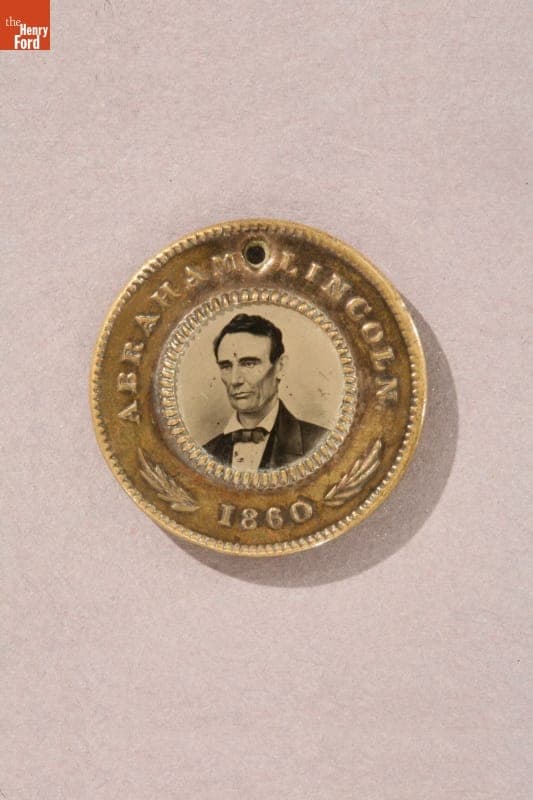
Presidential Campaign Medallion, "Abraham Lincoln: Republican Candidate," 1860
The possessor of this small token supported Abraham Lincoln for president in 1860. Trinkets, such as this one, reminded American citizens why they backed certain parties and candidates. This brass token portrays the Republican candidate on the front and the slogan "Liberty Union and Equality" on the back.
View ArtifactTHF130348
Wood Engraving "Procession of the Wide-Awake Club of Hartford, Conn.," July 26, 1860
This wood engraving shows men marching in a political campaign parade in Hartford, Connecticut, on July 26, 1860. Part of a group known as the Wide Awakes, these men actively supported the Republican Party and their presidential candidate, Abraham Lincoln. Wearing unusual capes and black hats, and carrying flaming torches, the Wide Awakes marched in nighttime parades in the northern states.
View ArtifactTHF127810
Republican Ballot from Massachusetts for the 1860 Presidential Election
During the mid-1800s, Americans used preprinted ballots to vote. Political parties printed and distributed these ballots, sometimes through local partisan newspapers. These ballots listed candidates only from a single party -- so everyone knew who you voted for. Bold voters could scratch out or paste over names. This ballot was used in 1860 by Massachusetts Republicans to vote for Abraham Lincoln.
View ArtifactTHF11619
Lithograph Portrait of Abraham Lincoln in 1860
On February 27, 1860, Abraham Lincoln delivered a carefully written speech at Cooper Union in New York City. This print quotes the speech, which detailed Lincoln's views on stopping further expansion of slavery and likely helped secure his nomination for the presidency. The image is based on a carte-de-visite made that day by pioneering photographer Mathew B. Brady.
View ArtifactTHF101182
Abraham Lincoln and Hannibal Hamlin Campaign Button, 1860
Abraham Lincoln and Hannibal Hamlin campaign button for the 1860 presidential election containing tintype portraits of the Republican Party candidates on each side. This use of photography in political campaigns was still unusual at the time--most campaign buttons did not include photographic images of the candidates.
View ArtifactTHF8155
Presidential Campaign Medallion, "For President: Abraham Lincoln of Illinois," 1860
The possessor of this small token supported Abraham Lincoln for president in 1860. Trinkets, such as this one, reminded American citizens why they backed certain parties and candidates. Most tokens were just that -- small coins carried around in purses or pockets. This token, however, was attached to a ribbon and became an outward display of support for the Republican candidate.
View Artifact

