
A Selection of Hallmark Ornaments: Classic American Cars
Share
share
Hallmark's ornaments -- with their original designs, increasing variety, and appeal to diverse customers -- have revolutionized Christmas decorating and led to the popularity of ornament collecting. Hallmark's "Classic American Cars" series, launched in 1991, celebrated beloved sports cars, pony cars, and muscle cars of the 1950s, 1960s, and 1970s.
THF183411
Hallmark "Classic American Cars Series: 1957 Corvette" Christmas Ornament, 1991
The Chevrolet Corvette debuted to mixed reviews in 1953. Enthusiasts cheered the car's arrival, but they jeered its six-cylinder engine and automatic transmission. The tide began to turn in 1955 when Chevy made a V-8 and a 3-speed manual gearbox available. For 1957, Corvette's options list included a 283-horsepower fuel-injected V-8, a detachable hardtop, and a four-speed manual transmission.
View ArtifactTHF177016
Hallmark "Classic American Cars Series: 1966 Mustang" Christmas Ornament, 1992
Ford's Mustang was unlike anything else on the market when it debuted in 1964. Its many options allowed buyers to customize their cars to their personal tastes, whether they wanted an economical daily driver, a factory-built hot rod, or a cool-looking luxury ride. Mustang sold 681,000 units in its first model year, inspiring a stampede of sporty "pony cars" from rival automakers.
View ArtifactTHF350637
Hallmark "Classic American Cars Series: 1956 Ford Thunderbird" Christmas Ornament, 1993
Introduced for 1955, Thunderbird was Ford's answer to Chevrolet's Corvette. While Corvette was pure sports car -- early models didn't even have glass side windows -- Thunderbird was a more refined "personal car" with optional power windows, power brakes, and power steering. Ironically, Thunderbird's success (and competitive threat) helped save the initially slow-selling Corvette from cancellation.
View ArtifactTHF352095
Hallmark "Classic American Cars Series: 1957 Chevrolet Bel Air" Christmas Ornament, 1994
For 1955, Chevrolet shed its stodgy image with a youthful new look and an optional new small-block V-8. Chevy rightfully branded the car "The Hot One." There were refinements for 1956, but designers achieved something close to perfection with the 1957 models. "Iconic" is an overused word, but it absolutely applies to the 1957 Chevrolet Bel Air.
View ArtifactTHF188198
Hallmark "Classic American Cars Series: 1969 Chevrolet Camaro" Christmas Ornament, 1995
Just as Ford answered Corvette with Thunderbird, Chevrolet responded to Mustang by introducing Camaro for 1967. The sporty model received a longer, lower body for 1969, and its formerly smooth sides were given a more sculpted treatment. Camaro paced the Indianapolis 500 in 1969, and race winner Mario Andretti got one with his prize package.
View ArtifactTHF351759
Hallmark "1958 Ford Edsel Citation Convertible" Collector's Club Christmas Ornament, 1995
Ford wanted a new brand to compete with mid-price offerings from GM and Chrysler. But Edsel -- named for Henry Ford's only child -- was overpriced, overstyled, and overhyped. Ford canceled it after three model years. Hallmark's Edsel ornament was only available to members of the company's Collector's Club, so it didn't sell in big numbers -- much like the car that inspired it!
View ArtifactTHF183945
Hallmark "Classic American Cars Series: 1959 Cadillac De Ville" Christmas Ornament, 1996
The chrome-and-tailfins era peaked with Cadillac's extravagant 1959 models. Designers looked to jet airplanes for inspiration, from the front parking lights that resemble B-52 bomber intakes to the swept-back tailfins. Under that aviation-inspired skin was a powerful V-8 engine and a host of luxury features. Eleven miles per gallon? If you could afford the Caddy, then you could afford the gas.
View ArtifactTHF184253
Hallmark "Classic American Cars Series: 1969 Hurst Oldsmobile 442" Christmas Ornament, 1997
Oldsmobile debuted the 442 as an options package for 1964. Four years later, it became a model in its own right. The numerical name referred to the muscle car's original four-barrel carburetor, four-speed transmission, and dual exhaust. Hurst sold popular aftermarket performance products for the car. Starting in 1968, Olds and Hurst partnered to offer enhanced-performance 442s straight from the factory.
View ArtifactTHF185206
Hallmark "Classic American Cars Series: 1970 Plymouth Hemi 'Cuda" Christmas Ornament, 1998
The Plymouth Barracuda -- a sporty car on a compact platform -- debuted two weeks before Mustang in 1964, but it wasn't the runaway hit that Ford enjoyed. Nevertheless, Mustang's success helped keep Barracuda swimming through ten model years. Plymouth's 1970 model line included the performance-oriented 'Cuda equipped with a four-barrel, 383-cubic-inch V-8 rated at 335 horsepower.
View ArtifactTHF187807
Hallmark "Classic American Cars Series: 1955 Chevrolet Nomad Wagon" Christmas Ornament, 1999
Chevrolet brought sporty style to the station wagon with its 1955-1957 Nomad models, based on the premium Bel Air sedans from those same years. Nomad's fold-down rear seat and two-piece tailgate made the most of its cargo space, but that two-door body wasn't exactly practical. Chevy built twice as many four-door Bel Air wagons in 1955 as it did Nomads.
View ArtifactTHF351062
Hallmark "Classic American Cars Series: 1969 Pontiac GTO - The Judge" Christmas Ornament, 2000
Pontiac's legendary GTO had its origins as a high-horsepower package for the 1964 Tempest LeMans intermediate sedan. GTO became its own model for 1966. The GTO Judge, introduced three years later, was the muscle-car equivalent of a fast-food value meal. It combined several popular GTO options into a package that cost less than buying each item separately.
View ArtifactTHF353093
Hallmark "Classic American Cars Series: 1953 Buick Roadmaster Skylark" Christmas Ornament, 2001
Introduced in 1936, Roadmaster became Buick's premier model. For 1953, it sported a redesigned hood to accommodate its new 322-cubic-inch, 188-horsepower V-8. The special convertible Skylark version boasted unique fenders, wire wheels, and sweeping chrome bodyside trim. Notably, Skylark did not have "Venti-Ports" -- the oval hood decorations that had become a Buick trademark.
View ArtifactTHF353746
Hallmark "Classic American Cars Series: 1970 Ford Mach 1 Mustang" Christmas Ornament, 2002
Mustang grew larger and more muscular through the 1960s. The Mach 1 performance package debuted for 1969. The base V-8 in the 1970 Mach 1 displaced 351 cubic inches and produced 250 horsepower. Mach 1 came only with a fastback -- or "SportsRoof" -- body. It was further distinguished by an optional "shaker scoop" air intake that vibrated atop the engine.
View ArtifactTHF354112
Hallmark "Classic American Cars Series: 1963 Corvette Sting Ray Coupe" Christmas Ornament, 2003
Corvette's all-new 1963 Sting Ray was a revelation. The gentle curves of earlier models were replaced with sharp edges, and toothy grilles gave way to an aggressive nose with hidden headlights. The coupe's racy fastback design included a split rear window -- seen only on 1963 models. The original Sting Ray remains a favorite with Corvette fans.
View ArtifactTHF354573
Hallmark "Classic American Cars Series: 1966 Oldsmobile Toronado Coupe" Christmas Ornament, 2004
Oldsmobile introduced Toronado, its personal luxury car, for 1966. Unlike competitors Ford Thunderbird and Buick Riviera -- or any other American car, for that matter -- Toronado boasted front-wheel drive. In fact, it was the first front-wheel-drive car built in the United States since Cord folded in 1937. Toronado lasted through four styling generations, with the final models manufactured in 1992.
View ArtifactTHF355484
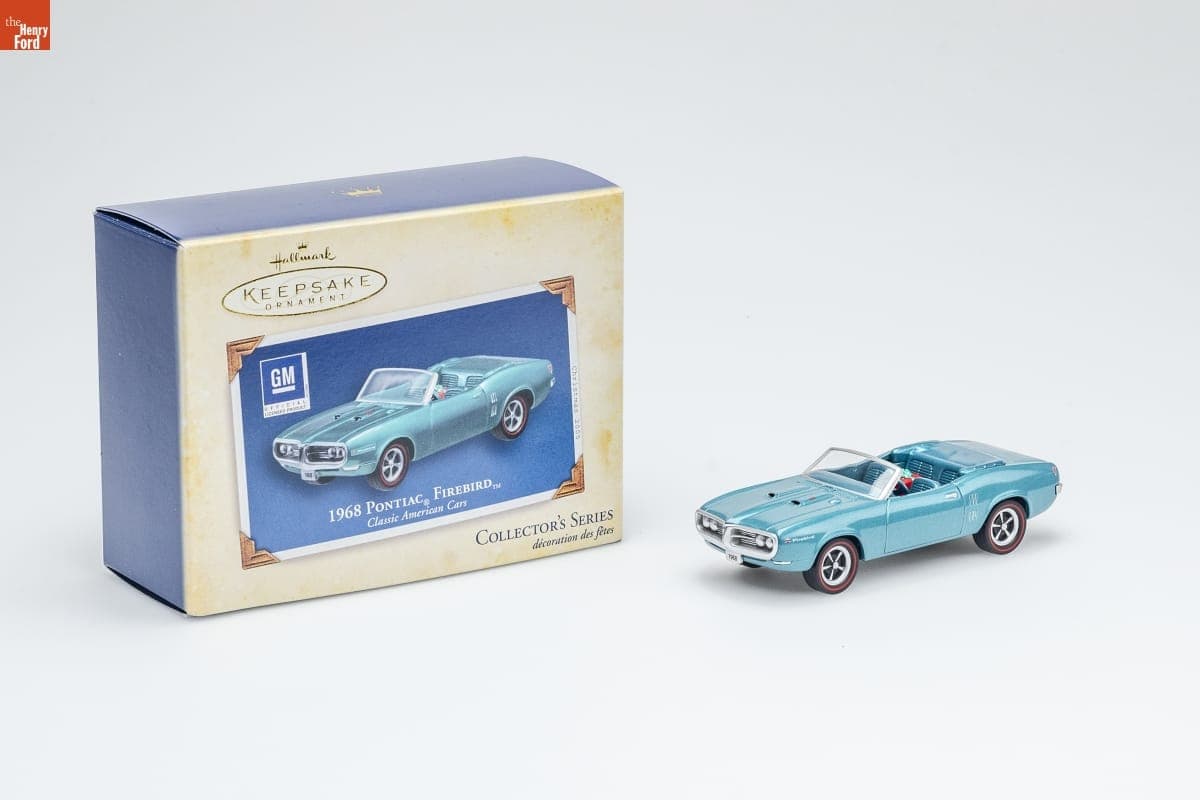
Hallmark "Classic American Cars Series: 1968 Pontiac Firebird" Christmas Ornament, 2005
Pontiac introduced its own pony car, on the heels of Mustang and Camaro, in 1967. True to formula, Firebird had a long hood, a short rear deck, an affordable base price, and a wealth of options and packages that allowed buyers to customize the car as they wished. Pontiac debuted the top-level Trans Am version in 1969.
View ArtifactTHF356269
Hallmark "Classic American Cars Series: 1961 Chevrolet Impala" Christmas Ornament, 2006
Chevrolet first used the "Impala" name on its full-size cars for 1958. The 1961 model year brought the popular car's third styling generation. Distinguishing features included triple taillights, premium disc wheels, and contrasting inserts on the bodyside moldings. The 1961 Impalas came standard with Chevy's 283-cubic-inch V-8, but performance-minded buyers opted for the "real fine" 409.
View ArtifactTHF177588
Hallmark "Classic American Cars Series: 1957 Ford Fairlane 500" Christmas Ornament, 2007
"Fair Lane" is a name steeped in Ford tradition. It was the area in Ireland that was home to Henry Ford's ancestors, and it was the name he and his wife Clara gave to their Dearborn estate. Ford Motor Company used it on several models produced from 1955-1970. For 1957, Fairlane 500 denoted the top trim level for Ford's full-size line.
View ArtifactTHF357094
Hallmark "Classic American Cars Series: 1970 Chevrolet Chevelle SS" Christmas Ornament, 2008
Chevrolet's mid-size Chevelle premiered for 1964, and it remained in production across three styling generations and 14 model years. One popular theory holds that "Chevelle" was a portmanteau of "Chevrolet" and "gazelle." No need to speculate on "SS" -- it stood for "Super Sport." Chevelle's 1970 SS package included a 350-cubic-inch V-8 good for 300 horsepower.
View ArtifactTHF177585
Hallmark "Classic American Cars Series: 1963 Ford Thunderbird Sports Roadster" Christmas Ornament, 2009
The two-seat Thunderbird was a hit, but Ford general manager Robert McNamara reasoned (correctly) that adding more seats would sell more cars. With that, 1958 brought the four-seat "Squarebird" -- so nicknamed for its boxy proportions. The 1963 Thunderbird Sports Roadster came with a tonneau cover to hide that backseat. All T-Birds that year sported distinctive diagonal marks on their doors.
View Artifact

