
Aerial Photography
Share
share
This selection of material traces the ways people have pushed photographic and aviation technology to capture images from the air, ultimately making aerial views widely available--and changing how we see ourselves and our world.
THF255721
"Birds Eye View of the Centennial Buildings and Grounds," 1876
Photographers eager to meet popular demand for "bird’s-eye" views -- once satisfied only by artist's renderings like this one -- tried everything from rockets and pigeons to kites and balloons to get their cameras into the air. The first aerial photograph, taken from a balloon tethered outside Paris in 1858, has been lost to history, but it marked the start of a new industry. Aerial photographs had replaced bird's-eye prints by the early 1900s.
View ArtifactTHF706259
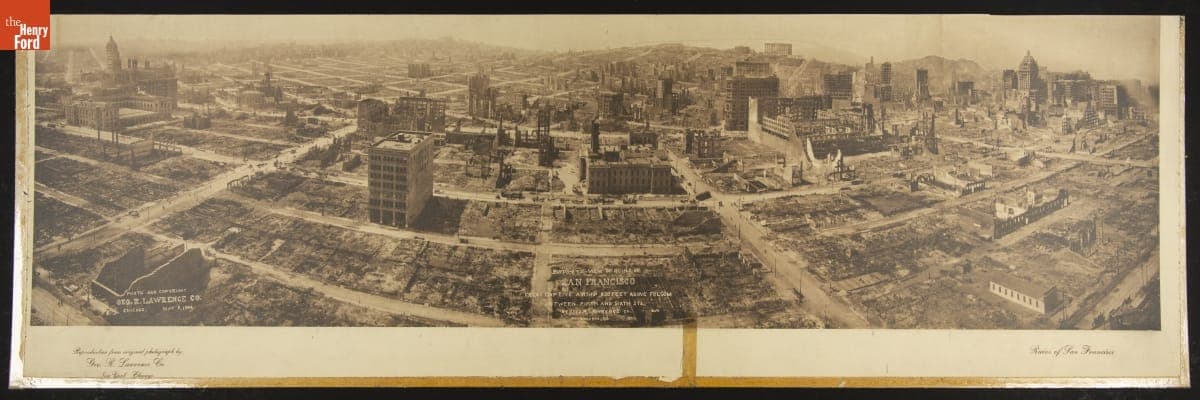
Bird's Eye View of the Ruins of San Francisco, 1906
Aerial photographs quickly proved to be powerful visual tools with wide-ranging applications. Some of the earliest and most important were used to report the news. One pioneering aerial photographer designed a train of kites to suspend and remotely trigger a panoramic camera over San Francisco after the devastating earthquake and fires in 1906. News organizations distributed these now-famous images across the country.
View ArtifactTHF111063
Wilbur Wright Flying at Hunaudieres Race Course, Le Mans, France, August 1908
The development of flying machines in the early 20th century presented new opportunities for aerial photography. A still from a motion picture taken aboard one of Wilbur Wright’s 1908-9 flying demonstrations in Europe is cited as the first photograph made from an airplane. Before long, manufacturers developed aerial cameras specially designed to be mounted to flying machines.
View ArtifactTHF160527
Graflex "Bag Mag," Cut Film Holder, circa 1925
As airplanes became more advanced, traveling higher and faster, manufacturers developed cameras that could quickly capture larger and more detailed photographs while remaining stable in the air. Other photographic equipment changed, too. The earliest aerial photographers had to develop their images immediately. With innovative equipment like this light-tight camera magazine, 20th-century photographers could safely store film for later processing.
View ArtifactTHF704272
Aviation Photography, Thornton-Pickard Manufacturing Company, 1918
Military interest has always been key to the advancement of aerial photography. During World War I, both the Allies and Central Powers took advantage of the latest aviation and photographic technology to conduct aerial reconnaissance. Aerial views of enemy troops and equipment completely changed the way militaries looked, moved, and fought. In turn, military research accelerated the evolution of aerial photography.
View ArtifactTHF259366
"Airview, Kentucky Dam and Lake, Western Kentucky," 1948
After World War I, aerial photography benefited from a surplus of planes and pilots, as well as cameras that were increasingly easy to operate. Aerial surveyors crisscrossed the continent, and their images informed agricultural practices, real estate development, urban planning, tax assessment, and major infrastructure projects, including the US government's monumental construction of large-scale hydroelectric dams beginning in the 1930s.
View ArtifactTHF706272
Aerial View of Washington, D.C., circa 1924
Sherman Fairchild had worked to advance aerial photographic technology during World War I. He continued developing improved cameras, got into the aerial survey business, and remained an important promoter of aerial photography until well after World War II. Fairchild images like this one documented population shifts and urbanization. Others helped track environmental changes, like eroding coastlines and the formation of the Dust Bowl.
View ArtifactTHF707177
Engineering Data from Aerial Views, 1925
Aerial photographs taken from different angles and used in conjunction with a ground survey could be used to create maps. Eventually, manufacturers developed aerial survey cameras with multiple lenses that made overlapping pictures of the ground. New equipment transformed these images into topographic maps that became invaluable for planning engineering projects.
View ArtifactTHF704263
Manual of Instructions for Type "L" Aviation Camera, American Model, Eastman Kodak Company, circa 1935
This instruction manual helps document the interwar development of aerial photographic technology. Kodak’s type "L" aviation camera, designed to be attached to aircraft in a variety of ways, could be operated manually or automatically using a special cable with a wind-activated propeller on one end.
View ArtifactTHF117847
Postcard, "The Rose Bowl, Pasadena, California," 1936
A rival of Sherman Fairchild's aerial survey companies, Spence Air Photos documented the rapid urbanization of Southern California during the 1920s and 1930s. This Spence photo of Pasadena's Rose Bowl stadium demonstrates the power of aerial images to depict large-scale events.
View ArtifactTHF238497
Pilot Frank Byerley and Photographer William Kuenzel aboard the Detroit News Autogiro, April 6, 1931
This novel aircraft, an autogiro operated by the Detroit News in the early 1930s, foreshadowed the later use of helicopters by television stations to report breaking news. It carried a large, swiveling camera to take photos of newsworthy events.
View ArtifactTHF706263
Aerial View of the Bombing of Corsica by B-24 Liberators, October 1943
World War II spurred further development of aerial photographic technology, and aerial reconnaissance helped determine the outcome of the conflict. Importantly, the liberal use of aerial images in newspapers and newsreels primed Americans on the home front for aerial photography’s commercial proliferation after the war.
View ArtifactTHF704296
Pictures from the Air...with Your Camera, 1952
Initially, for most Americans, professional aerial photography was prohibitively expensive. But technological development both improved the process and made it more accessible. The expansion of the commercial aviation industry complemented the availability of affordable, easy-to-operate photographic equipment after World War II. Anyone with a plane ticket and a camera could take pictures from the air.
View ArtifactTHF704289
Photography from Small Aircraft and Helicopters, 1966
This booklet encouraged the use of ordinary cameras for aerial photography and offered tips and technical suggestions. It also highlighted the increased use of aerial photographs taken from helicopters in reporting the news--a shift that began in late-1950s Los Angeles as law enforcement agencies and then television stations adopted the aircraft.
View ArtifactTHF193809
3DRobotics Solo Drone, 2015-2016
Photographic satellite and drone technology had transformed aerial photography by the 21st century. Modern aerial photography, while it raises tough questions about privacy and intrusion, is more accessible and more important than ever. Aerial images make it impossible for us to deny our place in the universe, our impact on the environment, and our connectedness to every other living thing on Earth.
View Artifact

