
The DC-3: Changing Passengers’ Expectations
Share
share
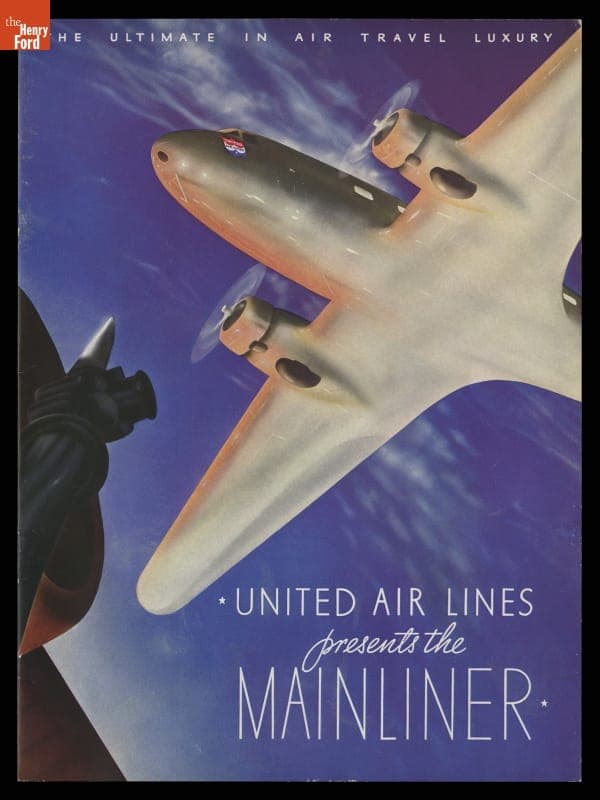
Reliable, economical, and safer than earlier aircraft, the DC-3 did more than any other single airplane to make commercial passenger aviation a viable industry.
"United Air Lines Presents The Mainliner," 1937
United Airlines promoted its new Douglas DC-3 "Mainliners" in this 1937 brochure. With a range of 1,500 miles, the Mainliners flew from New York to San Francisco in less than 16 hours with only three stops along the way. The planes came in three configurations: standard 21-passenger coaches, sleepers with folding berths for 14, and "Skylounges" with deluxe swiveling seats.
View ArtifactNorth Central Airlines Brochure, circa 1970
North Central Airlines was founded in Clintonville, Wisconsin, in 1944 but was headquartered in Minneapolis for most of its existence. As its name suggests, the airline served cities in the north central part of the U.S. including Minneapolis, Denver, Chicago, and Detroit. The company's mascot, Herman the duck, featured prominently in its logo. North Central merged with Southern Airways in 1979 to form Republic Airlines.
View ArtifactNorth Central Airlines' 1939 Douglas DC-3 in Flight, circa 1975
Minneapolis-based North Central Airlines bought DC-3 number N21728, built in 1939, from Eastern Airlines in 1952. After 13 years in passenger service, North Central converted the airplane into a VIP transport in 1965. The durable DC-3 logged almost 85,000 flight hours and traveled some 12 million miles over its 36-year career. It was donated to The Henry Ford in 1975.
View ArtifactCockpit of the 1939 Douglas DC-3 Airplane, Photographed in 2003
The Douglas DC-3, first flown in 1935, made use of several advancements in aircraft design. Internal bracing for the wings allowed for streamlined surfaces. Engine cowlings and retractable landing gear reduced drag. Improved engines increased range. The result was a rugged, stable airplane easy for pilots to handle. By 1939, DC-3 planes carried 75 percent of U.S. air travelers.
View ArtifactCockpit Controls inside a Ford Tri-Motor Airplane, 1927-1930 - 1
With its large, thick wing, the Ford Tri-Motor was very stable in flight. The three engines provided an excellent safety margin. The plane could fly well with two motors, and it could maintain level flight with only one. Cockpit design was efficient. Dual controls allowed either the pilot or co-pilot -- or, in bad weather, both -- to fly the craft.
View ArtifactPassengers Seated Inside a Ford Tri-Motor Airplane, October 1928
Americans initially wondered if air travel was safe. Fatal crashes by barnstorming pilots were well publicized, and wood and cloth airplanes did not inspire confidence. But when Henry Ford began making planes, the industrialist's solid reputation eased people's fears. Ford's all-metal Tri-Motors were rugged, dependable and safe. By the late 1920s these planes were the backbone of the budding airline industry.
View ArtifactStout Air Transport 2AT-2 Airplane, "Maiden Dearborn" at Ford Airport, 1925
The Stout 2AT airplane, designed by William B. Stout, first flew in February 1924. It had a cruising speed of 100 miles per hour, a range of 500 miles, and a capacity of six passengers or 1,500 pounds of freight. The plane in this photo was the first built at Stout's factory in Dearborn -- which explains its pun name, Maiden Dearborn.
View ArtifactAmerican Airlines DC-3 Flagship Model Airplane Kit, circa 1945
Model airplanes have been a popular hobby since the 1920s. Early modelers built from scratch, but entrepreneurs soon saw the business possibilities in making and selling model kits. Balsa wood was a favorite building material due to its strength, light weight, and the ease with which it could be shaped.
View Artifact1939 Douglas DC-3 Airplane - 4
The Douglas DC-3, introduced in 1936, carried 21 passengers -- enough to fly profitably without relying on subsidies from air mail contracts. While the DC-3's economy appealed to airlines, its rugged construction and comfortable cabin attracted passengers. More than any other aircraft, the DC-3 ushered in the era of dependable, long-distance air travel in the United States.
View ArtifactTWA Experimental Anti-Snow Static Loop Antenna, 1937 - 1
Airport radio navigation beacons required pilots to listen for Morse code patterns to hold the correct course--notoriously difficult during storms. In 1936, Transcontinental & Western Air introduced an anti-snow directional antenna which could be used, in high-static situations, to "home in" on airport radio signals. This loop was housed in a sleek metal enclosure, protecting it from the elements.
View ArtifactNorth Central Airlines Flight Log Sheet #19260, August 25, 1971
Airplanes require careful maintenance, and each flight must be thoroughly documented in a logbook. This log, for a 1971 flight by Douglas DC-3 N21728, records everything from crew members' names, to flight times, to the engines' fuel and oil pressures. Equipment problems and subsequent repairs are recorded as well.
View ArtifactNorth Central Airlines Douglas DC-3 Airplane Flight Log Binder, Presented to The Henry Ford on May 28, 1975
Airplanes require careful maintenance, and each flight must be thoroughly documented in a logbook. This book, for the final flights of the Douglas DC-3 in The Henry Ford's collection, records everything from crew members' names, to flight times, to the operating temperatures of the engines' cylinder heads. Equipment malfunctions and subsequent repairs are noted as well.
View Artifact

