
Henry Ford’s Owl Night Lunch Wagon
Share
share
While working the night shift at Detroit’s Edison Illuminating Company in the 1890s, Henry Ford frequented the Owl Night Lunch Wagon. He purchased the fondly-remembered Owl in 1927 for Greenfield Village, where it operates today.
THF95108
Henry Ford with Co-Worker at Edison Illuminating Company, Detroit, Michigan, 1896
In 1891, Henry Ford left his small lumber business to work as a night engineer at the Edison Illuminating Company in Detroit. By early 1894, he was promoted to chief engineer. The same year he posed for this photograph, Ford completed his first horseless carriage, the Quadricycle, with the help of some of his coworkers.
View ArtifactHenry Ford with Other Employees at Edison Illuminating Company Plant, circa 1894
This photograph from about 1894 shows Henry Ford, with a mustache, on the far right. While working as chief engineer at the Edison Illuminating Company in Detroit, Ford was also building his first horseless carriage, the Quadricycle, with the help of some of his coworkers.
View ArtifactHenry Ford When Employed by Edison Illuminating Company of Detroit, March 1893
In 1891, Henry Ford left his small lumber business to work as a night engineer at the Edison Illuminating Company in Detroit. By early 1894, he would be promoted to chief engineer. While working at the Edison Illuminating Company, Ford was also building his first horseless carriage, the Quadricycle, with the help of some of his coworkers.
View ArtifactVisitors at the Owl Night Lunch Wagon, Greenfield Village, 1935
The Henry Ford's Owl Night Lunch wagon served nighttime workers in Detroit in the late 19th and early 20th centuries. Among its customers was Henry Ford, a young engineer working at Edison Illuminating Company during the 1890s. Ford acquired the Owl in 1927 and moved it to Greenfield Village, where it served as the first food service operation.
View ArtifactWoman Seated in the Restored Owl Night Lunch Wagon, Greenfield Village, circa 1986
The Henry Ford's Owl Night Lunch wagon operated in Detroit, serving food to nighttime workers. Among its customers was Henry Ford, an engineer at Edison Illuminating Company during the 1890s. Ford acquired the Owl in 1927 and moved it to Greenfield Village, where it became the first food service operation. The last known horse-drawn lunch wagon in America, the Owl was restored in 1983.
View ArtifactServing Food from the Owl Night Lunch Wagon in Greenfield Village, 1935
The Henry Ford's Owl Night Lunch wagon served nighttime workers in Detroit in the late 19th and early 20th centuries. Among its customers was Henry Ford, a young engineer working at Edison Illuminating Company during the 1890s. Ford acquired the Owl in 1927 and moved it to Greenfield Village, where it served as the first food service operation.
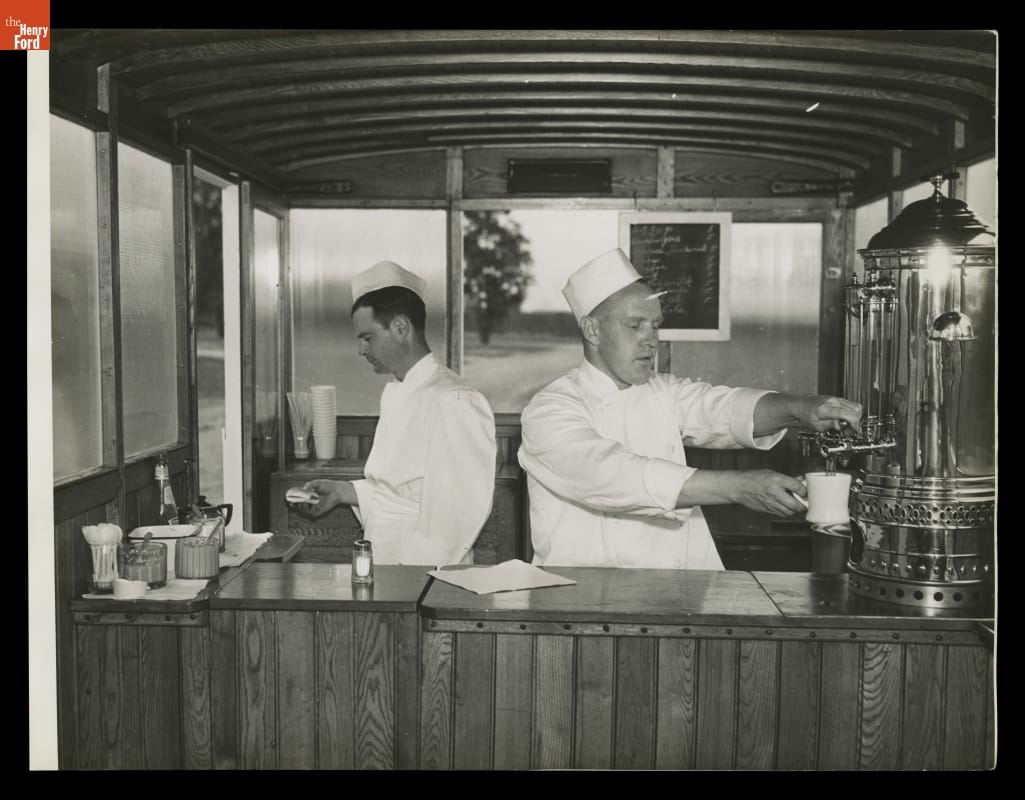
View ArtifactPreparing Food inside the Owl Night Lunch Wagon in Greenfield Village, 1935
The Henry Ford's Owl Night Lunch wagon served nighttime workers in Detroit in the late 19th and early 20th centuries. Among its customers was Henry Ford, a young engineer working at Edison Illuminating Company during the 1890s. Ford acquired the Owl in 1927 and moved it to Greenfield Village, where it served as the first food service operation.
View ArtifactBusiness Card for J. M. Colquhoun, Central Night Lunch Wagon, Detroit, Michigan, 1901-1927
John Colquhoun operated a night lunch wagon in Detroit. He offered simple, affordable food to hungry customers after regular restaurants closed for the night. Henry Ford patronized Colquhoun's wagon while working at the Edison Illuminating Company in the 1890s. After a city ordinance banned lunch wagons in 1926, Ford acquired the fondly remembered wagon from Colquhoun for use in Greenfield Village.
View ArtifactMap Showing Layout of Greenfield Village, Dearborn, Michigan, 1947
By 1947, Henry Ford had assembled a collection of nearly 90 historic and reproduction buildings in Greenfield Village. Ford had established the Edison Institute as a teaching institution in 1929, but relented to public demand and began admitting visitors in 1933. This map shows some efforts to accommodate increasing attendance figures, including a gatehouse, lunch wagon, and rest rooms.
View ArtifactOwl Night Lunch Wagon in Greenfield Village, 1938
This Owl Night Lunch wagon originally operated in Detroit, serving food to nighttime workers. Among its customers was Henry Ford, a young engineer working at Edison Illuminating Company during the 1890s. Ford acquired the Owl in 1927 and moved it to Greenfield Village. Today, it is thought to be the last remaining horse-drawn lunch wagon in America.
View ArtifactOwl Night Lunch Wagon Used by Henry Ford, circa 1890
The Henry Ford's Owl Night Lunch wagon is thought to be the last remaining horse-drawn lunch wagon in America. It served food to nighttime workers in downtown Detroit, and attracted such diverse clientele as reporters, politicians, policemen, factory workers, and supposedly even underworld characters! Among its customers was Henry Ford, a young engineer working at Edison Illuminating Company during the 1890s.
View ArtifactDetroit News Clipping from March 14, 1954, "Hot Dog Wagon a Bright Spot of Old Detroit"
Night lunch wagons became popular in the 1890s. These horse-drawn "restaurants on wheels" served simple, affordable food like hot dogs after regular restaurants closed for the night. The Owl Night Lunch wagon pictured here operated in Detroit until 1926, when a city ordinance banned lunch wagons. Henry Ford, who had patronized the Owl as a young engineer, acquired it for Greenfield Village in 1927.
View Artifact

