
Curators' Choice: Info Technology & Communications
Share
share
Top picks: Information Technology & Communications
THF95404
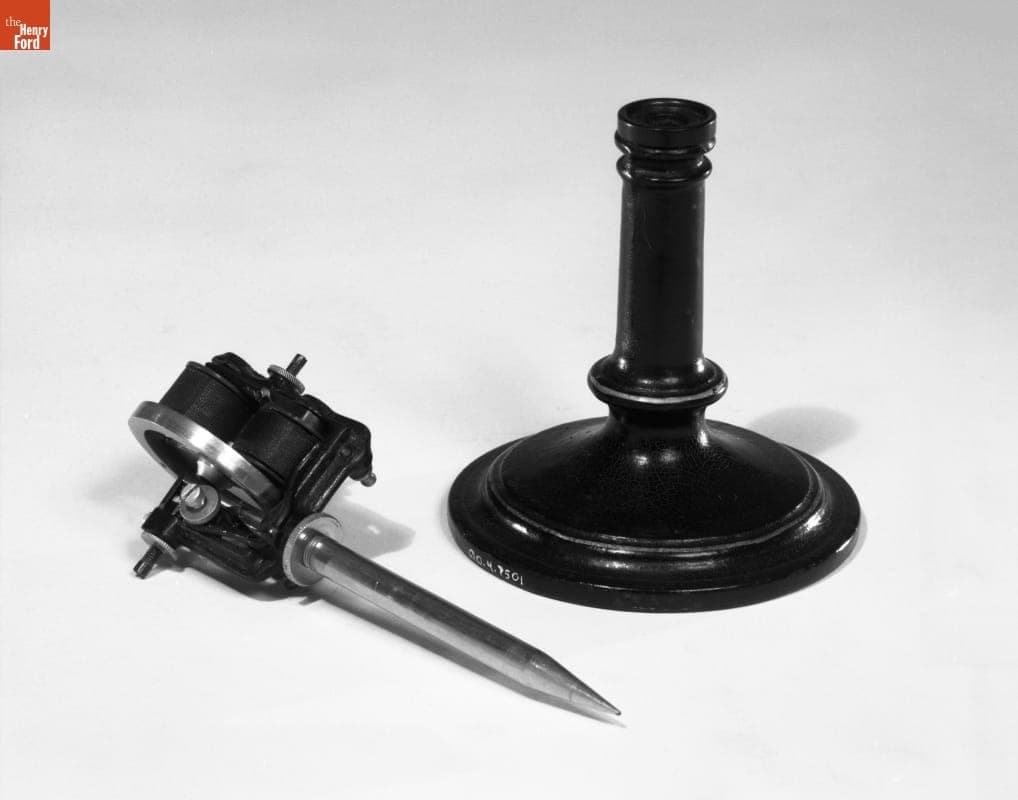
Edison Electric Pen, circa 1877
Thomas Edison's electric pen, an ancestor of both the mimeograph and the tattoo needle, was a successful product in the mid-1870s. Users would write normally with the pen, which, instead of a nib, had a needle powered by an electric motor. The needle poked holes into a stencil, which was then used to copy the document. Many businesses found document duplication an attractive possibility.
View ArtifactTHF727356
Washington Press, circa 1848
This peripatetic press was used to print newspapers in the 19th-century American West. Washington hand presses were rugged and extremely popular; this one crossed the Isthmus of Panama on its way from New Orleans to California's gold fields. In 1851, the press's owner, John Judson Ames, started San Diego's first newspaper. The press also printed newspapers in San Bernardino and Independence, California, and in Aurora, Nevada.
View ArtifactTHF95405
Columbian Press, 1857
This ornate cast iron hand press paid homage to America, but sold best in England. George Clymer developed the press and its ingenious system of levers in Philadelphia in 1813. He named it "Columbian" and decorated it with an eagle (which also served as counterweight), a horn of plenty, and other symbols of American prosperity. Our Columbian was made in England in 1857, after Clymer's death.
View ArtifactTHF36593
Edison Kinetoscope with Kinetophone, 1912-1913
Thomas Edison invented entire industries. By the 1890s, this included the phonograph, to record and play sound, and the kinetoscope, to display moving images. In the 1910s, he was able to synchronize projecting kinetoscopes with "kinetophone" phonographs, marrying the new film industry with the already robust phonograph industry. The kinetophone played huge "concert" cylinder records. This setup would have been used in a theater, though Edison also marketed it for home use.
View ArtifactTHF152546
Sholes & Glidden Desk Typewriter, 1874-1876
Developed by Christopher Glidden in the 1860s and manufactured by the Remington arms company beginning in 1873, the Sholes & Glidden was the first commercially successful typewriter. Its adoption by large corporations kickstarted the typewriter industry and contributed to the speedup of American work life. The innovations of the Sholes & Glidden, particularly its keyboard layout, were widely adopted. This typewriter is why your computer keyboard reads QWERTYUIOP.
View ArtifactTHF1075
Tinfoil Phonograph, 1878
In 1877, Thomas Edison invented the phonograph, a machine for recording and playing back sound that was based on earlier work with telegraphs and telephones. This phonograph, which recorded recitation or music onto strips of tin foil, was manufactured for Edison by Sigmund Bergmann, a former employee. This "Concert" sized phonograph was meant for demonstrations of the astonishing new possibilities of recorded sound.
View ArtifactTHF98041
Machine Used to Strand Transatlantic Cable, 1860-1865
Laying telegraph cable across the Atlantic Ocean in the 1860s was a huge undertaking. This massive cable stranding machine was used in Greenwich, England, to wind together the different elements of the cable: iron for strength, copper for conductivity, gutta-percha rubber for insulation, and tarred hemp for durability. Following several failed attempts, the heavy, flexible cable was laid successfully by the SS Great Eastern in 1866.
View ArtifactTHF160301
Hollerith Tabulating Machine, 1890
After seven years tabulating the 1880 census, the US Census Bureau ran a contest for a quicker method. Herman Hollerith won, and his "computer" was used for the 1890 census. Data was transferred to punched cards, which were pressed under a plate with pins in it. The pins went through punched holes into mercury-filled wells, completing a circuit and registering the data on the machine's dials.
View ArtifactTHF95334
Jenkins Mechanical Scanning Tabletop RadiovisorTelevision Receiver RK-1 Kit, circa 1931
Television innovator Charles Frances Jenkins developed mechanical television projectors and receivers like this one as early as the 1920s. Mechanical television works by scanning images with a spinning disk and sending the data via radio waves; the spinning disks of the projectors and receivers must be synchronized. This kit receiver was marketed to radio amateurs. At its height, Jenkins's station in Washington, D.C., broadcasted to several hundred "radiovisor" owners.
View ArtifactTHF127315
Kodak No. 3 Folding Brownie Camera, 1905-1915
Kodak's Brownie cameras made photography an accessible hobby for millions of amateurs. Introduced in 1900, the Brownie was inexpensive and simple to use. Kodak marketed the camera to everybody; they advertised in general interest magazines, not just technical journals. By the time this Model 3 Brownie was introduced, Brownies had already changed photography.
View ArtifactTHF153072
Webster-Chicago Model 80 Wire Recorder, circa 1947
During the prosperous years following World War II, sound recording was a creative, experimental field. Wire recorders used magnetized steel wire to record and play back sounds--music, dictation, and so on. Magnetic wire and magnetic tape were both in use during the 1940s and 50s. Webster-Chicago was a leading manufacturer of both wire recorders and reel-to-reel tape recorders.
View ArtifactTHF163704
DEC PDP-11/20 Minicomputer, 1970
Digital Equipment Corporation's PDP 11 computers were popular, widely used machines in the era before personal computers. These 16-bit minicomputers ("mini" as opposed to the room-sized mainframe computers of the 1950s and '60s) were relatively inexpensive and were used for business (payroll, accounting), scientific, educational, and timesharing purposes. Many Americans were introduced to computing through PDP 11s installed at schools and offices beginning in 1970.
View ArtifactTHF95408
Felt & Tarrant Comptometer, 1951
Mechanical adding machines like this Comptometer were indispensable--and almost indestructible--office equipment until the computer era. Dorr Felt's 1884 invention of a key-driven mechanical adding machine had become big business by the 1950s, when this Comptometer was made. This particular Comptometer was used in the accounting department of an eyewear manufacturing company from 1951-1967, when its operator retired.
View ArtifactTHF151500
Macintosh 512K Personal Computer, Model M0001W, 1985
In 1984, the Apple Macintosh became the first popular personal computer to feature the now-ubiquitous mouse and "graphical user interface" desktop. Despite the Mac's relatively high price, its user-friendly features helped it demystify computing for many people without a technical bent. This computer is a Macintosh 512k, released in 1985 with increased memory.
View ArtifactTHF95409
Datamath TI-2500-II Electronic Calculator, circa 1974
The Texas Instruments TI-2500 "Datamath" was TI's first electronic calculator and one of the most important consumer calculators of the 1970s. Produced beginning in 1972, the Datamath made complicated calculations accessible to many people. Because of the Datamath's popularity and ease of use, electronic calculators began to replace the heavy mechanical adding machines previously used in small businesses.
View ArtifactTHF153080
View Camera, 1860-1880
Photography was invented in France but quickly became a transatlantic industry; this American-made view camera had a French lens. By the mid nineteenth century portraiture had become photography's killer app. Tintype and other "wet plate" technologies, such as those this camera used, allowed for a relatively short exposure and relatively quick development time, making photographs more accessible to everyday people.
View ArtifactTHF92287
Western Electric 500 Series Phone, 1960-1969
The iconic 500 series phone was designed by Henry Dreyfuss and was used in millions of homes across the world for decades. The Bell system began to produce these rugged phones and distribute them to telephone subscribers in 1949. Even after the breakup of the AT&T monopoly in 1984, 500 series phones continued to be produced.
View ArtifactTHF92288
Pay Telephone, 1905-1915
By 1905, telephones had been around for almost thirty years. Although most people didn't have phones in their homes, they had become indispensable in certain situations -- business and emergencies. Hotels, grocery stores, and restaurants owners often installed pay telephones in their establishments. This phone features William Gray's mechanism for making a secure pay phone, which was licensed to many phone manufacturers.
View ArtifactTHF95336
Motorola StarTac Cellular Telephone with Charger, 1996-1999
Motorola's StarTAC was the first flip phone. It was released in 1996, and its small, portable size and light weight (less than 4 ounces) helped make it popular among consumers for several years. The StarTAC's popularity helped everyday Americans develop a familiarity and comfort with cellphones.
View ArtifactTHF95337
Transceiver, Section of the Original Ethernet, 1973-1974
This is a section of the original Ethernet, developed by Bob Metcalfe and David Boggs at the Xerox Palo Alto Research Center (PARC) in 1973. PARC was a center of innovation; this pioneering internetworking architecture was developed to connect (PARC-developed) personal computers to (PARC-developed) laser printers. Ethernet has changed business and home computing and has reigned for thirty years as a global standard.
View ArtifactTHF95341
Radio Receiver, Used by Amateur Radio Station W6DQZ, circa 1930
Hamid (Charlie) Durmisevich, call sign W6DQZ, connected to the world from his ham radio station in Los Angeles. Amateur radio operators use two-way radios to talk to global networks of other "hams" about technology, weather, emergency preparedness and daily life. This ham, who emigrated from Eastern Europe in 1920, was active in amateur radio communities from the 1930s to 1990s.
View ArtifactTHF153084
Universal Stock Ticker, 1872
Thomas Edison's reputation was initially established through his work in telegraphy, particularly on stock tickers -- telegraphs that printed real-time financial information. While he did not invent the stock ticker, his improvements -- particularly those related to synchronizing multiple units -- were a great commercial success. Edison's experience with telegraphy infrastructure, and his approach to continually refining his designs, was foundational for his later successes.
View ArtifactTHF153254
RCA Television-Radio-Phonograph Combination Console, Model 7T143, circa 1950
By 1950, television had joined more established modes of entertainment to become a literal fixture in America's living rooms. This RCA console is both furniture and high-tech entertainment system. An expensive, heavy, showcase piece, it includes a television, radio, and two types of phonograph, the up-to-date 45 rpm as well as the standard 78 rpm.
View ArtifactTHF153124
Sony Walkman II, circa 1982
Introduced in Japan in 1979 and in the US the following year, the Walkman allowed users to enjoy music while walking, exercising, or using public transport. It changed the way people enjoy music--providing a private experience in the midst of everyday life--encouraging a trend that escalated with the development of the iPod and other digital music players.
View ArtifactTHF153123
RCA Selectavision VCR, 1981
By the early 1980s the reduced price and scale of video recording and playback technology had helped create a lucrative and competitive home video market. JVC's VHS and Sony's Betamax--two incompatible video formats--rose to prominence. Despite Beta's superior picture quality, VHS's longer recording capability--ideally suited for recording broadcast television for later viewing--established it as the standard.
View Artifact

