
Henry Ford: Heroes
Share
share
Henry Ford admired many people throughout his lifetime. Some, like his late mother Mary Litogot Ford and his wife Clara Bryant Ford, made personal marks on his life. He admired others, like Abraham Lincoln and the Wright brothers, for their self-made success. And some, like trailblazing agriculturalist George Washington Carver and celebrated inventor Thomas Edison, were both heroes and friends.
THF132845
Portrait of Mary Litogot Ford, circa 1865
William Ford and Mary Litogot married in 1861 and gave birth to a son, Henry, two years later. Henry Ford's mother taught him to read and encouraged many of his lasting characteristics. Mary had a profound effect on her eldest child, who remarked after her death during childbirth in 1876 that their house "was like a watch without a mainspring."
View ArtifactTHF98987
Henry Ford and Clara Ford at the Wayside Inn, Sudbury, Massachusetts, circa 1923
Henry Ford referred to Clara Bryant Ford as "the believer." The couple married on April 11, 1888. Throughout their early years together, Clara's unswerving faith in him sustained Henry as he experimented with gasoline engines and automobiles, and when he left his comfortable job at Edison Illuminating Company to join the budding car business.
View ArtifactTHF1872
Scotch Settlement School
Henry Ford attended this one-room schoolhouse from age seven to ten. Because of Ford's fondness for his teacher John Chapman, he not only followed Chapman to Miller School but also brought Chapman's house to Greenfield Village. This school, originally built in 1861 in Dearborn Township, was the first classroom of the Greenfield Village school system Henry Ford started in 1929.
View ArtifactTHF16556
Miller School
Henry Ford attended Miller School at age nine. He followed a favorite teacher, John Chapman, there from the Scotch Settlement School. The small, one-room building was typical of rural schools throughout the United States in the 1800s. Ford had this replica built in Greenfield Village in the early 1940s.
View ArtifactTHF806034
Chapman Family Home
During the 1870s, this simple farmhouse was the home of John B. Chapman and his wife Susie. Chapman taught several terms in the one-room schools of his rural community. Young Henry Ford was one of his pupils. Chapman also worked at other tasks for much of the year, as a farmhand and as a cooper, making barrels for local farmers.
View ArtifactTHF125071
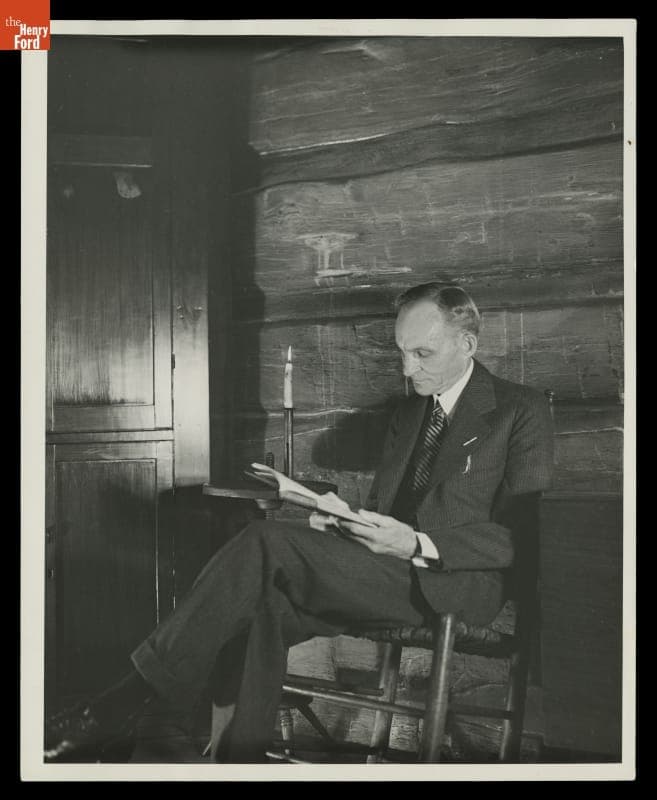
Henry Ford at McGuffey Birthplace in Greenfield Village, circa 1940
Part of Henry Ford's love of the past stemmed from his fondness for the McGuffey Readers he had read as a boy. But collecting hundreds of readers was not enough to satisfy his yearning to re-claim this part of his past. In 1932, he purchased the log birthplace of William Holmes McGuffey and moved it to Greenfield Village.
View ArtifactTHF96214
Textbook, "McGuffey's Newly Revised First Reader," circa 1844
The McGuffey Readers textbook series was used in American schools during the nineteenth and early twentieth centuries. The Readers emphasized the fundamental skills of reading and writing but included stories on a wide range of subjects from many sources (hence, "eclectic"). The books were also intended to develop proper character in children, and had a religious overtone.
View ArtifactTHF1969
William Holmes McGuffey Birthplace
This log home is typical of Scots-Irish log structures built in the densely forested area of southwestern Pennsylvania during the late 1700s. Anna and Alexander McGuffey lived here for five years and had three children before moving west to Ohio. Their second child, William Holmes (1800-1873), went on to create the popular Eclectic Readers for frontier schoolchildren.
View ArtifactTHF238362
Interior of Logan County Courthouse at Its Original Site, circa 1925, Used as a Private Residence
Between 1840 and 1847, Abraham Lincoln tried cases as a traveling lawyer in this courthouse when it was located in Postville (later Lincoln), Illinois. When the Logan County seat moved to Mt. Pulaski, this courthouse was reused as a general store, jail, post office, and private dwelling. Henry Ford purchased it in 1929 and brought it to Greenfield Village.
View ArtifactTHF118582
Portrait of Abraham Lincoln, 1860
On Sunday June 3, 1860, Alexander Hesler made this photograph of Abraham Lincoln. It was shortly after Lincoln's nomination as the Republican Party's candidate for president, at their convention held May 16-18, 1860 in Chicago. Lincoln was back in Springfield, Illinois attending to his law practice when Republican Party officials asked Hesler of Chicago to make several election campaign photographs.
View ArtifactTHF240762
Ford Engineering Laboratory, August 1951, Showing Names Engraved on Facade
When Henry Ford built his Dearborn Engineering Laboratory in 1923-1924, he had the names of people whom he considered great innovators engraved into the facade. Some, like Thomas Edison and the Wright brothers, were well known. Others, like naturalist John Burroughs, were Ford's friends. And some, like marine architect Frank Kirby, for whom Ford apprenticed as a teenager, were personal influences.
View ArtifactTHF123609
Henry Ford and Orville Wright at Wright Home, Dayton, Ohio, 1936
Henry Ford admired brothers Wilbur and Orville Wright. They were all sons of the Midwest (Ford from Michigan, the Wrights from Ohio) who achieved great success in the early 20th century. After Ford purchased the Wrights' home and cycle shop in 1936, Orville Wright helped him locate original family furnishings, books and equipment to outfit the buildings.
View ArtifactTHF123601
Wilbur and Orville Wright at Home in Dayton, Ohio, circa 1910
Wilbur and Orville Wright pose on the porch of the Wright family home in Dayton, Ohio. Neither of the brothers married or had children, and both continued to live with their father, Milton, and sister, Katharine. Without families of their own, the Wright brothers were free to devote increasing amounts of time and money to their aviation experiments.
View ArtifactTHF97802
Wright Brothers Home and Cycle Shop, Greenfield Village, 1971
Henry Ford acquired the Wright brothers' home and cycle shop in 1936. He then relocated the buildings from Dayton, Ohio, to his Dearborn, Michigan, museum complex. Ford placed the structures right next to each other in Greenfield Village. In Dayton, the buildings had been located a few blocks apart.
View ArtifactTHF116237
Henry Ford and Luther Burbank, circa 1915
Henry Ford admired the work of Luther Burbank (1849-1926), an American plant breeder, naturalist, and author who was especially noted for his experiments with plants, fruits, and vegetables. The fellow innovators posed together for this photograph around 1915.
View ArtifactTHF189115
Luther Burbank Birthplace
Luther Burbank (1849-1926), an American plant breeder, naturalist, and author, was especially noted for his experiments with plants, fruits, and vegetables. He was born in this house, built around 1800 and originally located in Lancaster, Massachusetts. Although he attended local schools there, much of his knowledge about nature and plant life came from reading books at the public library.
View ArtifactTHF189117
Luther Burbank Garden Office
Luther Burbank (1849-1926), an American horticulturalist and author, gained a reputation for selective breeding that yielded more than 800 new fruits, vegetables, flowers, and other plants. He opened this Bureau of Information in 1910 at the corner of his 40-acre experimental garden in Santa Rosa to sell seeds and souvenirs. It served various purposes over the years until Burbank's widow offered it to Henry Ford in 1928.
View ArtifactTHF112474
Henry Ford with Thomas Edison at the West Orange Laboratory for Edison's 80th Birthday Celebration, February 1927
Thomas Edison's birthday had become a major celebration by the 1920s. Henry Ford traveled to New Jersey for the festivities in 1927, Edison's eightieth year. Ford joined Edison's annual birthday press conference, conducted at his West Orange laboratory. Other events marking the occasion were held at the Robert Treat Hotel in Newark.
View ArtifactTHF1927
Edison Illuminating Company's Station A
This power plant is an edited, scaled-down version of the station in Detroit where Henry Ford became Chief Engineer; it is also a setting for one of Edison's most startling electrical devices -- the only surviving "Jumbo" dynamo from Manhattan's Pearl Street Station. During his time working for the Edison Illuminating Company Henry Ford built his first car -- and had his first meeting with Thomas Edison.
View ArtifactTHF214105
George Washington Carver and Henry Ford at the Carver Nutrition Laboratory, Dearborn, Michigan, 1942
In 1942, Henry Ford showed his admiration for his friend and colleague George Washington Carver by naming a Ford Motor Company nutrition laboratory after him. This was appropriate: Carver had dedicated his career to experimental agriculture and to improving farmer nutrition and health as well as crop yields. Though frail, Carver traveled to Dearborn for the dedication. Edsel Ford was also present.
View ArtifactTHF146841
George Washington Carver at Dedication of George Washington Carver Cabin, Greenfield Village, 1942
In this photo, scientist George Washington Carver adjusts his ever-present boutonniere in the Carver Memorial Cabin in Greenfield Village. Carver came to Dearborn in July 1942 for the dedication of this cabin, which Henry Ford built to honor his friend. The cabin is based on Carver's own sketches of the slave cabin in Missouri in which he was born.
View ArtifactTHF1896
George Washington Carver Cabin
Henry Ford built this cabin in 1942 to honor his friend, agricultural scientist George Washington Carver. The cabin was based on Carver's recollections of the slave cabin in Missouri in which he was born in 1864. Carver spent his career at the Tuskegee Institute in Alabama, advocating for new crops, such as peanuts, that would enrich both Southern farmers and Southern soils.
View Artifact

