
Food for Thought: Marguerita Mergentime, Textile Designer
| Written by | |
|---|---|
| Published | 9/9/2026 |
Food for Thought: Marguerita Mergentime, Textile Designer
| Written by | |
|---|---|
| Published | 9/9/2026 |
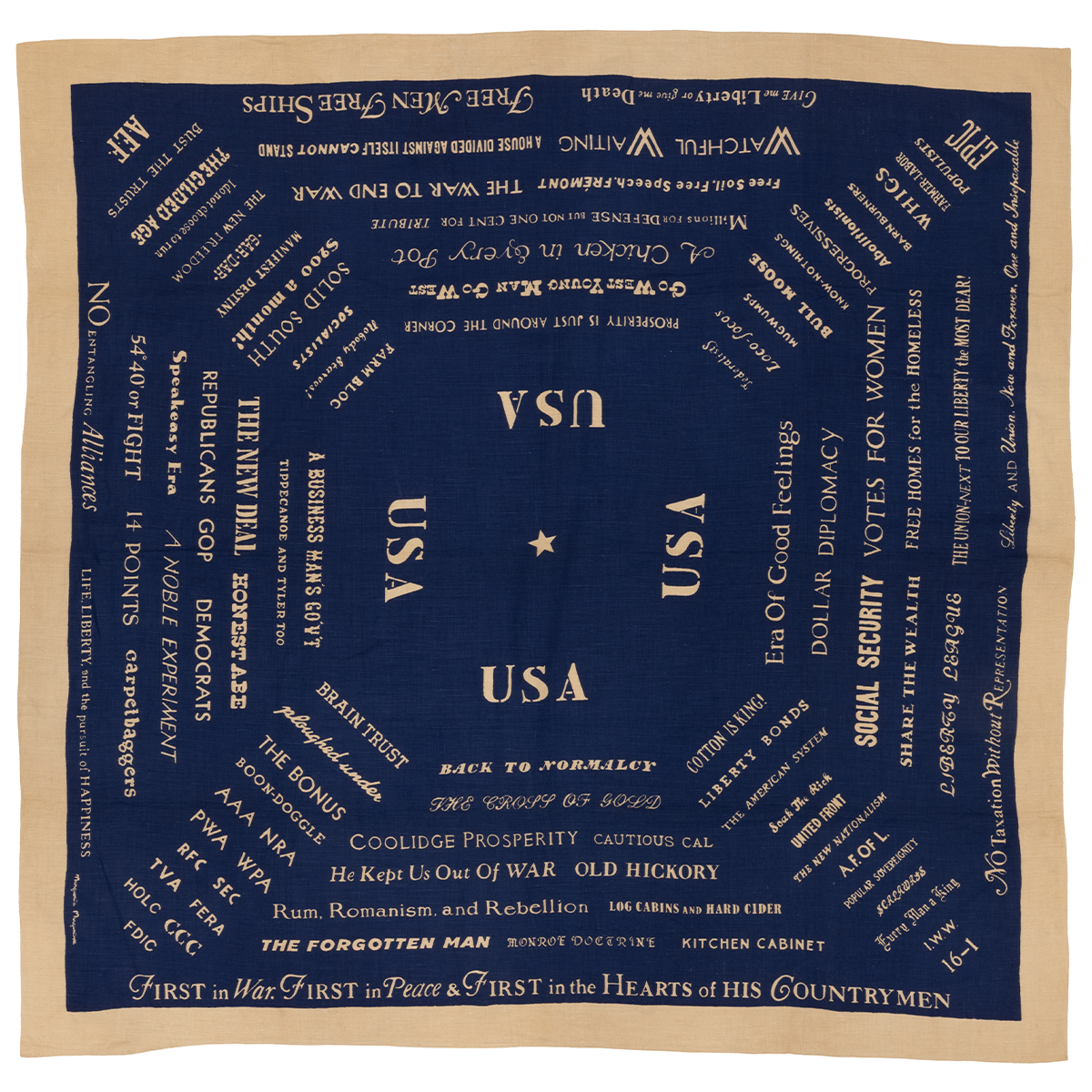 "Food for Thought" Tablecloth, 1936-1940. / THF373360
Imagine being seated at a dinner party. Instead of the expected stark white tablecloth, a riot of text on a vivid blue background beckons from underneath your water glass. You read “A Chicken in Every Pot,” “Boon-doggle,” “Votes for Women,” and “Bull Moose.” It is 1936, and many of these terms are familiar. Inevitably, dialogue about these phrases begins — some are controversial, some nostalgic, and others historical or even humorous. If any of the phrases stump the partygoers or spur disagreement, a handy pamphlet explaining each phrase and slogan accompanies the textile. Descriptions for the aforementioned phrases read as follows:
- A Chicken in Every Pot and Two Cars in Every Garage: slogan of the first Hoover campaign, 1928.
- Boon-doggle: a word now used to describe work of doubtful or no permanent value created under the various relief administrations to obviate a dole payment to the unemployed.
- Votes for Women: the cry of the Suffragettes which was shouted so lustily from 1848 to 1920 that it was translated into the law of the land in the Nineteenth Amendment of the latter year.
- Bull Moose: what Theodore Roosevelt claimed he felt like when he bolted from the Republican Party to lead the Progressive ticket in 1912.
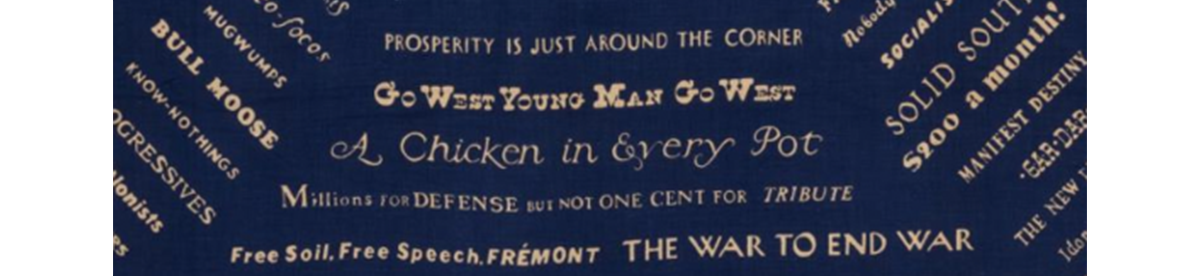 Detail, “Food for Thought" Tablecloth, 1936-1940. / THF373360
While this tablecloth certainly maintained its functional purpose as a table covering, it also became the basis for a lively dinner conversation — or perhaps debate. Textile designer Marguerita Mergentime designed it for the Lord & Taylor department store in 1936, and supposed that the tablecloth might “separate families, sever old friendships and create general havoc.”
This tablecloth, as well as the many other printed table linens designed by Mergentime, are perpetual conversation starters. Mergentime was a self-taught New York City-based textile designer who used Manhattan’s museums as her education and, in some cases, her inspiration. Born Marguerita Straus in New York City in 1894 to an established German-Jewish family, she married Charles Mergentime in 1914 and soon had two daughters. She began her career in textile design in the late 1920s as a settled wife and mother. She quickly established herself as one of New York City’s primary modern textile designers, with an early credential of designing fabrics for Radio City Music Hall thanks to a 1932 commission by chief interior designer Donald Deskey himself.
Food for Thought: Marguerita Mergentime, Textile Designer


In the difficult economic period of the early 1930s, Mergentime convinced manufacturers to mass produce her designs. She joined the American Union of Decorative Arts and Craftsmen, which exhibited some of her earliest work designed for Cohn-Hall-Marx Co. and I.B. Kleinert Rubber Company. By 1934, the table linens she designed could be purchased at department stores in New York City and throughout the country.
Mergentime was immensely prolific throughout the 1930s. Her printed table linens frequently boasted bold color, and even those without her signature text-forward design often referenced American culture and society or featured native flora and fauna. For example, her “Instead Of” tablecloth and napkins, designed in 1934, referred to the groundbreaking opera Four Saints in Three Acts, which debuted the same year. Mergentime specifically quoted novelist Gertrude Stein's libretto from the opera for a series of printed table linens, which she titled “Once in a While,” “Have to Have,” and “Instead Of.”
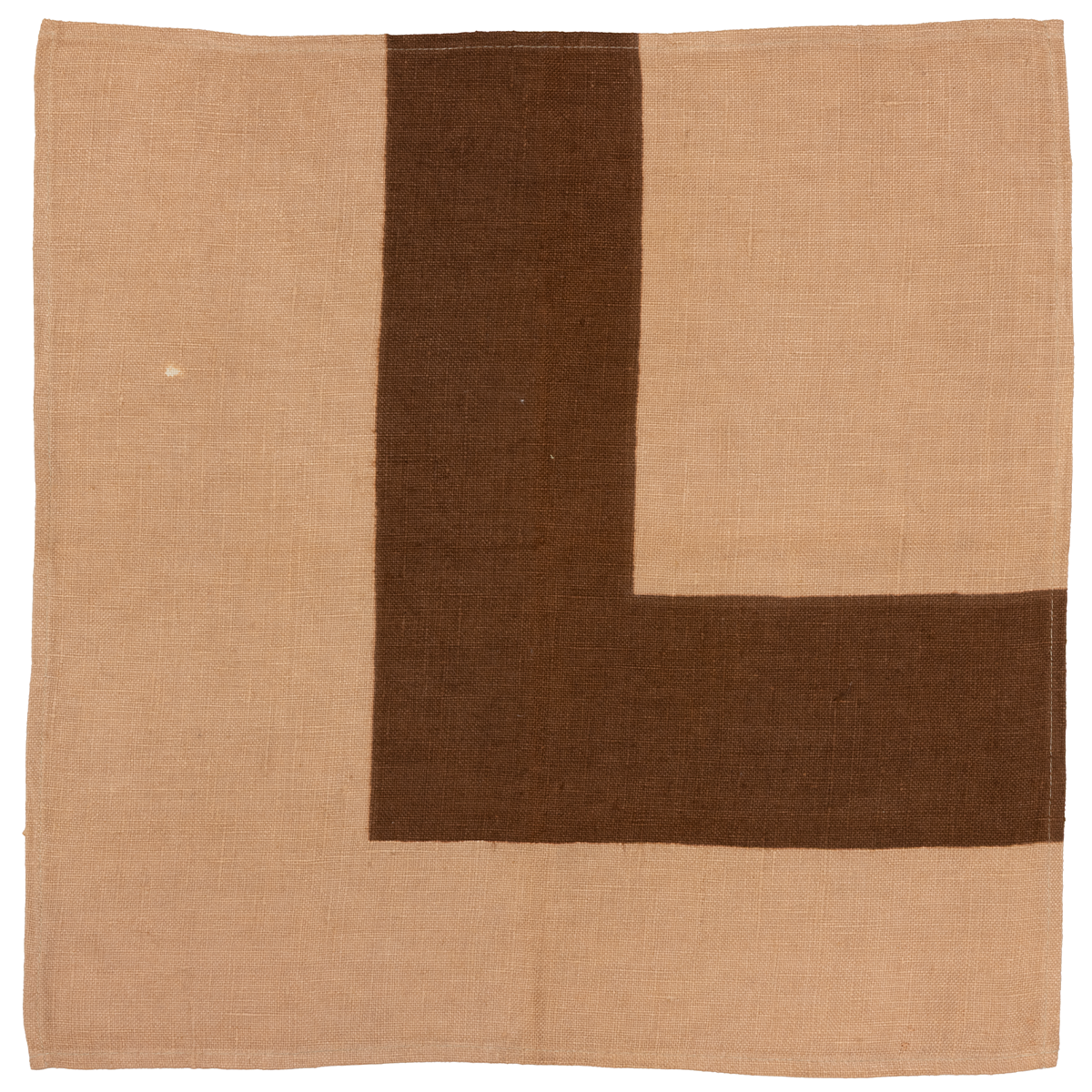 "Instead Of" Napkin, 1934. / THF374340
As the 1930s came to a close, Mergentime participated in bicoastal expositions: both the 1939 New York World’s Fair and the 1939 Golden Gate International Exposition in San Francisco (to which the famed textile designer and weaver Dorothy Liebes personally invited Mergentime’s participation). The tablecloth she designed for the New York World’s Fair served as a map of the festivities, as well as a colorful souvenir, and the wall hanging created for the Golden Gate Exposition served as a stunning review of American phrases, with clear similarities to the “Food for Thought” tablecloth.
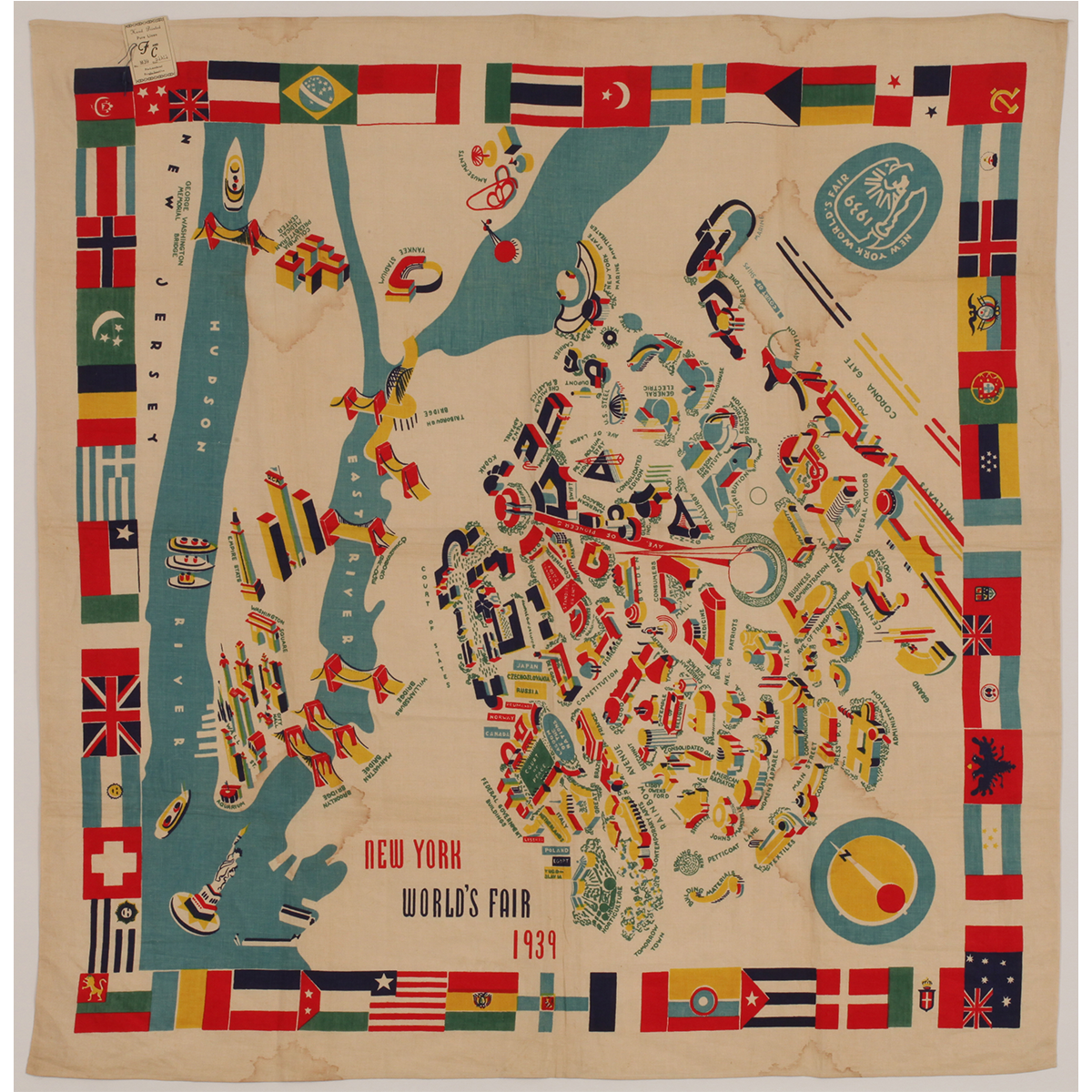 New York World's Fair Souvenir Tablecloth, 1939. / THF152560
Tragically, Mergentime died in 1941 after a short illness. She was just 44 years old and at the height of her career. She remained in relative obscurity for many years, despite her obvious talent and impact, but has begun to receive well-deserved acknowledgement and celebration, thanks in large part to the stewardship of her granddaughter, Virginia Bayer.
Katherine White is curator of design at The Henry Ford. She is grateful to Virginia Bayer, granddaughter of Marguerita Mergentime, for the recent donation of numerous table linens designed by Mergentime. Mergentime is featured in The Henry Ford’s Fabric of America: Our Fashions, Textiles, and Technologies exhibition that runs from June 7-September 13, 2026.
Keywords | |
|---|---|
Series | |
Themes |