
Edsel Ford and Hugo Junkers at Ford Airport to Greet the Bremen Fliers, May 17, 1928
THF130165 / Edsel Ford and Hugo Junkers at Ford Airport to Greet the Bremen Fliers, May 17, 1928
01
Artifact Overview
German engineer Hugo Junkers rejected conventional wood-and-fabric aircraft construction and introduced the first all-metal production airplane in 1916. Made from corrugated duralumin, a strong but lightweight aluminum alloy, Junkers's sturdy planes were adopted by the German military. After World War I, Junkers focused on civilian aircraft. Junkers's career was cut short when the Nazis seized control of his company in 1934.
Artifact Details
Artifact
Photographic print
Subject Date
17 May 1928
Creators
Place of Creation
Collection Title
Location
By Request in the Benson Ford Research Center
Object ID
P.O.10060
Credit
From the Collections of The Henry Ford. Gift of Ford Motor Company.
Material
Paper (Fiber product)
Technique
Gelatin silver process
Color
Black-and-white (Colors)
Dimensions
Height: 3.75 in
Width: 5.75 in
Keywords |
|---|
02
Related Artifacts
 Artifact
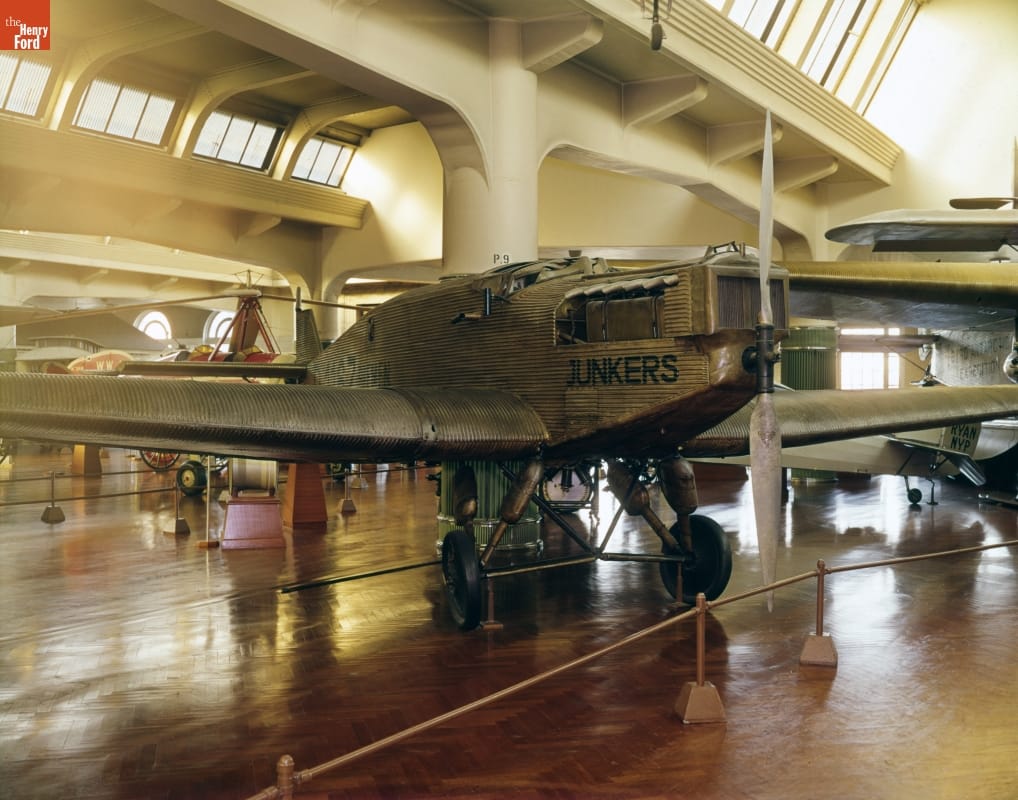
1928 Junkers W33 "Bremen" Airplane
The Bremen was the first aircraft to fly nonstop from Europe to North America. Hermann Kohl, Ehrenfried Guenther von Huenefeld, and James Fitzmaurice took off from Baldonnel, Ireland, on April 12, 1928, and touched down on Greenly Island, Canada, the next day. The east-to-west crossing, made against prevailing winds, was more difficult than a flight from North America to Europe.