
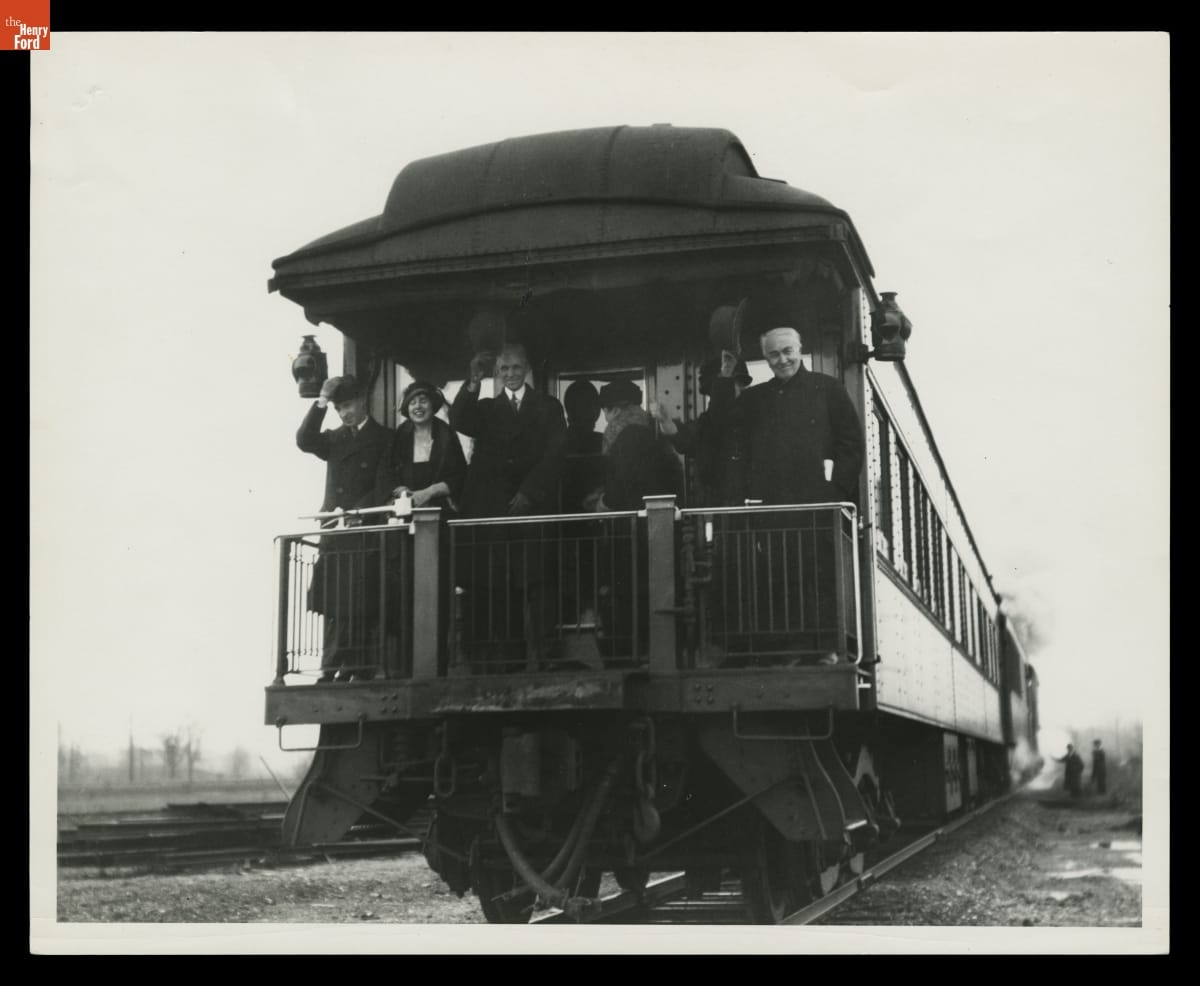
Henry Ford's Private Railroad Car, "Fair Lane," November 12, 1942
THF148020 / Henry Ford's Private Railroad Car, "Fair Lane," November 12, 1942
01
Artifact Overview
By 1920, Henry and Clara Ford found it increasingly difficult to travel with any degree of privacy. They purchased a private railcar and named it Fair Lane. The car had four private rooms, an observation lounge, a dining room, and a fully equipped kitchen. It could accommodate eight passengers. The couple made over 400 trips using Fair Lane before selling the passenger car in 1942.
Artifact Details
Artifact
Photographic print
Subject Date
12 November 1942
Collection Title
Location
By Request in the Benson Ford Research Center
Object ID
84.1.1660.P.188.70773.A
Credit
From the Collections of The Henry Ford. Gift of Ford Motor Company.
Material
Paper (Fiber product)
Technique
Gelatin silver process
Color
Black-and-white (Colors)
Dimensions
Height: 8.25 in
Width: 10 in
Keywords |
|---|
02
Related Content
 Set
SetFair Lane: The Fords' Private Railroad Car
- 25 Artifacts
By 1920, Henry and Clara Ford found it difficult to travel by railroad. Henry Ford was widely recognized -- pestered by the public and hounded by reporters. The Fords purchased a private railroad car they called Fair Lane, so they could travel conveniently and quietly across the extensive American railroad network. The Fords made more than 400 trips with Fair Lane from 1921 to 1942. article
The Fair Lane Business Car: Restrained Luxury
Henry Ford’s private railroad car Fair Lane was one of the largest passenger railcars built when it was completed by Pullman in 1921. article
Fair Lane: The Fords’ Private Railroad Car
Fair Lane, the private Pullman railroad car built for and used by Henry and Clara Ford, turns 100 years old in 2021. It provides a fascinating window into business and pleasure travel for the wealthy in the early 20th century. article
Behind the Scenes: Photographing the Interior of the Fair Lane Railroad Car
Get a behind-the-scenes look at what it takes to photograph the interior of the 1921 Fair Lane, Henry Ford’s private railroad car, on exhibit in Henry Ford Museum of American Innovation.