
African American Artists and Craftspeople in the Collections of The Henry Ford
Share
share
This selection of artifacts explores a diversity of creative expressions from the Black American community.
THF191109
Jar, 1797-1819
Thomas Commeraw (1771/2-1823) was an active member of New York City's free Black community. He owned and operated a successful pottery in the Corlears Hook neighborhood from the 1790s until 1819. Commeraw's stoneware typically featured distinctive decorations accented with bold cobalt blue glaze.
View ArtifactSculptor Edmonia Lewis, 1870
Edmonia Lewis (c. 1844-1907) was an internationally renowned sculptor of African American and Native American heritage. Though she worked primarily in Rome, Lewis gained acclaim in the United States during the Civil War. She is noted for work that incorporated African and Indigenous American themes into the Neoclassical style.
View Artifact"Mirandy That Gal O' Mine," 1919
This sheet music documents a pivotal moment in the African American music scene. The central figure is James "Jim" Reese Europe (1881-1919), the best-known Black American bandleader of the 1910s, who was tragically killed the year it was published. Noble Sissle (1889-1975), also pictured, and collaborator Eubie Blake (1887-1983) would soon create the 1921 Broadway musical sensation Shuffle Along, helping to launch the Harlem Renaissance.
View Artifact"Crazy Blues," 1920
When Vaudeville artist Mamie Smith (1891-1946) recorded "Crazy Blues" in August 1920, she changed the course of popular music. The record was an instant success, selling more than 70,000 copies in the first month--and compelling other companies to record African American blues singers. Smith's performance helped establish the genre and gave voice to Black Americans during a time of intense racial violence.
View Artifact"Oh Daddy" and "Down Home Blues," by Ethel Waters
In 1921, Vaudeville performer Ethel Waters (1896-1977) recorded "Oh Daddy" (backed by "Down Home Blues") for Black Swan Records--the first record company with African American owners and operators. It was Black Swan's number one record, selling about 500,000 copies in six months. The company's success was short-lived, but Waters went on to achieve success as an accomplished singer and actress.
View ArtifactProduct Label for Sweet Georgia Brown Cocoanut Oil Shampoo, 1936
One of Chicago's foremost Black designers of the 19th century, Charles Dawson (1889-1981) developed the signature style of the Valmor Products Company. Though many Valmor products encouraged an assimilatory white ideal, Dawson’s packaging designs celebrated Black and non-white people. His depictions of modern, attractive Americans diverged from the racialized stereotypes common at the time.
View ArtifactGeorge Washington Carver with His Painting, "Yucca and Cactus," 1941
Agricultural science was a natural outlet for the artistic talents of George Washington Carver (1864?-1943). Carver received the first major public viewing of his artwork at the World's Columbian Exposition in 1893. His larger-than-life painting Yucca and Cactus, seen in this photograph, received an honorable mention. Unfortunately, a 1947 fire destroyed it and other Carver paintings housed at a Tuskegee University museum dedicated to him.
View ArtifactCommemorative Half Dollar Coin Featuring Booker T. Washington, 1946
Isaac Scott Hathaway (1872-1967) is best known for sculpting busts of famous African American figures, but he was also the first Black artist commissioned by the U.S. Mint to design a coin. The Hathaway-designed half dollar depicting educator Booker T. Washington -- the first African American subject of a U.S. coin -- was sold to help establish and maintain Washington's birthplace as a national monument.
View ArtifactPig Pen Variation and Mosaic Medallion Quilt by Susana Allen Hunter, 1950-1955
After working the fields of her rural Alabama tenant farm and tending to her family's needs, Susana Hunter (1912-2005) sat down to lavish her creativity on quilt making. On-the-fly inspiration -- rather than tradition -- guided this quiltmaker's improvisational creations. Hunter made more than one hundred quilts -- each of them unique -- from the worn clothing and fabric scraps available to her.
View ArtifactThe Collected Poems of Langston Hughes, 1995
A noted leader of the Harlem Renaissance, Langston Hughes (1901-1967) was a prolific writer who protested injustice and championed African American cultural expression. Hughes penned everything from plays and short stories to nonfiction essays and newspaper articles, including an influential column for The Chicago Defender. But he is best known for vivid poetry that portrayed the everyday lives of working-class Black Americans.
View ArtifactSelected Poems, 1963
Author and poet Gwendolyn Brooks (1917-2000) wrote some of the most widely read and influential poetry of the 20th century. She was highly regarded, becoming the first African American poet to receive a Pulitzer Prize (1950) and being appointed Poet Laureate of both the state of Illinois (1968-2000) and the United States (1985-86).
View ArtifactMcKinley Thompson and Crew Testing the Warrior Concept Car, 1969
As a child, McKinley Thompson, Jr. (1922-2006), displayed impressive artistic talent and an interest in futuristic themes. He became one of the automotive industry's first African American designers when he was invited to join Ford Motor Company's Advanced Styling Studio in 1956. In the 1960s, the forward-thinking Thompson conceptualized this rugged, easy-to-build car for use in developing countries.
View ArtifactPoster Showing Emory Douglas Painting, "Free Huey," 1969
Political artist Emory Douglas (b. 1943) created bold imagery that helped define the Black Panther Party's visual identity. As the Panthers' Revolutionary Artist and Minister of Culture, Douglas designed more than 500 issues of the group's newspaper. His illustrations also appeared on posters, like this one from 1969--part of an influential campaign calling for the release of then-imprisoned Panthers' co-founder Huey P. Newton.
View ArtifactPortfolio of Lithographs by Elizabeth Catlett, 1958-1972
Elizabeth Catlett (1915-2012) produced sculptures, paintings, and prints that reflected her unique perspective as a woman, mother and grandmother, and an African American citizen of Mexico. Catlett's political art coincided with the rise of feminism and the civil rights movement, including references to the "black is beautiful" philosophy and the Black Panther Party. Her work often features Black women, especially mothers.
View ArtifactJ Dilla and Madlib Looking through Records in Brazil, 2005
J Dilla (James DeWitt Yancey, 1974-2006) is celebrated as one of the most important musicians to emerge from Detroit’s underground hip hop scene--as a member of Slum Village, the Soulquarians, and for his innovative solo work. Here, he is pictured with producer and collaborator Madlib (Otis Jackson, Jr., b. 1973) digging for records in Brazil, just months before his untimely death in February 2006.
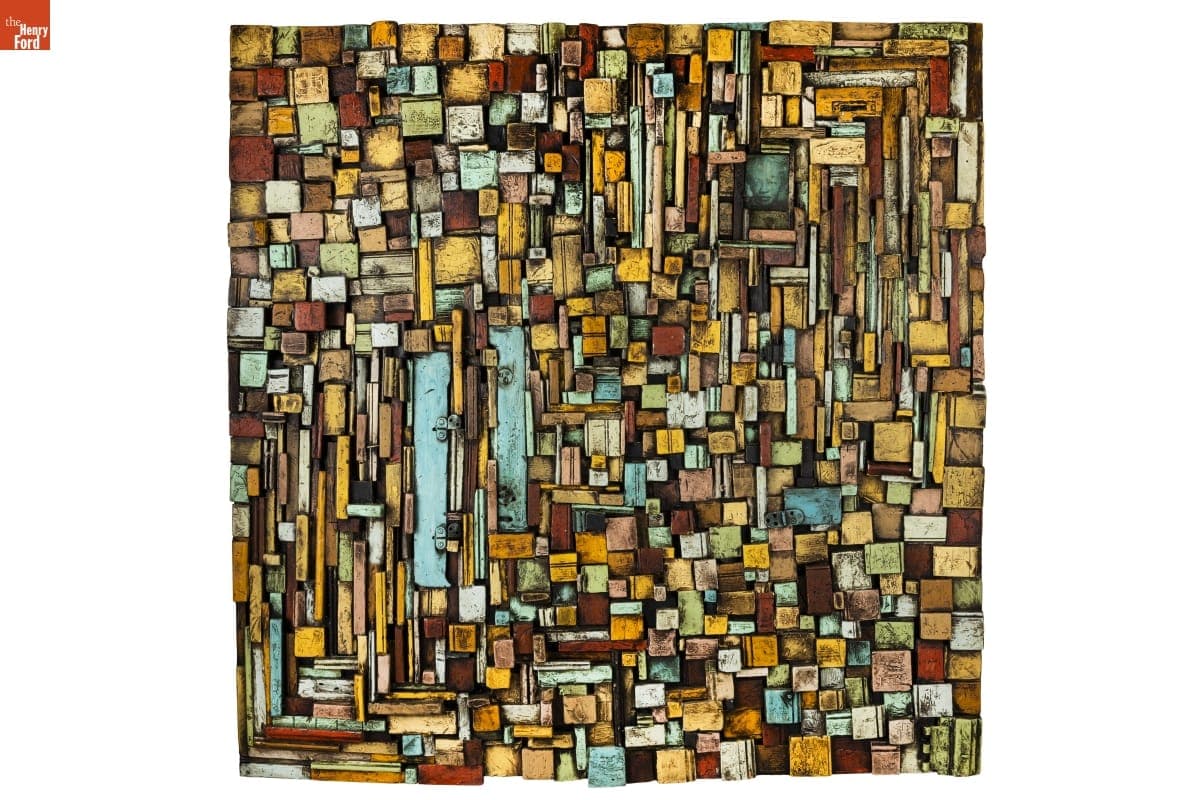
View Artifact"A Wooden Quilt for Big Mama" by Jean-Marcel St. Jacques, 2023
New Orleans artist Jean-Marcel St. Jacques (b. 1972) creates "wooden quilts" like this one using wood and other debris from his Hurricane Katrina-damaged home. The style of his work honors both his quilter great-grandmother — to whom this piece is particularly dedicated — and his great-grandfather, who was a junk collector and hoodoo practitioner.


