
Airships
Share
share
"Airship" refers to any lighter-than-air craft that moves under its own power. Lift is achieved using a gas, like hydrogen or helium, that is less dense than surrounding air. Non-rigid airships -- blimps -- use the gas's pressure on the containment envelope to maintain their shape. Rigid airships -- Zeppelins -- support their gas cells with an internal framework. In peace and in war, airships have known triumph and tragedy.
THF242383
Crowd Gathered to Watch a Balloon Launch, circa 1900
Hot air balloons, dating to 1783, are the oldest human-flight technology, but they differ from airships. Hot air balloons achieve lift by heating ordinary air to make it less dense than the surrounding atmosphere. No special lifting gasses are used. And hot air balloons go where the wind takes them, though balloonists can seek favorable breezes by adjusting altitude.
View ArtifactGondola Landing after Piccard Stratosphere Balloon Flight, Cadiz, Ohio, October 23, 1934
Some balloons do use lifting gasses. Hydrogen lifted the balloon and gondola used by Jean and Jeannette Piccard on their record-setting ascension in 1934. Taking off from Dearborn, Michigan, the Piccards reached an altitude of 10.9 miles, and Jeanette became the first woman to reach the stratosphere. They landed at Cadiz, Ohio -- nearly 300 miles from their starting point.
View ArtifactGoodyear Blimp "Mayflower" over Martha-Mary Chapel, Greenfield Village, October 21, 1929
Few blimps are as famous as those operated by Goodyear. The company manufactured military airships during World War I and built its first promotional blimps in 1919. Goodyear's Mayflower visited Greenfield Village for the "Light's Golden Jubilee" celebration in 1929. While its military blimp production ended in 1960, Goodyear's promotional fleet continues to fly.
View ArtifactFord Advertising Airship with Slogan "There's a Ford in Your Future," 1946-1948
With their large gas envelopes and relatively low speeds, blimps make excellent aerial billboards. Goodyear wasn't the only company to realize this. Ford Motor Company decorated this blimp with its optimistic post-World War II advertising slogan, "There's a Ford in Your Future." Advertising blimps are still seen today -- particularly at large sporting events.
View ArtifactZeppelin Hovering over German Ships, 1909
German inventor Ferdinand von Zeppelin began experimenting with rigid airships in the late 19th century and launched his first successful craft in 1900. By the time of his death in 1917, Zeppelin's airships were in regular service in both civil and military aviation. His name became synonymous with the design -- "Zeppelin" remains a common term for rigid airships.
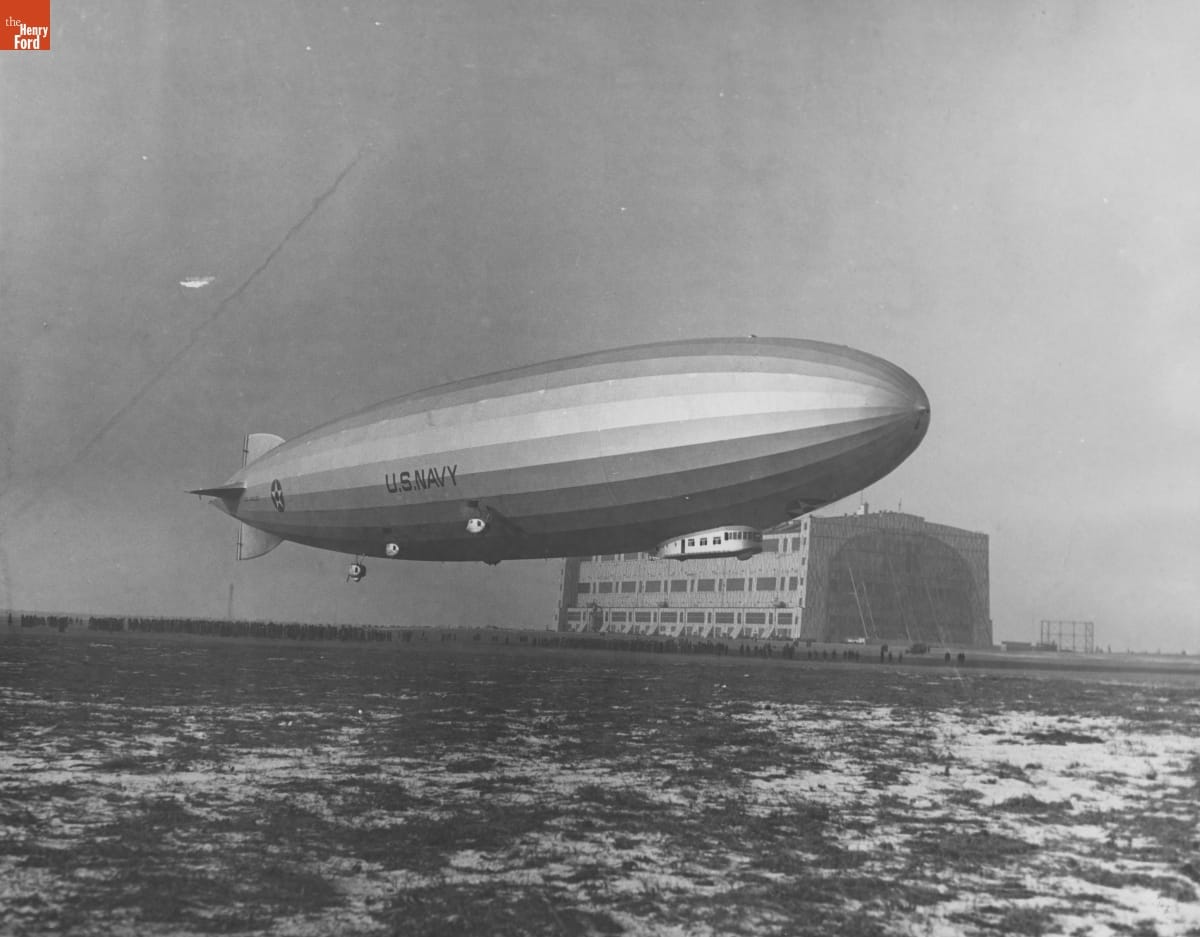
View ArtifactZeppelin "Los Angeles" Leaving Hangar at Lakehurst, New Jersey, 1926
Impressed by German airships in World War I, the U.S. Navy envisioned rigid airships in long-range scouting activities, and as flying aircraft carriers for specially designed airplanes. Four helium-lifted Navy airships, including Los Angeles, were built starting in 1921. But after three were lost in storms, the Navy abandoned the program. Los Angeles didn't crash, but it was dismantled in 1939.
View ArtifactStout Air Transport 2-AT Circles the Dirigible Mooring Mast at Ford Airport, December 19, 1925
Airships had a seemingly bright future when Ford Airport opened near Detroit in 1924. The airport installed a 210-foot tall mooring mast to accommodate them. It featured an elaborate "collar" that rotated 360 degrees, allowing an airship to face into the wind regardless of direction. The collar also lowered the ship so that passengers could disembark at ground level.
View ArtifactUnited States Army Airship at Ford Airport, September 18, 1926
Only two airships ever used Ford Airport's mooring mast: the Navy's Los Angeles and the U.S. Army's RS-1. The Goodyear-built RS-1 was a semi-rigid craft with a stiff keel supporting its gas envelope. Unlike German Zeppelins, which used hydrogen lifting gas, American airships used helium. Though less buoyant and more expensive, non-flammable helium was safer.
View ArtifactAirship "Norge," Designed and Piloted by Umberto Nobile, before Departure to the North Pole, May 1926
Norwegian explorer Roald Amundsen led a flight to the North Pole in the airship Norge on May 12, 1926. He was joined by American adventurer Lincoln Ellsworth and Italian pilot Umberto Nobile. Their flight came three days after Richard Byrd's airplane flight to the North Pole -- though debate continues over whether Byrd reached the actual pole.
View ArtifactAirship "Graf Zeppelin" Arriving at Lakehurst, New Jersey Naval Hangar, August 4, 1929
While America's rigid airships were restricted to military use, Germany captured headlines and imaginations by putting Zeppelins into passenger service. The Graf Zeppelin, built in 1928, made 590 flights in its nine-year career. It crossed the Atlantic Ocean several times, and even circled the Earth in 1929. Five V-12 propeller engines provided Graf Zeppelin's propulsion.
View ArtifactSouvenir Booklet, "The Log of the Graf Zeppelin," 1930
The 1929 around-the-world flight of the Graf Zeppelin began and ended at Lakehurst, New Jersey. The airship departed on August 8, flying east over the Atlantic Ocean, and returned to Lakehurst from the west on August 29, having covered 20,651 miles in three weeks. This souvenir booklet chronicled the voyage in a lengthy poem.
View ArtifactToy Zeppelin, 1937-1942
The glamorous Graf Zeppelin inspired toys. The ship measured 776 feet long, with room for 24 passengers. Graf Zeppelin was eclipsed by the 814-foot, 72-passenger Hindenburg in 1936. Hindenburg's lounge and dining room were comparable in quality to those on elegant ocean liners. Designers intended Hindenburg to use helium, but U.S. export restrictions forced the substitution of hydrogen.
View ArtifactAirship "Hindenburg" Disaster, Naval Air Station Lakehurst in Manchester Township, New Jersey, May 6, 1937
Hindenburg was minutes away from completing a transatlantic flight when it burst into flames at Lakehurst, New Jersey, on May 6, 1937. Of 36 passengers and 61 crew members aboard, 35 died in the hydrogen-fueled inferno -- in addition to another fatality on the ground. Debate continues about the fire's origins. Investigators considered everything from static electricity, to lightning, to sabotage.
View ArtifactAirship "Hindenburg" Disaster, Naval Air Station Lakehurst in Manchester Township, New Jersey, May 6, 1937
Whatever its cause, the Hindenburg disaster effectively marked the end of airship travel. Germany intended to continue passenger operations with helium-filled ships, but ongoing U.S. helium export restrictions frustrated those plans. Any lingering hopes vanished with the outbreak of World War II in 1939.
View ArtifactPulling Down the Dirigible Mooring Mast at Ford Airport, 1946
Ford Airport's mooring mast remained in place until October 26, 1946, when curious onlookers gathered to watch a demolition crew pull down the tower. In a sense, the mooring mast's removal marked the final coda on the golden age of passenger airships. They were now only a memory -- one forever clouded by Hindenburg's loss.
View Artifact

