
Auto Pioneers
Share
share
Early automobile innovators and innovations.
THF108083
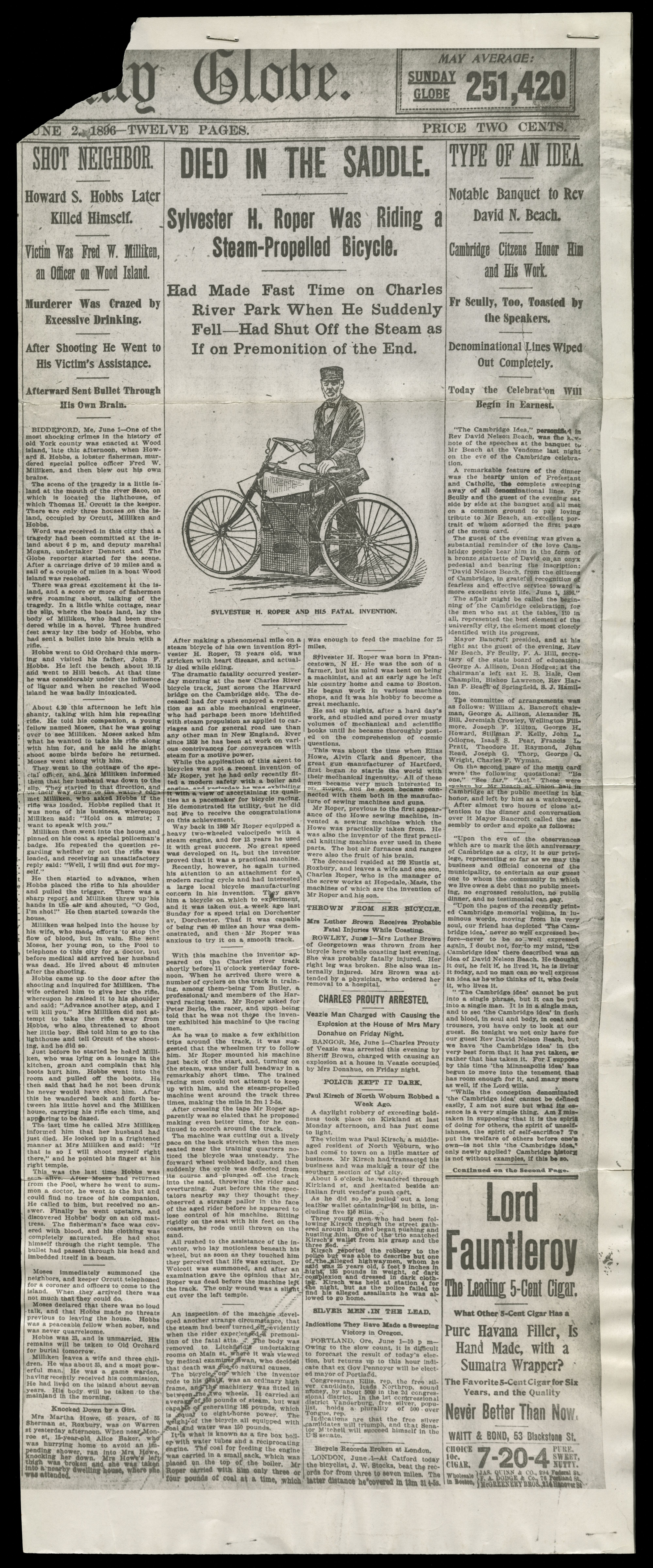
Boston Daily Globe Obituary for Inventor Sylvester H. Roper, June 2, 1896
Sylvester Roper built steam carriages and motorcycles during the latter half of the nineteenth century. His vehicles were not considered practical but became popular attractions at circuses and fairs. Roper had a heart attack at age 73 while riding one of his steam motorcycles. His death made front-page news in Boston, where he lived and worked.
View ArtifactCaliper Belonging to Gottlieb Daimler, circa 1880
This set of metric calipers, used to take precise measurements, is inscribed "G Daimler" on the handle. It was in a tool chest given to Henry Ford Museum by Daimler's daughter Emilie in 1930.
View ArtifactKarl Benz and Family with Benz Automobiles, circa 1896
Karl Benz, the inventor of the modern automobile (in light-colored suit, center), posed with family members in front of Benz automobiles for this circa 1896 photograph.
View ArtifactAdvertisement, "Get a De Dion-Bouton "Motorette" and Keep Ahead of Time," circa 1900
In Brooklyn, New York, the De Dion-Bouton Motorette Company was formed under a license agreement with the parent company in Paris, France. Despite the exciting image in their ads, the manufacturing business was unsuccessful. Instead, De Dion-Bouton cars were imported for use in the U.S., and their single-cylinder engines became popular power plants for early automobiles, including American-made Pierce-Arrow and Peerless cars.
View ArtifactSwiss Engineer Rene Thury on His Steam-Powered Three-Wheeler, circa 1880
Inventor, Rene Thury is best known as an electrical engineer during the 1870s through the 1920s. Less well-known is his experiment with powering a three-wheeled carriage using steam. He built this early automobile with assistance from his friend and co-worker, Jean-Jacques Nussberger. In 1879 they drove this car around Lake Geneva in Switzerland, traveling over 100 miles in 5-1/2 hours.
View ArtifactThe 1893 Duryea Automobile in the Museum of History and Technology, 1964
Charles and Frank Duryea built their first automobile in 1893. Three years later the brothers established the Duryea Motor Wagon Company. The company built thirteen identical vehicles in its first year. This Smithsonian Institution publication contains a photograph of factory employees working on some of the thirteen vehicles.
View ArtifactRiker Electric Vehicles Sales Catalog, 1900
The Riker Electric Vehicle Company, formed by inventor Andrew Riker, became known for producing electric touring cars and commercial trucks. This catalog from 1900 shows the company's line of electric vehicles. Riker later developed internal-combustion engines for the Locomobile Company of America.
View Artifact"The Horseless Age," Volume 1, November 1895 to October 1896
The Horseless Age was an early well-known automobile journal, useful to motoring enthusiasts. These first issues from 1895 and 1896 contain articles, images, and advertisements for a number of automobile manufacturers. It also pictured important automobile pioneers Charles King and Andrew Riker.
View Artifact"American Machinist," Bound Volume, January 3-December 26, 1895
Henry Ford and other inventors kept up-to-date on the latest automotive developments with magazines like American Machinist. Ford's Quadricycle engine was based on the one in this 1895 issue.
View ArtifactReceipt Showing Purchase of Bicycle Chain for Henry Ford's Quadricycle, May 28, 1896
Clara Ford saved this 1896 receipt. The purchase included 10 feet of bicycle chain -- possibly the chain Henry used in the drivetrain of his Quadricycle.
View ArtifactHenry Ford with the Quadricycle, Detroit, Michigan, October 1896
Henry Ford drove his first automobile, the Quadricycle, on the streets of Detroit in June 1896. Just before he sold it, he asked John Livesey to take this photo in October 1896. Lawyers for Ford used this photographic print in 1905 as evidence in the Selden Patent Suit. It has a handwritten label at the top meaning defendants' exhibit 4.A.
View ArtifactDriving Gloves, 1910-1920
Gauntlets, part of many early 1900s motorists' outfit, kept driver's hands warm and cold air from rushing up the sleeves.
View ArtifactLeague of Amercian Wheelmen Membership Card, 1891
Members of the League of American Wheelmen were early advocates of good roads and the rights of cyclists. The organization issued membership cards to cyclists in good standing. According to this 1891 card, members also received special hotel rates and other privileges.
View ArtifactCertificate for Driving an Automobile in Chicago, Illinois, 1900
The first driver's license ordinance in America was passed by Chicago in 1899. This 1900 license was good for one year.
View ArtifactMichigan License Plate, 1906-1907
In the early 1900s, the state of Michigan required automobile owners display a license plate with an assigned registration number. Before 1910, car owners had to make their own. This 1906 leather plate with metal numbers was registered to a car in Detroit, Michigan.
View ArtifactThree Men Examining Tire on Ford Model T Car, 1909
Early automobiles required a lot of maintenance. Drivers like these, dressed for motoring and examining their Model T by the side of the road, had to be ready to perform mobile repairs.
View ArtifactPoliceman Standing in Traffic Tower at Intersection, Detroit, Michigan, circa 1920
In the late 1910s and 1920s, many cities used traffic towers to make it easier for traffic officers to see -- and be seen -- by drivers. This traffic tower was located at the busy intersection of Grand Boulevard and Second Avenue in Detroit, Michigan.
View ArtifactAlice Ramsey and Three Companions on Cross-Country Automobile Trip, 1909
These ladies wore duster overcoats, hats, and veils to protect their clothing and hair during their Maxwell touring car journey from New York City to San Francisco. Alice Ramsey (second from left) was the first woman to drive across the continent, traversing 3,800 miles in 59 days. The Maxwell-Briscoe Motor Company sponsored this publicity trip and reaped a 50 percent sales increase in 1910.
View Artifact"The Stanley System of the Locomobile" circa 1900
This cutaway diagram reveals the inner workings of an early steam-powered Locomobile. The vehicle packed a water tank, boiler, two-cylinder steam engine, and fuel supply under the seat of the automobile.
View ArtifactRoy D. Chapin Seated in Curved-Dash Oldsmobile, "First Car to Travel from Detroit to New York--Syracuse, 1901"
Olds Motor Works sent Roy Chapin, Sr., on a promotional trip from Detroit to New York City in a small Curved Dash Olds in 1901. The trip took the car and driver, seen in this photograph, through Canada, along the Erie Canal, down Fifth Avenue, and finally to the Waldorf-Astoria Hotel. The eventful trip took over a week.
View ArtifactMayo-Diamond Torch Matchbox, circa 1900
Steam-powered vehicle owners needed reliable matches to ignite fuels that heated water in the vehicle's boiler. The Diamond Match Company proclaimed that their product "Burns 15 seconds" and was "excellent for launches, yachts, motor cars, [and] automobiles."
View ArtifactLocomobile Sales Catalog, 1902
Steam cars were popular in the early days of automobility. This Locomobile catalog features the 1902 models of the company's fast, powerful steamers.
View ArtifactAmmeter, 1905-1920
In an electric car, an ammeter shows how much current the car is using and how fast the batteries are discharging. The flow of electrical current through a circuit is measured in amperes, often called amps.
View ArtifactHenry Ford's "Kitchen Sink" Engine, 1893
Henry Ford built his first experimental engine using scrap metal for parts. He tested it on the kitchen sink after supper on December 24, 1893. For ignition he ran a wire from the ceiling's light bulb. His wife Clara hand-fed gasoline to the intake valve while Henry spun the flywheel. The engine roared into action, shaking the sink.
View ArtifactVoltmeter, 1905-1920
Voltmeters in electric cars show the level of charge in the batteries, measured in volts. They help drivers judge how far a car can travel before the batteries must be recharged.
View ArtifactDriving Duster, circa 1915
New leisure activities like driving required new clothes. Drivers protected themselves from the dirt and dust of unpaved roads with long overcoats called dusters. This high-end duster was owned by Willis C. Ward, heir to a wealthy Michigan lumber family.
View Artifact1865 Roper Steam Carriage
This vehicle is the oldest surviving American automobile. In the 1860s, a small steam carriage running under its own power -- without horses! -- was so startling that people paid to see it driven. It was a curiosity, not transportation. By the time its inventor, Sylvester Roper, died in 1896, new innovators were transforming horseless carriages from curiosities into practical vehicles.
View Artifact1896 Duryea Runabout
Early automobile inventors tended to make one-of-a-kind vehicles. Charles and Frank Duryea had a different idea. In 1896, they established the Duryea Motor Wagon Company and built thirteen identical vehicles. Based on their second model that had recently won America's first automobile race, this car was user friendly. A single lever controlled steering, shifting, and accelerating. The Henry Ford owns the only known surviving 1896 Duryea.
View Artifact1896 Ford Quadricycle Runabout, First Car Built by Henry Ford
The Quadricycle was Henry Ford's first attempt to build a gasoline-powered automobile. It utilized commonly available materials: angle iron for the frame, a leather belt and chain drive for the transmission, and a buggy seat. Ford had to devise his own ignition system. He sold his Quadricycle for $200, then used the money to build his second car.
View Artifact1901 Columbia Victoria
Early automobiles, even electric-powered ones like this 1901 Columbia, looked like carriages. Batteries located over the front and rear axles powered this victoria. The carriage had a 20- to 30-mile range between charges. The owner, Washington Post publisher John McLean, rode in the covered center while his chauffeur steered from behind.
View Artifact1899 Locomobile Runabout
This steam-powered runabout, by Locomobile, was built from designs by twin brothers F.E. and F.O. Stanley. These early vehicles were fast, cheap, and relatively uncomplicated. However, fuel needs, excessive water consumption, and other inherent problems dogged the lightweight steamer. In 1902 Locomobile began production of a gasoline internal combustion engine. The company phased out its steam-powered vehicles in 1904.
View Artifact1903 Oldsmobile Curved Dash Runabout
When it inspires a song, you know it's popular. This Olds was the bestselling car in America from 1902 to 1905. Automobiles had an emotional appeal. A driver in 1901 said that controlling a car satisfied "an almost universal sense, the love of power." Despite the attraction, cars were not a significant player in the transportation world. In 1903 some 4,000 people bought Oldsmobiles, but more than 900,000 bought buggies and carriages.
View Artifact

