
Before Cars
Share
share
Transportation options before automobiles.
THF121308
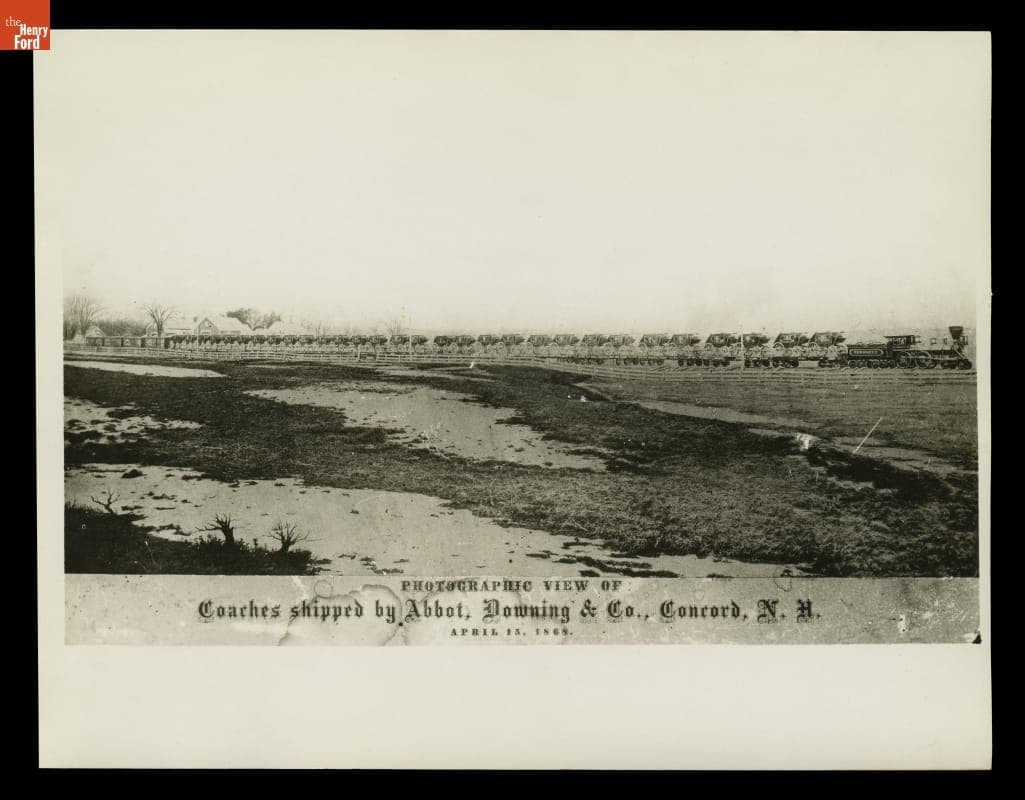
Concord Coaches Being Shipped by Train, 1868
Abbot, Downing & Company of Concord, New Hampshire, was the largest and best-known maker of stagecoaches. Sturdy, durable, and comfortable, Concord coaches were shipped by rail all over the country.
View ArtifactTHF100882
"The Close of a Career in New York," 1900-1906
Horse power created its own kind of pollution. Manure -- and dead horses, like this one in New York City -- were not uncommon on urban streets.
View ArtifactTHF100012
Horsecars on a Commercial Street, Detroit, Michigan, circa 1880
This photograph shows the busy streets of Detroit with horse-drawn streetcars. These vehicles carried commuters, shoppers, and other passengers throughout the city. Fresh horses were required several times a day to keep people moving.
View ArtifactTHF206455
Concord Coach Hitched to Four Horses in Front of Post Office, circa 1885
This hack passenger wagon, with its smaller, square body and open sides, was a less expensive type of public coach. Used for short distance travel in rural areas, these vehicles carried passengers between towns and villages. Quite appropriately, this driver has posed his vehicle in front of a post office -- stage lines also transported the U.S. mail along their routes.
View ArtifactTHF133557
Veterinary Ambulance, circa 1900
Horses and mules were everywhere on 19th-century American streets pulling cabs, carriages, streetcars, and commercial vehicles. This ambulance wagon, used by Detroit veterinarian Elijah Patterson, transported sick or injured draft animals for medical treatment. The wagon bed was lowered toward the street with a winch, which then pulled the bed, complete with animal, back into the wagon.
View ArtifactTHF150166
Stagecoach Odometer, 1879
This stagecoach odometer, built by San Francisco inventor John Roach in 1879, counted wheel revolutions to register the distance a coach traveled. Stagecoach lines used the information to calculate speed and how much to pay operators. The odometer was secured on the wheel hub and protected by a leather cover.
View ArtifactTHF202611
John C. Howard Livery & Sale Stables, Washington, D.C., April 1865
The horse was central to most forms of urban travel in the United States during the 1800s. This substantial fire-resistant brick building lodged many horses needed for carriages, coaches, and firefighting vehicles in Washington, D.C. This stable became infamous during the investigation into President Abraham Lincoln's assassination because confederate spy and conspirator, John H. Surratt, boarded his horses here.
View ArtifactTHF101218
Women's Leather Boots, 1890-1910
Walking is the oldest form of transportation. A pair of walking shoes served a 19th-century American through city and country. By the late 1800s, shoes were increasingly made in factories instead of by hand, at half the cost. These factory-made, brown leather boots were made for a woman.
View ArtifactTHF204241
Wood Engraving, "View of the Public Landing at Louisville, Kentucky," 1850-1855
By the 1850s, Louisville, Kentucky, was the nation's tenth largest city and the largest Ohio River port between Pittsburgh and St. Louis. Manually operated flatboats and steam-powered riverboats carried freight and passengers up and down the river. Louisville was also the largest slave trading center in the country, with between 2,500 and 4,000 enslaved people passing through each year.
View ArtifactTHF733521
Hudson River Railroad Schedule of Fares Between New York City, Albany and Troy, New York, 1852
As the 19th century progressed, Americans had additional travel options. Railroads competed with steamboats for freight, mail, and passenger traffic. Rail routes often paralleled major river traffic routes. In 1852, the Hudson River Railroad offered travel to points along the river between New York City and Troy. This schedule shows the different travel schedules and options available to passengers.
View ArtifactTHF100060
Buggy Dash Lantern, 1900-1920
Nighttime driving can be hazardous, even for horse-drawn vehicles. R. E. Deitz Company produced this lantern to help drivers see each other in the dark. A spring clip attaches the lantern to the dash and a convex, bull's-eye glass concentrates the light.
View ArtifactTHF100009
A Busy Day in Lapeer, Michigan, circa 1908
In 1908 -- the year Henry Ford developed the Model T -- the streets of Lapeer, Michigan, were dominated by buggies. But at least one automobile can be spotted on the busy thoroughfare.
View ArtifactTHF203264
Wabash Avenue, Looking North from Monroe Street, Chicago, Illinois, circa 1900
In turn-of-the-twentieth-century downtown Chicago, pedestrians and horse-drawn vehicles shared the streets with streetcars and elevated rail.
View ArtifactTHF203177
Lithograph Advertising Belding Bros. & Co. Silk Thread, "Sectional View of Cable Street Cars," circa 1880
This print shows a cutaway of Chicago City Railways' State Street cable car line. In the 1880s Chicago transit companies invested heavily in cable railways, but most had switched to electric streetcars by 1900. Belding Brothers, a leading manufacturer of silk thread, put the strong fiber to work pulling cable cars-but most transit companies eventually settled on cheap, sturdy wire rope.
View ArtifactTHF118831
Wabash Avenue, North from Adams Street, Chicago, 1900
Some cities built municipal elevated urban railways to move people quickly. This postcard shows the Chicago "L" about 1900. Note the pedestrians and horse-drawn vehicles on the street below.
View ArtifactTHF100014
Passengers in a New York City Street Car, 1901
This 1901 pen and ink drawing shows New Yorkers packed into a streetcar.
View ArtifactTHF202645
Horse-Drawn Streetcar in Superior, Wisconsin, circa 1890
Pulled by one horse, this streetcar is typical of city railroads in the United States during the 1880s. Urban areas built these rail systems to deal with heavy traffic and provide a quick way of getting about town. Traveling on a cold winter day inside a street car provided some comfort to passengers who could pay the fare.
View ArtifactTHF204100
Along the Towpath of the Chesapeake and Ohio Canal, Washington, D.C., circa 1915
Moving heavy goods and materials on water is a cost-effective shipment method. On this canal, boats traveled 184 miles from Washington, D.C., to Cumberland, Maryland, beginning in 1831 until 1924. Here a typical 19th-century canal boat is pulled by two mules through the city. It is below the level of the streets allowing the boat to maintain momentum.
View ArtifactTHF203458
Young Men with High-Wheel Bicycles and Safety Bicycle, circa 1885
Bicycles were very popular for recreation in the late nineteenth century, especially after the invention of the "safety bicycle," whose equally sized wheels made accidents much less likely. But the earlier high-wheeled "ordinaries" had nonetheless been a favorite of bicycle clubs and young people in search of leisure adventures. This photograph features riders of both types of bicycles.
View ArtifactTHF203414
Cyclist Margaret Kirkwood with a Bicycle, circa 1890
Bicycles meant a measure of independence for many 1890s women. Margaret Kirkwood of Malden, Massachusetts, even brought hers to a portrait studio.
View ArtifactTHF90435
Noyes Piano Box Buggy, circa 1910
Factory-built buggies made the pleasures of carriage ownership affordable for a new group of people. Whether in town or on the farm, people loved these inexpensive, lightweight vehicles. The piano box buggy -- named for its resemblance to 19th-century square pianos -- was the most popular of all. Buggy owners quickly became accustomed to the freedom and control offered by personal vehicles.
View ArtifactTHF91050
Jones Horse-Drawn Streetcar, circa 1875
The horse-drawn streetcar was an important means of public transportation in 19th-century American cities. New York's Brooklyn City Railroad ran this car on its line between Hunters Point in Long Island City, and Erie Basin in South Brooklyn. But horses were expensive to stable and feed -- and messy too. Operators embraced electric streetcars starting in the late 1880s.
View ArtifactTHF90415
1891 Abbot Downing Concord Coach
The stagecoach is a symbol of the American West, but its origins are in New England. First built in the 1820s, Concord coaches featured an innovative leather-strap suspension that produced a rocking motion over rough roads -- easier on passengers and horses alike. This example carried passengers and mail in New Hampshire and Maine before the automobile made it obsolete.
View Artifact

