
Collecting Mobility
Share
share
The Henry Ford's collections are never finished. We constantly add new objects and new stories to our holdings. Our efforts are guided generally by the museum's mission statement, and specifically by formal policies and plans that define how and what we collect. The items in this expert set were all added to our mobility collection between 2012 and 2021. Each one helps us to tell the story of American transportation past, present, and future.
THF116226
"Fairlane Inn Motel, Dearborn, Michigan," 1960
The Fairlane Inn opened in Dearborn, Michigan, in the mid-1950s and operated under various names until 2005. In 1961, the motel was home to a series of discreet meetings between Ford Motor Company vice president Lee Iacocca and other senior Ford executives. This "Fairlane Committee" conceived a sporty new car aimed at the growing baby boomer market: the Ford Mustang.
View ArtifactTHF170601
Resin Cast of Ford Mustang Automobile Badge, circa 1963
Credit for the Ford Mustang's galloping horse emblem goes to Philip Clark, a designer who consulted on Ford's experimental 1962 Mustang I. Sculptor Charles Keresztes converted Clark's two-dimensional sketch of a wild, running horse into a three-dimensional badge. Clark's logo was later adapted for the production Mustang introduced in 1964.
View ArtifactTHF173560
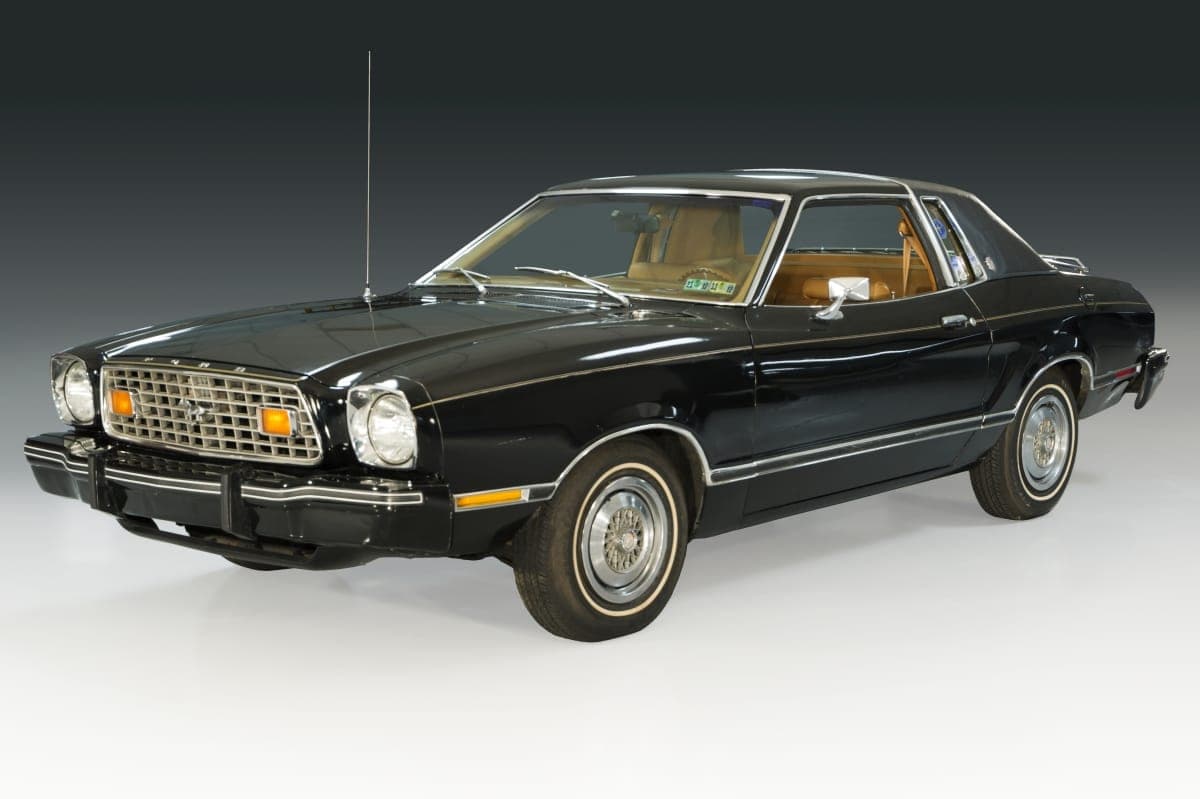
1977 Ford Mustang II
Modern fans might find the Mustang II undersized and underpowered. But its specifications were typical for the mid-1970s into the mid-1980s, when American automakers struggled with new safety, efficiency and emissions requirements, and against growing competition from high-quality foreign cars. Regardless, buyers embraced the smaller Mustang II and Ford sold more than 1.1 million of them from 1974-1978.
View ArtifactTHF188549
Surrey, 1890-1910
Clinton Firestone co-founded Columbus Buggy Company in 1875. His cousin, Harvey Firestone, worked there before establishing his own Firestone Tire and Rubber Company. Like other carriage manufacturers, Columbus Buggy struggled once the automobile arrived. Efforts to manufacture its own line of cars failed and the company went bankrupt in 1913.
View ArtifactTHF172232
Lincoln Continental Stretch Limousine, Used by Various Dignitaries in New York City and Chicago, 1964-1965
Ford Motor Company and coachbuilder Lehmann-Peterson stretched and modified this 1964 Lincoln Continental for Pope Paul VI to use on his 1965 visit to New York City. The removable roof panel allowed the pontiff to stand and wave to crowds, while step plates and handrails accommodated security personnel. Later, the limousine served as an official parade car in Chicago.
View ArtifactTHF288386
Apollo 13 Astronauts Jack Swigert and Jim Lovell in a Parade, Chicago, Illinois, May 1, 1970
NASA marked some of its finest hours in April 1970 when Apollo 13, crewed by Jim Lovell, Jack Swigert and Fred Haise, returned safely to Earth despite a potentially lethal explosion aboard the spacecraft. The crew and mission controllers were celebrated as heroes. Swigert and Lovell enjoyed a ticker-tape parade through Chicago on May 1. Haise was absent due to illness.
View ArtifactTHF188369
Locomotive Bell, 1927
For 45 years, engineer Charles Vaughn operated the Plymouth gasoline-mechanical locomotive that shuttled coal cars around the Detroit Public Lighting Department's Mistersky Power Plant. Vaughn received the engine's bell and whistle as retirement gifts. The Henry Ford acquired the Plymouth in 1979. Vaughn's family gifted the bell and whistle to the museum in 2013 to reunite them with the locomotive.
View ArtifactTHF173561
1994 Mercury Sable Aluminum Intensive Sedan
Ford Motor Company built 20 functional 1994 Mercury Sable sedans with unitized bodies and body panels made from lightweight aluminum. During tests in real-world driving conditions, the experimental cars rated better fuel economy and suffered less corrosion than their steel-bodied counterparts. Aluminum Sables never went into regular production, but lessons from the project informed Ford's aluminum F-150 pickup introduced 20 years later.
View ArtifactTHF172635
Ford "Mode: Flex" Functional Bicycle Prototype, 2015
Automakers increasingly considered themselves "mobility providers" in the 2010s. Ford Motor Company's MoDe:Flex bicycle prototype was born of that thinking. The power-assisted bike operated via an Apple iPhone app that controlled the electric motor, monitored the rider's speed and heart rate, and provided navigation assistance and traffic updates. When disassembled, the bike fit neatly into the trunk of a compact car.
View ArtifactTHF172637
Ford "Mode: Flex" Non-Functional Bicycle Prototype, 2015
Automakers increasingly considered themselves "mobility providers" in the 2010s. Ford Motor Company's MoDe:Flex bicycle prototype was born of that thinking. The power-assisted bike operated via an Apple iPhone app that controlled the electric motor, monitored the rider's speed and heart rate, and provided navigation assistance and traffic updates. When disassembled, the bike fit neatly into the trunk of a compact car.
View ArtifactTHF188012
Navya Autonom, Driverless Shuttle Bus, Used on the University of Michigan's North Campus and Mcity Test Facility, 2017
For 18 months in 2018-19, the Mcity advanced mobility research center operated this Navya Autonom driverless shuttle on a one-mile route around the University of Michigan's North Campus. Mcity encouraged shuttle passengers to complete a survey about the experience. The research project, focused on public attitudes toward autonomous vehicles, was the first of its kind in the United States.
View ArtifactTHF185938
"Have You Ridden It?" Mcity Shuttle Sign, 2018
Mcity, an advanced mobility research center at the University of Michigan, operated two driverless shuttles on its campus for 18 months in 2018-19. The research project studied public attitudes toward autonomous vehicles. This sign encouraged people to complete an online survey about their experiences with the shuttles -- whether they rode on them or simply encountered them on the street.
View ArtifactTHF185936
Mcity Shuttle Rules Sign, 2018
Mcity, an advanced mobility research center at the University of Michigan, operated two driverless shuttles on its campus for 18 months in 2018-19. The research project studied public attitudes toward autonomous vehicles. This sign informed riders that they would be photographed and recorded as a part of the study. It also listed general policies for the shuttles' operation.
View ArtifactTHF185939
"Attention Driverless Vehicle Route" Sign, 2018
Mcity, an advanced mobility research center at the University of Michigan, operated two driverless shuttles on its campus for 18 months in 2018-19. The research project studied public attitudes toward autonomous vehicles. On their one-mile route, the shuttles traveled over two-way streets mixed with conventional traffic. Signs like this alerted other street users to the shuttles' presence.
View ArtifactTHF185937
"Mcity Shuttle Stop" Sign, 2018
Mcity, an advanced mobility research center at the University of Michigan, operated two driverless shuttles on its campus for 18 months in 2018-19. The research project studied public attitudes toward autonomous vehicles. This sign indicated one of the two stops on the shuttles' one-mile looping route around the university's North Campus.
View ArtifactTHF154728
Air Traffic Control Radar Scope, 1969
Federal oversight of air traffic control began in 1938, but radar technology -- greatly improved during World War II -- was not widely implemented until the late 1950s. This computer-integrated radar scope, used at Detroit Metro Airport from 1970 to 2001, was one of the first units capable of displaying an airplane's identification number and altitude directly on the screen.
View ArtifactTHF188371
Waze Mobile Navigational Beacon, 2018
Established in 2009, Waze Mobile developed crowdsourced maps that were updated and improved by users. The company's offerings expanded to include real-time traffic and road construction alerts. The Waze Beacons project, launched in 2017, eliminated dead spots in GPS navigation by placing battery-powered beacons in tunnels where GPS satellite signals couldn't reach.
View ArtifactTHF188109
Ford Transit Van, Modified for Use as a COVID-19 Mobile Testing Facility, 2020
In spring 2020, early in America's COVID-19 pandemic, Ford Motor Company and Troy Design & Manufacturing converted four Ford Transit vans into mobile test units. The vehicles collected genetic samples in the field and transported them to labs for testing. Free tests were given to first responders, nursing home residents, and people at substance abuse centers and community shelters in Michigan.
View ArtifactTHF185919
pNeuton Model A-E Pneumatic Ventilator, Signed by Rawsonville Components Plant Employees, 2020
Early in America's COVID-19 pandemic, Ford Motor Company converted a portion of its Rawsonville Components Plant to the production of medical ventilators. These critical machines helped patients with serious infections to breathe. Ford built more than 51,000 ventilators. This unit, the last one off the Rawsonville assembly line, was signed by some of the 1,100 Ford employees involved in the effort.
View ArtifactTHF188696
Tricycle, Used by Kevin Degen
Kevin Degen raised hundreds of thousands of dollars cycling for charitable causes. Degen was born with cerebral palsy and rode using only his left leg and left arm. Toyota engineers designed this tricycle for him. The seat is offset to accommodate Degen's off-center riding posture, and the shift and brake controls are all on the left handlebar.
View ArtifactTHF188699
Stryker Prime TC Transport Chair, 2013
Starting in the early 1980s--and already established as an internationally recognized architect--Michael Graves began to pursue a parallel career as a product designer. Over the following three and a half decades he and his collaborators designed everything from humble household goods to limited edition luxury items for clients as diverse as Steuben, Alessi, Target, J. C. Penney, and Disney.
View ArtifactTHF155407
Infant Safety Carrier, 1973
Child seats are as old as automobiles, though for many years they were more about keeping the child out of mom's and dad's way than protecting her in an accident. General Motors' rear-facing Infant Love Seat, introduced in 1969, became a model for future infant car seats and helped inspire states to pass safety seat laws starting in 1978.
View ArtifactTHF185389
Sleepypod Pet Carrier, 2019
Sleepypod pet carriers were designed to protect small animals during motor vehicle collisions. Straps on the carrier's exterior attached to a car's seat belt, and the padded interior cushioned the animal in a crash. Sleepypod tested and refined its carriers using some of the same facilities used to test child safety seats.
View ArtifactTHF185385
Sleepypod "MAX 2" Crash-Test Dog, 2012
Sleepypod tested and refined its automobile pet carriers using some of the same facilities used to test child safety seats. Sleepypod created MAX 2 to simulate a small, six-pound dog riding in one of the company's carriers. MAX 2 and his carrier both endured vehicle crash tests at speeds up to 30 miles per hour.
View ArtifactTHF188010
Winged Sprint Car, Driven by Steve Kinser in the 1993 World of Outlaws Racing Season
Formed in 1978, World of Outlaws racing features lightweight cars with large wings to help them grip the dirt tracks where they compete. No driver dominated the series like Steve Kinser. He won 577 feature events in his 38-year career, and fans crowned him "King of the Outlaws." Kinser drove this car in 1993 -- one of his 20 championship seasons.
View ArtifactTHF186045
2016 Ford GT 40 Percent Clay Model, 2014
Ford Motor Company returned to Le Mans in 2016 with the Ford GT. Designers refined the car working with this scale clay model, 40 percent the size of the finished car. Computer-aided design was powerful but, when it came to seeing design proposals in the real world, it was still no substitute for modeling with traditional clay.
View ArtifactTHF188731
Toolbox and Tools, Used by Phil Remington
Phil Remington was one of racing's greatest fabricators and metalworkers. He worked alongside innovators like Lance Reventlow, Carroll Shelby, and Dan Gurney throughout his 70-year career. Remington got this toolbox while still in high school, and he used it for the rest of his life. Always resourceful, "Rem" often made his own tools suited to the job at hand.
View ArtifactTHF176453
"Distance Winner" Trophy, Awarded to Ford Motor Company at the 1966 24 Hours of Le Mans Race
Bruce McLaren and Chris Amon won the 24 Hours of Le Mans in 1966 co-driving the #2 Ford GT40 Mark II. They covered 3,009.36 miles over the duration of the race at an average speed of 125.39 miles per hour. Ford Motor Company swept the podium that year with GT40 cars taking second and third places as well.
View ArtifactTHF154154
Ford Racing 200th Funny Car Win Banner, 2011
On July 8, 2011, Ford Motor Company celebrated its 200th tournament win in NHRA drag racing's Funny Car class. Mike Neff, driving for John Force Racing, earned the victory at the O'Reilly Auto Parts NHRA Nationals, held at Route 66 Raceway in Joliet, Illinois. Signers of this commemorative banner included Neff, Force, and Ford Racing head Jamie Allison.
View ArtifactTHF186736
Racing Suit Worn by Armani Williams while Competing in the ARCA Truck Pro Series, circa 2016
Armani Williams didn't let an autism spectrum disorder diagnosis hold him back from his goal to be a racing driver. He began competing in NASCAR's Canadian Pinty's Series in 2017, and in its American K&N Pro Series East the following year. Williams used this gear while driving in ARCA Truck Series races in 2016.
View ArtifactTHF188688
National Hot Rod Association Top Fuel Competition Drag Racing Car, Driven by Gary Ormsby in the 1989 and 1990 NHRA Seasons, 1989
Top Fuel dragsters are the fastest cars approved for NHRA drag racing. Their nitromethane fuel requires less oxygen during combustion, so their engines produce more horsepower than with gasoline. Gary Ormsby drove this car to an NHRA Top Fuel championship in 1989. He used it again in 1990 -- racing at speeds near 300 miles per hour.
View Artifact

