
Eggs
Share
share
Eggs are familiar. They're available nearly everywhere Americans shop for food and appear daily on menus at homes and restaurants across the country. What's less familiar is the story of their rise from products of the family farm to a major agricultural commodity. This group of artifacts helps document that story, revealing important developments in egg production and distribution and exploring consumers' evolving relationship with eggs.
THF119904
Oil Painting, Landscape with Hens, by Jean Maurice Thibon, 1875-1900
Chickens come in many shapes, sizes, and colors, as represented in this French genre painting. They scratch the dirt in search of worms and bugs for protein and seeds that add calories to their diets. Dust baths help them ward off lice and other pests. Nineteenth-century farm families kept flocks like this in and around barnyards as a source of protein-rich eggs.
View ArtifactFirestone Chicken Shed
Chickens spent their days in the farmyard, foraging for food, but at night they needed a place to roost above the reach of foxes, raccoons, and other nocturnal hunters. Farm families built specialized shelters with places for chickens to rest and boxes where hens could lay their eggs. It was easier to gather eggs from these laying boxes than to hunt around for them in barnyard nests.
View ArtifactGathering Bowl
Life on a farm involved many chores, such as taking care of chickens and gathering eggs. Eggs were important to farm families not only as food -- they could be sold for extra money. This wooden bowl, used to collect eggs in the late 1800s, has flared sides that created additional surface area for eggs to rest on and reduced damage to their fragile shells.
View ArtifactEshelman Red Rose Feed Sign
Farms specializing in egg production emerged in the 1800s. Egg farmers purchased enriched poultry feed and other supplements to ensure that chickens consumed the nutrients and calcium they could not forage for themselves. Supplements included oyster shells, which provided calcium to harden eggshells -- making them more durable for transport from farm to frying pan.
View Artifact"An Egg Farm: The Management of Poultry in Large Numbers," 1876
Egg farming grew into a specialized industry after the Civil War. Books like this one provided information for farmers interested in large-scale egg production. They also helped popularize exotic breeds that consistently laid high-quality eggs.
View ArtifactAcme Egg Grading Scale, 1924-1930
Different types of poultry lay eggs of different sizes, shapes, and colors. Farmers use a grading system to ensure consistency when packing eggs for shipment and sale. "Grading" involves visually sorting the eggs, then weighing them with a scale, like this one from the 1920s.
View ArtifactPrice List for Stevens' Patent Egg Cases, 1878
Egg producers initially used different sizes and types of containers to pack eggs for market. As the egg industry developed, standardized cases that held thirty dozen (360) eggs became the norm. Egg case manufacturers touted their own versions of the design, hoping to beat out the competition. A Massachusetts poultry farmer believed one product, Stevens' Patent Egg Cases, was "much the best."
View ArtifactChampion Egg Case Machine, 1900-1925
Civil War veteran James K. Ashley patented this machine in 1896. Egg farmers used it to build uniform boxes that held 360 eggs each. Farmers clamped wood boards between the vices, and then nailed the sides, middle and bottom together to complete a box. They stenciled finished boxes with the farm name and other advertising before shipping their eggs to urban markets.
View ArtifactPressed Paper Egg Tray, 1930-2000
Pressed paper egg trays provided padding between layers of eggs packed for transport from farms to urban markets. Each tray, or flat, held 30 eggs and fit easily within the standard wholesale package -- a wooden box (and later a wire cage). These packages held twelve flats -- a total of thirty dozen (360) eggs!
View ArtifactEgg Box
Urban grocers purchased eggs in cases of 360 and repackaged them for retail sale by the dozen. Customers could carry their farm-fresh eggs home in containers like this one, a lightweight paper carton with protective dividers that kept eggs safe during transit.
View ArtifactEgg Carrier
Farmers who sold directly to customers used carriers like this one to safely transport their eggs from farm to market. The manufacturers of these containers hand-stenciled capacity specifications on the case. Farmers could also request customized carriers bearing their own names.
View ArtifactCogswell Brothers Invoice for Egg Purchase, with Additional Order from C.H. Whitney & Co., March 31, 1883
General store operators in American small towns during the 19th century purchased eggs from dealers, as confirmed by this invoice from a general store in Cincinnatus, New York. Storekeepers may also have extended credit to local families in exchange for eggs.
View ArtifactBlank Order Form from the George F. Wagner Co. Inc. for Butter, Cheese & Eggs, 1905-1949
Because eggs are a perishable commodity, companies labeled them with clear shipping information to ensure prompt delivery. The George F. Wagner Co. Inc., which sold eggs (along with butter and cheese) in New York City, used this form when shipping orders from farms to busy markets in the country’s largest city.
View ArtifactFord V-8 Stake Truck with a Sign for Claude Neer Fresh Eggs, 1938
Most farmers had little time to move their eggs from farm to market, so some individuals went into business as "distributors." Distributors bought eggs from farmers, transported them to wholesale markets, and sold them in bulk to hotels or grocery stores. Wholesale distributor Claude Neer of Santa Anna, California, used this 1-1/2-ton Ford truck to handle his delicate cargo of eggs.
View ArtifactEggcup, 1869-1871
People have used eggcups for centuries. This small specialized tableware held soft-boiled eggs served in the shell. Pressed glass eggcups, like this one, could be found on middle class Americans' breakfast tables throughout the 19th century.
View ArtifactDover Egg Beater, circa 1900
Eggbeaters whisk, whip, stir, or beat eggs, cream and other liquid ingredients. These hand-operated, rotary crank beaters were first patented in the mid-1800s and by the end of the century had become valued labor-saving devices for cooks and housewives. The Dover Stamping Company produced one of the first well-designed rotary beaters. It was so successful other companies named their similar looking models "Dover."
View ArtifactEgg Slicer, 1900-1930
Decorative--and useful--this chicken-themed egg slicer was used for soft-boiled eggs served at the breakfast table. Scissor-like, it cut through shells to remove the top of the eggs as they stood upright in egg cups. Soft-boiled eggs delivered tender egg whites and liquid yolks.
View ArtifactEgg Slicer, 1930-1960
This egg slicer has a slotted dish for holding a peeled hard-boiled egg and a hinged plate made of wires that, when closed, slices the egg quickly and evenly--faster and more "eggs-actly" than one could with a knife. This food preparation utensil can also be used to slice other soft foods, such as strawberries or avocados.
View ArtifactToastmaster Toaster Advertisement, "You Crunch, You Munch, You Smile... It's Toastmaster Toast," 1955
This 1955 toaster ad includes a breakfast staple--the egg. Yet the "reputation" of eggs has waxed and waned in more recent years. Busy consumers have turned to quicker-to-prepare breakfast foods. And the cholesterol in egg yolks has raised health concerns--harmful or not? The answer has ranged from "yes" to "no" to "yes/no." Moderation may be the key, balancing the bad effects (cholesterol) with the good (essential vitamins and minerals).
View ArtifactSalton Deluxe Electric Egg Cooker, 1970-1975
Electric egg cookers offered convenience and consistency--no need to keep an eye on a boiling pot of water on the stove to avoid undercooking or overcooking. Egg cookers also helped yolks stay an appealing yellow, rather than becoming a less appetizing greenish-gray. Designed for style as well as function, the sleek, modern look of this 1970s egg cooker was meant to increase its appeal to consumers.
View ArtifactThe Fabulous Egg Cookbook, 1979
Eggs are readily available and inexpensive. They are nutritious--packed with protein, vitamins, and minerals that are essential parts of a healthful diet. And eggs are versatile. This cookbook is filled with egg-centric recipes for breakfast, lunch, and dinner, as well as desserts. From "soups to souffles, snacks to main dishes"--the recipes offer ideas for turning "any meal into a tasty treat that won't put a dent in your wallet."
View ArtifactMcDonald's "Egg McMuffin Sandwich" Container, 1980-1990
Herb Peterson, owner of a Santa Barbara McDonald's franchise, helped make the traditional egg and cheese sandwich an indispensable morning staple in 1972, when he introduced the Egg McMuffin breakfast sandwich. This invention opened up the entire fast food breakfast market. Eggs became a standard part of many fast food breakfast menus -- and of many Americans' mornings on-the-go.
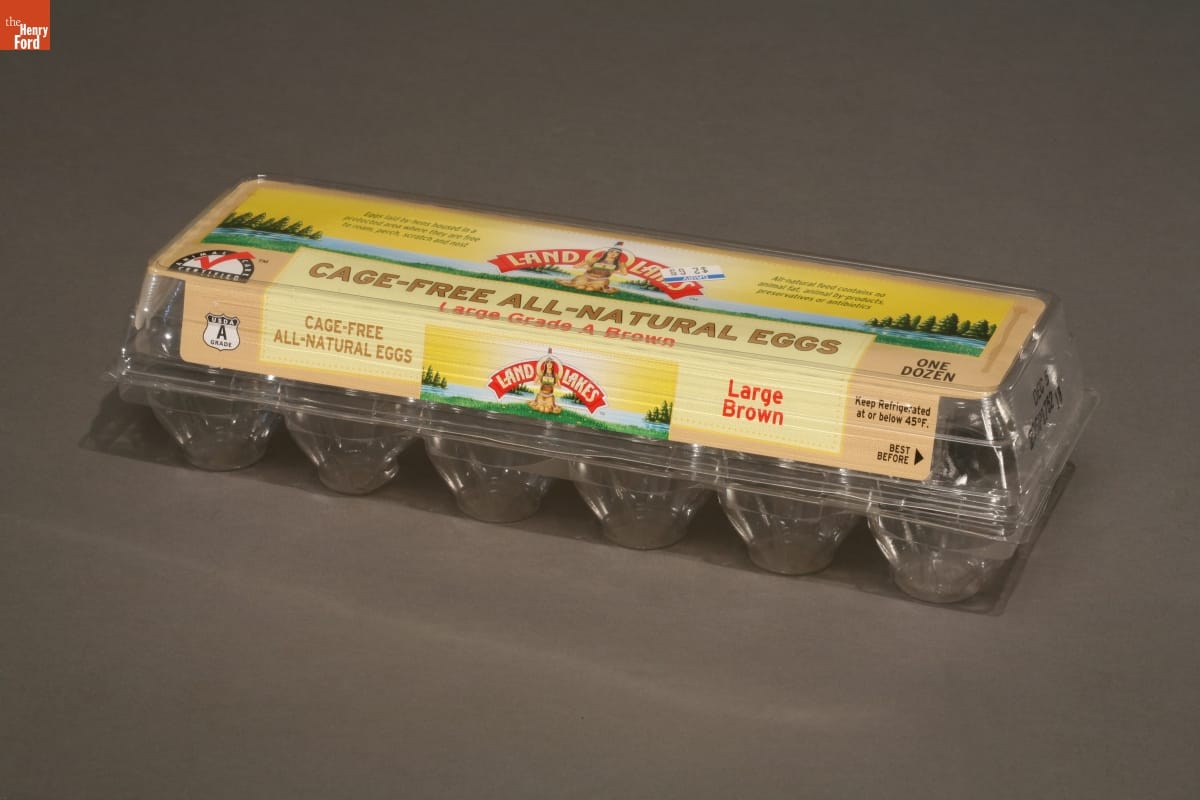
View ArtifactLand O' Lakes Egg Carton, 2008
By the early 2000s, major U.S. egg producers raised massive flocks of hens in cramped conditions. Ironically, these producers marketed some of their eggs as "cage free" or "free range." Although terms like these often misrepresented the true conditions for hens on large-scale egg farms, they appealed to consumers who were concerned about animal welfare (and willing to pay more for it).
View Artifact

