
Fair Lane: The Fords' Private Railroad Car
Share
share
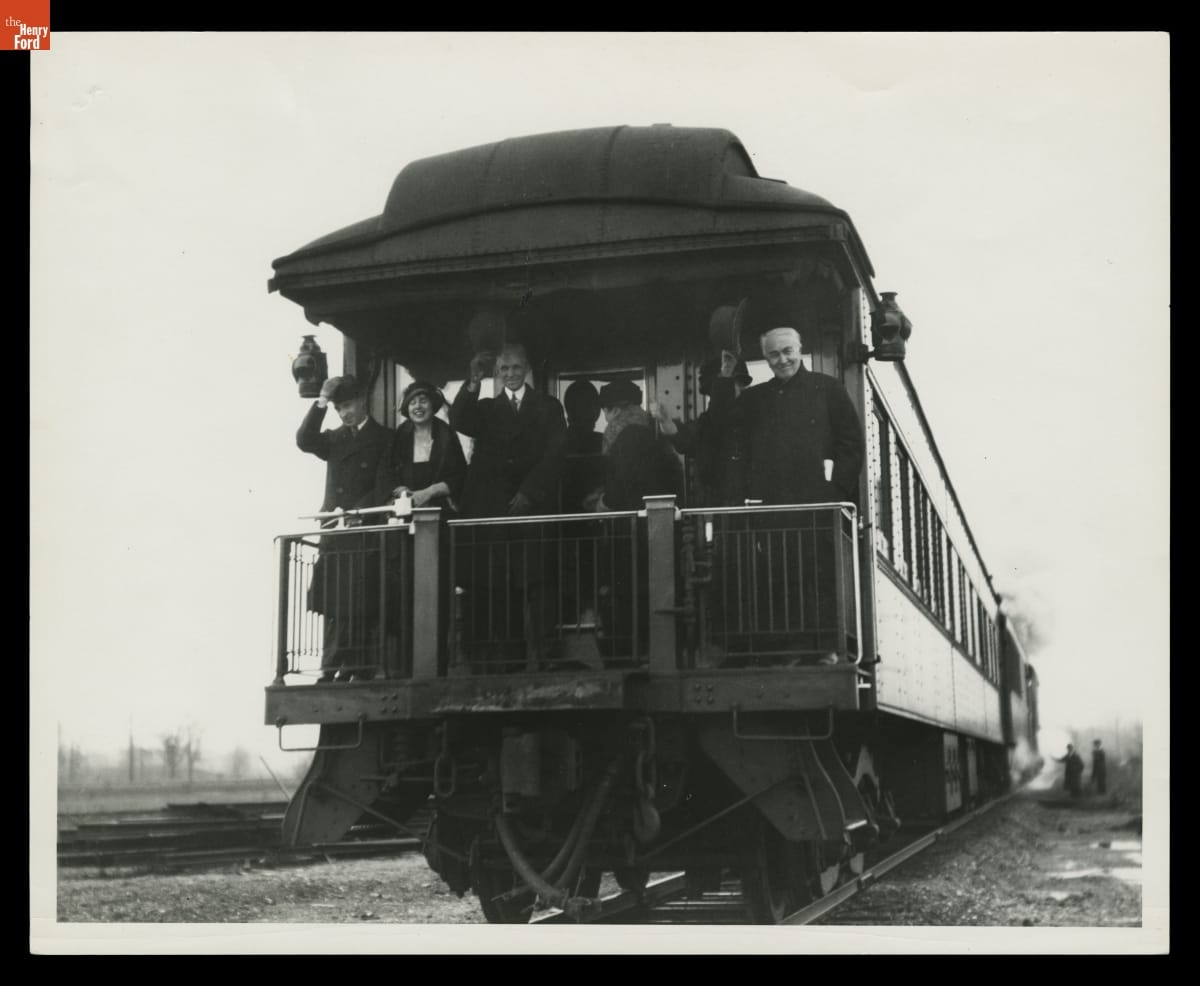
By 1920, Henry and Clara Ford found it difficult to travel by railroad. Henry Ford was widely recognized -- pestered by the public and hounded by reporters. The Fords purchased a private railroad car they called Fair Lane, so they could travel conveniently and quietly across the extensive American railroad network. The Fords made more than 400 trips with Fair Lane from 1921 to 1942.
THF203195
Railroad Passenger Train, circa 1840
America's first common-carrier railroad, the Baltimore & Ohio, began regular passenger service in 1830. The first private railroad cars appeared soon after that. President John Tyler traveled by private car on the Camden & Amboy Railroad, to dedicate Boston's Bunker Hill Monument, in 1843.
View ArtifactPortrait of Cornelius Vanderbilt, circa 1860
Not surprisingly, railroad officials like New York Central Railroad president Cornelius Vanderbilt were early and frequent private car users. These cars served as mobile workspaces where business could be conducted at distant points on the railroad line, far from company headquarters.
View ArtifactModern Train from New York, to Sacramento, California, with Pullman's Palace Cars, circa 1870
In the 1870s, the Pullman Palace Car Company earned a reputation for its opulent public passenger cars. They featured comfortable seating and sleeping accommodations, and added a touch of luxury for first-class ticket holders. Company founder George Pullman designed a private railcar that the company rented for $85 a day -- over $2,000 today.
View ArtifactClara Ford and Henry Ford in the Peony Garden at Fair Lane, Dearborn, Michigan, 1923
Like a modern business jet, a private railroad car could be chartered or purchased outright. Clara and Henry Ford purchased their car, placing the order with the Pullman Company on February 18, 1920. The Fords hoped to have the car by that fall for a planned trip. But delays pushed the delivery date to June 23, 1921.
View ArtifactHoughton Studio Catalog, "Houghtons...Design & Manufacture of Decoration, Furniture, Etc.," 1925-1928
Some of that delay was due to changes to the railroad car's planned interior appointments and finishes. Clara Ford designed the car's interior in consultation with Sidney Houghton of London. Houghton had earlier provided the same service for the Fords' yacht Sialia.
View ArtifactHenry Ford's Home, Fair Lane, Reflected in the Rouge River, circa 1920
The Fords named their railroad car Fair Lane, the same name they gave to their estate in Dearborn, Michigan. The name came from the area in County Cork, Ireland, where Mr. Ford's grandfather was born. The railcar cost $159,000 -- some $2.3 million today. The Fords paid 25 percent at order, 25 percent during construction, and the remaining 50 percent upon delivery.
View ArtifactHenry Ford's Private Railroad Car, "Fair Lane," outside Henry Ford Museum, November 12, 1942
Surely the finished Fair Lane was worth the wait and expense. The car included accommodations for six passengers, sleeping quarters for staff, and a kitchen. When traveling, Fair Lane was staffed by a porter to attend to the passengers' needs, and a cook to prepare meals.
View ArtifactInterior of Henry Ford's Private Railroad Car, "Fair Lane," June 22, 1921
At the rear of the car, a comfortable lounge area provided space to read, relax, or watch the passing scenery. Generally, Fair Lane was coupled to the very end of a train, so the Fords could enjoy the porch-like open platform as well.
View ArtifactInterior of Henry Ford's Private Railroad Car, "Fair Lane," June 22, 1921
From the lounge, a narrow hallway ran most of the car's length. Four bedrooms were located along the corridor, and a dining area at the end. The dining table comfortably seated six adults. The chandelier was secured with guys that kept it from swaying as the car moved. The dining space was close to the kitchen at the car's front.
View ArtifactAerial View of the Ford Engineering Laboratory and Ford Airport, April 25, 1927
When not traveling, Fair Lane sat in a shed near Henry Ford's flour mill in Dearborn. The mill (though not the shed) is visible at bottom right in this photo. The shed sat alongside the New York Central Railroad's Michigan Central line. Generally, NYC coordinated the car's travels -- though it might run on multiple railroads in the course of a trip.
View Artifact"Aeroplane View, Michigan Central Terminal, Detroit, Michigan," circa 1915
Usually, Fair Lane was coupled to a regularly scheduled passenger train. The fee was equivalent to 25 standard passenger tickets. For a run from Detroit to New York at the time, that was around $750 -- about $10,000 today when adjusted for inflation. If Fair Lane was moved by a special train, the fee ballooned to the equivalent of 125 standard passenger tickets.
View ArtifactHenry Ford aboard the Detroit, Toledo & Ironton Railroad #7 Locomotive at Ford Rouge Plant, 1921
Fees were different on the Detroit, Toledo & Ironton Railroad -- because Henry Ford owned DT&I from 1920 to 1929. Travels by Mr. Ford on DT&I were considered railroad business, so he paid no fare himself. But Ford did pay fares for Fair Lane passengers who weren't associated with DT&I.
View ArtifactHenry Ford at Wilson Dam, near Muscle Shoals, Alabama, 1921
The Fords made quick use of Fair Lane, taking several trips in 1921. The first was to Decatur, Alabama, where Henry Ford was working on a hydroelectric project on the Tennessee River at Muscle Shoals. The round trip cost $730.08 -- nearly $11,000 today.
View ArtifactFord Motor Company Branch in Iron Mountain, Michigan, June 2, 1924
In the fall of 1921, the Fords traveled with Fair Lane to Iron Mountain in Michigan's Upper Peninsula. Ford Motor Company operated a sawmill and factory there that produced wooden bodies for Ford automobiles.
View ArtifactUnion Station, Washington, D.C., circa 1913
Washington, D.C., was a frequent destination for Fair Lane. Both Henry Ford and Edsel Ford traveled to the nation's capital to meet with government officials, or to lobby on behalf of Ford Motor Company or the automotive industry generally. Washington Union Station is steps away from the United States Capitol building.
View ArtifactPennant, "Traverse City, Mich.," 1940-1965
Among the closer destinations in the Fair Lane travel log was Traverse City, Michigan, located some 250 miles northwest of Detroit. Round trip charges for a January 1924 visit there totaled $550, including a one-day parking fee for Fair Lane in Traverse City.
View ArtifactNorth Along Michigan Boulevard, Chicago, Illinois, 1910-1915
In terms of logistics, Chicago was among the simplest destinations to reach. The Windy City was the western terminus of New York Central's Michigan Central Railroad, with Dearborn and Detroit at its eastern end. Fair Lane could travel from its Dearborn storage shed to Chicago and back all on a single railroad line.
View ArtifactInterior of Grand Central Station, New York City, Postcard Mailed July 30, 1948
New York City was a favorite destination for Mrs. Ford. Fair Lane was often attached to direct Detroit-New York trains like the Wolverine or the Detroiter. Those trains arrived at Grand Central Terminal in the heart of Manhattan. In 1922, the overnight run from Detroit to New York on the Wolverine took 16 hours.
View Artifact"North Station, Boston, Massachusetts," circa 1905
On a trip to Boston by the Fords in May 1926, the Boston & Albany Railroad charged $239.80 to store Fair Lane in a railyard for three days. B&A, like Michigan Central, was a New York Central subsidiary, meaning the Fords could travel directly to Boston from Detroit. B&A served Boston's South Station, though North Station is pictured here.
View Artifact"The Mangoes," Henry and Clara Ford's Residence in Fort Myers, Florida, circa 1920
Starting in 1922, Henry and Clara Ford took Fair Lane to their winter home in Fort Myers, Florida. The Fords purchased The Mangoes -- located next to the winter estate of their friends Thomas and Mina Edison -- in 1916. They visited less often after Mr. Edison's death in 1931. The Fords sold The Mangoes in 1945.
View ArtifactAerial View, Richmond Hill, Georgia, circa 1947
The Fords built a new winter home near Savannah, Georgia, in 1936. Each year, Fair Lane carried them to Ways Station, Georgia, the closest point on the Atlantic Coast Line Railroad to the estate they named Richmond Hill. The Fords established a sizeable agricultural operation there, and they constructed housing, schools, and amenities for area residents.
View ArtifactPanoramic View of Seal Harbor, Maine, 1927
Edsel and Eleanor Ford, Henry and Clara Ford's son and daughter-in-law, regularly used Fair Lane with their own family. The younger Fords took the car when traveling to Skylands, their vacation home in Seal Harbor, Maine. Railroads didn't directly serve Mount Desert Island -- where Seal Harbor is located -- so the Fords journeyed the last few miles by boat.
View ArtifactEdsel and Eleanor Ford, Henry and Clara Ford, and Mina and Thomas Edison on the Private Railroad Car "Fair Lane," circa 1923
Fair Lane carried its share of special guests over the years. Thomas and Mina Edison posed with Henry and Clara Ford, and with Edsel and Eleanor Ford, for this group portrait on the rear platform circa 1923. At other times, guests aboard the car included Presidents Warren Harding and Calvin Coolidge, and humorist Will Rogers.
View ArtifactHenry Ford's Private Railroad Car, "Fair Lane," November 12, 1942
Altogether, the Fords made more than 400 trips on Fair Lane. But by the early 1940s, their aging railcar needed work. Restrictions brought on by World War II made repairing or replacing -- or even using -- the private railroad car difficult. Henry and Clara Ford reluctantly sold Fair Lane in 1942.
View ArtifactHenry Ford's Private Railroad Car "Fair Lane," 1921
Following the sale, Fair Lane served as a railroad business car for the St. Louis Southwestern Railway, and then as an office space for the Cherokee Nation in Tahlequah, Oklahoma. Richard and Linda Kughn bought the railcar in 1982, restored it, and gifted it to The Henry Ford in 1996.
View Artifact

