
Featured on The Henry Ford’s Innovation Nation: Season 10
Share
share
These key artifacts appeared on the tenth season of The Henry Ford's Innovation Nation. For episode information, please visit https://www.thehenryford.org/explore/innovation-nation/episodes.
THF119789
Montgomery Ward & Co. Sales Catalog, Fall & Winter, 1894
In 1872, Montgomery Ward & Company launched America's first general mail order company. Through their catalogs, the company offered a broad selection of goods at affordable prices. Other retailers would follow. But as this 1894-1895 catalog proudly states, Montgomery Ward & Company were the "Originators of the Mail Order Business."
View ArtifactTHF15919
1927 Plymouth Gasoline-Mechanical Locomotive
Because they didn't use the coal and water required by steam engines, Plymouth gasoline locomotives were well suited to small industrial railroads. This engine shuttled coal cars at the Mistersky Power Plant in Detroit. Unlike modern diesel locomotives, which operate via electric motors powered by on-board generators, this locomotive's gas engine is mechanically connected to its wheels.
View ArtifactTHF705425
Advertisement, R.H. Spalding Fluid and Oil Chandeliers, 1854
THF191163
Cane Handle Models on Display Board, 2014-2015
Starting in the early 1980s--and already established as an internationally recognized architect--Michael Graves began to pursue a parallel career as a product designer. Over the following three and a half decades he and his collaborators designed everything from humble household goods to limited edition luxury items for clients as diverse as Steuben, Alessi, Target, J. C. Penney, and Disney.
View ArtifactTHF190466
Detroit Central Market, Built 1860
The Detroit Central Market's vegetable shed sheltered vendors and customers from 1861 to 1894. The structure was then removed to Belle Isle and was slated for demolition in 2003 when The Henry Ford acquired it. The reconstructed building--which opened in Greenfield Village in 2022--includes several original cast-iron columns and ornamental woodwork, siding, and other details that convey the Swiss-Chalet aesthetic of the original design.
View ArtifactTHF119939
Sears, Roebuck and Company Mail-Order Catalog, "Consumers Guide, 1901," Catalogue No. 111
By 1900, Sears, Roebuck and Company was one of the greatest merchandisers in the world. Flipping through the catalogs of this mail order giant brought a visual feast of tens of thousands of products. For farm families especially, mail order catalogs opened a world of new material possibilities, offering many goods similar to those found in America's burgeoning cities.
View ArtifactTHF175172
Daggett Farmhouse
Like other farm families living in northeastern Connecticut in the 1760s, the Daggetts made and grew many of the things they needed. Along with farming, Samuel Daggett was a house builder and furniture maker. The "saltbox" form of this house -- with short roof in front and long in back -- was a typical New England house type of this era.
View ArtifactTHF186037
1974 Warrior Concept Car
When McKinley Thompson, Jr., joined Ford Motor Company in 1956, he was one of the automotive industry's first African American designers. In 1974 he completed a rugged, easy-to-build vehicle designed for developing countries: the Warrior. Thompson's prototype, built on a Renault 10 chassis, featured a buoyant plastic body and a removable top. Thompson couldn't interest automakers or investors in his bold idea.
View ArtifactTHF160921
Bandbox, Made by Hannah Davis, circa 1840
Hannah Davis (1784-1863), a Jaffrey, New Hampshire, entrepreneur, created colorful, wallpaper-covered bandboxes. Davis sold many of her bandboxes to the young, migrant women who worked in the textile mills in the surrounding New England villages. Davis's attractive and affordable bandboxes were ideal for the millworkers. The boxes could hold clothing and accessories and they served as useful storage cases when the women traveled home.
View ArtifactTHF188527
"Haon's Kral AI-202" by Lillian F. Schwartz, 1989
Lillian Schwartz is a pioneer of computer-generated art. From 1969-2002, she was a "resident visitor" at Bell Laboratories, producing groundbreaking films, videos, and multimedia works. The Schwartz Collection spans Lillian's childhood into her late career, documenting an expansive mindset, mastery over traditional and experimental mediums alike--and above all--an ability to create inspirational connections between science, art, and technology.
View ArtifactTHF131127
1970 Meyers Manx Dune Buggy
The Meyers Manx was a famous model of the dune buggies first built for use on the beaches of California. Less than $1,000 bought a fiberglass body, a windshield and a hood. Buyers supplied the rest from a used Volkswagen Beetle, plus the labor to assemble the parts. A teenager from Birmingham, Michigan, built this one with his grandfather.
View ArtifactTHF154923
Travelpro Rolling Carry-On Suitcase, 1997
Airline deregulation in the 1980s and 1990s created an explosive growth in air travel. As airports grew in size to accommodate more flights, most travelers raced through expansive concourses carrying their own luggage. Roller bags created in the late 1980s provided relief.
View ArtifactTHF704705
"The Gibson Bathing Girl," 1907
Charles Dana Gibson's illustrations of beautiful, independent young women reflected and helped define a new ideal of American femininity in the 1890s and early 1900s. These popular images, known collectively as "the Gibson Girl," became a cultural phenomenon referenced in fashion and entertainment. A powerful marketing tool, the widely imitated Gibson Girl proliferated in advertisements and on product packaging.
View ArtifactTHF91419
1991 Ford Explorer Sport Utility Vehicle
Sport utility vehicles -- boxy light trucks with high ground clearance, substantial cargo capacity, and often featuring four-wheel drive -- were long used by people living in rural areas. In the late 1980s urban families adopted them as replacements for minivans. The 1991 Explorer was Ford's entry into this new market and soon became the bestselling vehicle in the class.
View ArtifactTHF370313
"Proxima Centauri" by Lillian F. Schwartz with Per Biorn, 1968
Lillian Schwartz is a pioneer of computer-generated art. From 1969-2002, she was a "resident visitor" at Bell Laboratories, producing groundbreaking films, videos, and multimedia works. The Schwartz Collection spans Lillian's childhood into her late career, documenting an expansive mindset, mastery over traditional and experimental mediums alike--and above all--an ability to create inspirational connections between science, art, and technology.
View ArtifactTHF191319
Prototype Sarah Lounge & Rocker Combination Chair, 1987-1991
THF704730
"Arrow Collars and Shirts," Advertisement from Collier's Magazine, 1912
Commercial illustrator J.C. Leyendecker (1874-1951) produced illustrations of handsome men who exuded style and sophistication for a long-running campaign advertising Cluett Peabody & Co.'s line of Arrow brand shirts, collars, and cuffs. These popular images, known collectively as the Arrow Collar Man, became a cultural phenomenon that set a new standard for men’s fashion and beauty.
View ArtifactTHF2996
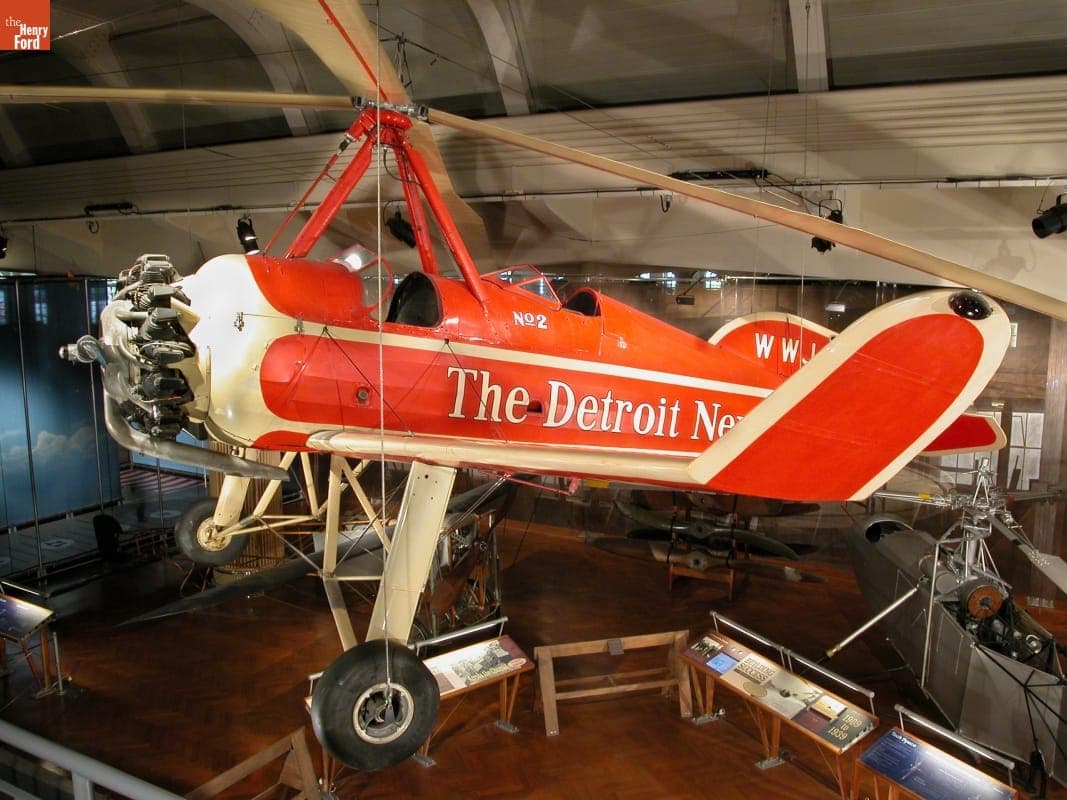
1931 Pitcairn-Cierva Autogiro
Like an airplane, the autogiro is moved by an engine-powered propeller, but like a helicopter, lift is provided by a rotor. The rotor is not powered, and while the aircraft can land vertically, it cannot take off vertically. The Detroit News purchased this autogiro to gather news. The novel aircraft probably was better at making news!
View Artifact

