
Henry Ford and Abraham Lincoln
Share
share
Henry Ford admired Abraham Lincoln’s humble character and his embodiment of the “self-made man.” Ford collected many Lincoln-related artifacts, some associated with the Lincoln legend, others actually used by Abraham and Mary Todd Lincoln.
THF159011
Chair Allegedly Made from Rails Split by Abraham Lincoln, circa 1929
Henry Ford admired Lincoln's down-to-earth, frontier character. The image of Lincoln as the "rail splitter" is central to that theme - it emerged during the 1860 Illinois Republican nominating convention when Lincoln's cousin emerged with a banner constructed of rails split by Lincoln and the audience went wild. This chair, acquired by Henry Ford, was said to consist of fence rails split by Lincoln.
View ArtifactTHF153301
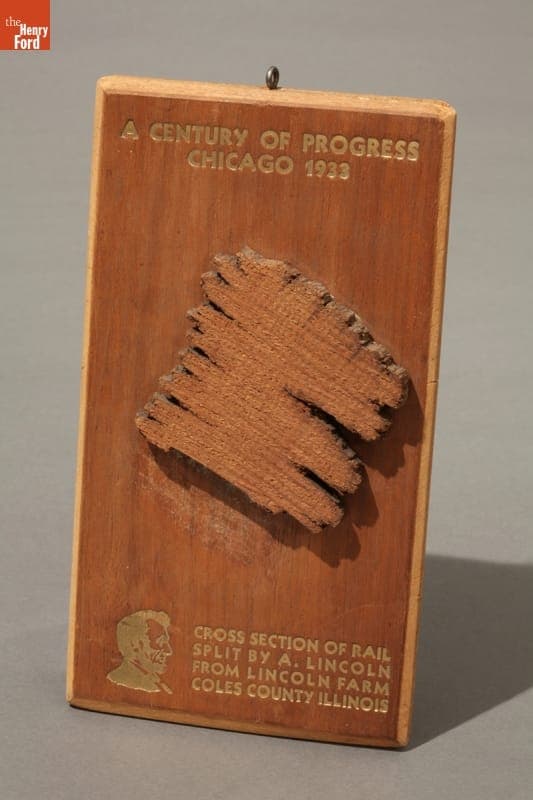
Century of Progress Souvenir, Cross Section of Rail Split by Abraham Lincoln, 1933
Henry Ford admired Lincoln's down-to-earth, frontier character. The image of Lincoln as the "rail splitter" is central to that theme - it emerged during the 1860 Illinois Republican nominating convention when Lincoln's cousin emerged with a banner constructed of rails split by Lincoln and the audience went wild. This fragment of a split rail was retailed at the 1933 Chicago World's Fair.
View ArtifactTHF121090
Abraham Lincoln Wedgwood Plate, circa 1906
This souvenir pictorial plate was made as a Christmas 1906 premium for the Springfield, Illinois merchant, R.N. Herndon. Herndon's retailed mostly women's and children's clothing, specializing in gloves from 1866 to 1978. Collected by the Museum in 1931, the plate was one of the earliest Lincoln souvenirs - illustrating Augustus Saint Gaudens' Standing Lincoln sculpture and the Lincoln Home and Monument.
View ArtifactTHF121089
Square Piano, 1841
Henry Ford collected many Lincoln-related artifacts, including this piano acquired as a relic from Abraham Lincoln's White House. Research since indicates that it was made by the Chickering Company of Boston, Massachusetts, in 1841 and had a history in the Boston area. There is no evidence that this object ever graced the White House, although it was chronologically possible.
View ArtifactTHF1858
Logan County Courthouse
Between 1840 and 1847, Abraham Lincoln tried cases here as a traveling lawyer. Visiting once or twice a year, he worked mostly on cases resolving neighbors' disagreements over land, contracts, and debts. As Lincoln traveled, people got to know him because he always took time to talk to them. This helped him earn votes later when he went into politics.
View ArtifactTHF159006
Walking Stick, 1861-1863, Allegedly Owned by Abraham Lincoln
Henry Ford collected many Lincoln-related artifacts, including this richly carved walking stick, containing images related to Emancipation. Its short length and notched peg at the end suggest that it is a handle once attached to a longer shaft. Our files hold affidavits by previous owners testifying that the stick was owned by the assassinated president. Whatever its origins, this is a remarkable example of Folk Art.
View ArtifactTHF159031
Split Rail, Said to Be Split by Abraham Lincoln
Henry Ford admired Lincoln's down-to-earth, frontier character. The image of Lincoln as the "rail splitter" is central to that theme - it emerged during the 1860 Illinois Republican nominating convention when Lincoln's cousin emerged with a banner constructed of rails split by Lincoln and the audience went wild. Henry Ford acquired a group of rails said to have been split by Abraham Lincoln.
View ArtifactTHF121394
Charles Roscoe Miles with Henry Ford in Greenfield Village, October 1934
Henry Ford admired Lincoln's character and collected many Lincoln-related artifacts, including the Logan County, Illinois, courthouse in which Lincoln practiced law in the 1840s. Here, Mr. Ford stands outside the courthouse with Lincoln portrayer Charles Roscoe Miles. Miles was a distant relative of Lincoln's and used his resemblance to the president to support himself during the Great Depression.
View ArtifactTHF121380
Interior View of Logan County Courthouse in Greenfield Village, March 1935
Henry Ford admired Lincoln's character and his embodiment of the ideals of the "self-made man." Ford collected many Lincoln-related artifacts, including the Logan County, Illinois, courthouse in which Lincoln had practiced law in the 1840s. This photograph, taken in the 1930s, shows how Mr. Ford displayed furniture from the Lincolns' Springfield home, acquired to honor Lincoln and provide visitors with a sense of the time period.
View ArtifactTHF121383
Interior View of Logan County Courthouse in Greenfield Village, 1953
Henry Ford admired Lincoln's character and his embodiment of the ideals of the "self-made man." Ford collected many Lincoln-related artifacts, including the Logan County, Illinois, courthouse in which Lincoln had practiced law during the 1840s. This view, taken in the 1950s, shows furniture from the Lincolns' Springfield home and the chair from Ford's Theatre in which Lincoln was assassinated.
View ArtifactTHF121385
Interior of Logan County Courthouse in Greenfield Village, April 1954
Henry Ford admired Lincoln's character and his embodiment of the ideals of the "self-made man." Ford collected many Lincoln-related artifacts, including the Logan County, Illinois, courthouse in which Lincoln had practiced law in the 1840s. This photograph, taken in the 1930s, shows how Mr. Ford displayed furniture from the Lincolns' Springfield home, acquired to honor Lincoln and provide visitors with a sense of the time period.
View Artifact

