
Just Added to Our Digital Collections
Share
share
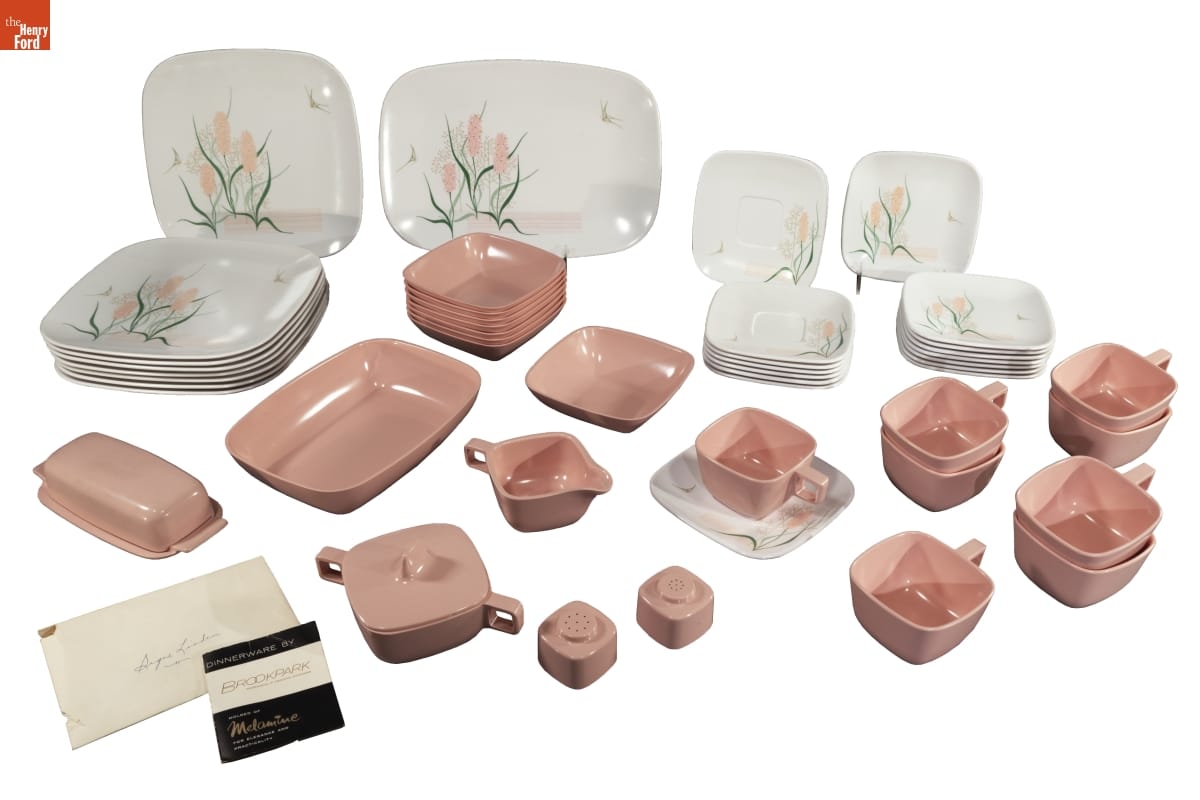
Browse selected artifacts recently added to The Henry Ford's Digital Collections. These are just a handful of the more than 300 new items digitized in October 2022.
THF191935
Bowl, 1930-1950
Detroit's Pewabic Pottery was founded by artist Mary Chase Perry in 1903 as part of the American Arts and Crafts movement. The pottery is known for the iridescent glazes on its tiles and vessels. This vase exhibits the iridescent surfaces for which Pewabic was renowned. The blue-glazed interior contrasts with the gold on the exterior, heightening this effect.
View ArtifactSign for War Bond Drive at Ford Motor Company Rouge Plant Pressed Steel Building, December 1944
The U.S. government held bond drives during World War II to encourage Americans to support the war effort. Average citizens could invest in bonds where they worked, and many companies set goals for their employees to meet. Promotions for these campaigns--some depicting racist caricatures--often appealed to Americans' sense of patriotism to help raise money to defeat the enemy.
View ArtifactBlaisdell Grease Pencil, Used by Lillian F. Schwartz
Lillian Schwartz is a pioneer of computer-generated art. From 1969-2002, she was a "resident visitor" at Bell Laboratories, producing groundbreaking films, videos, and multimedia works. The Schwartz Collection spans Lillian's childhood into her late career, documenting an expansive mindset, mastery over traditional and experimental mediums alike--and above all--an ability to create inspirational connections between science, art, and technology.
View ArtifactEverlast "Forged" Pitcher and Mugs, 1938-1960
In 1932, Louis Schnitzer and Nathan Gelfman formed Everlast Metal Products Corporation, producing high-quality, hand-forged aluminum giftware. In an era of growing uniformity via factory production, the "made by hand" aspect of these products held an aesthetic appeal for consumers. In 1933, Everlast introduced its first product line, "Forged Giftware" featuring Colonial Revival inspired designs.
View Artifact"The Saturday Evening Post," March 18, 1905
The Saturday Evening Post, first published in 1821 as a four-page weekly newspaper, became one of America's most popular weekly publications by the mid-1900s. The magazine contained news, commentaries, fiction, and general interest articles. But its most distinctive feature was its front cover illustrations by artists such as George Hughes, John Falter, J.C. Leyendecker, and Norman Rockwell.
View ArtifactKitchen Timer, 2000
Starting in the early 1980s--and already established as an internationally recognized architect--Michael Graves began to pursue a parallel career as a product designer. Over the following three and a half decades he and his collaborators designed everything from humble household goods to limited edition luxury items for clients as diverse as Steuben, Alessi, Target, J. C. Penney, and Disney.
View ArtifactDismantling Daggett Farmhouse in Connecticut for the Move to Greenfield Village, 1977
In 1977, Henry Ford Museum acquired an 18th-century farmhouse from northeastern Connecticut. Skilled workers dismantled the home and rebuilt it in Greenfield Village using hand construction methods. It was originally interpreted with a focus on architecture and antiques, but furnishings and demonstrations in the home now recreate the life of its original occupants, the Daggett family, in the 1760s.
View Artifact

