
Lesson: Forces in Automobile Racing
Share
share
Lesson 2 of "Physics, Technology and Engineering in Automobile Racing"
THF69252
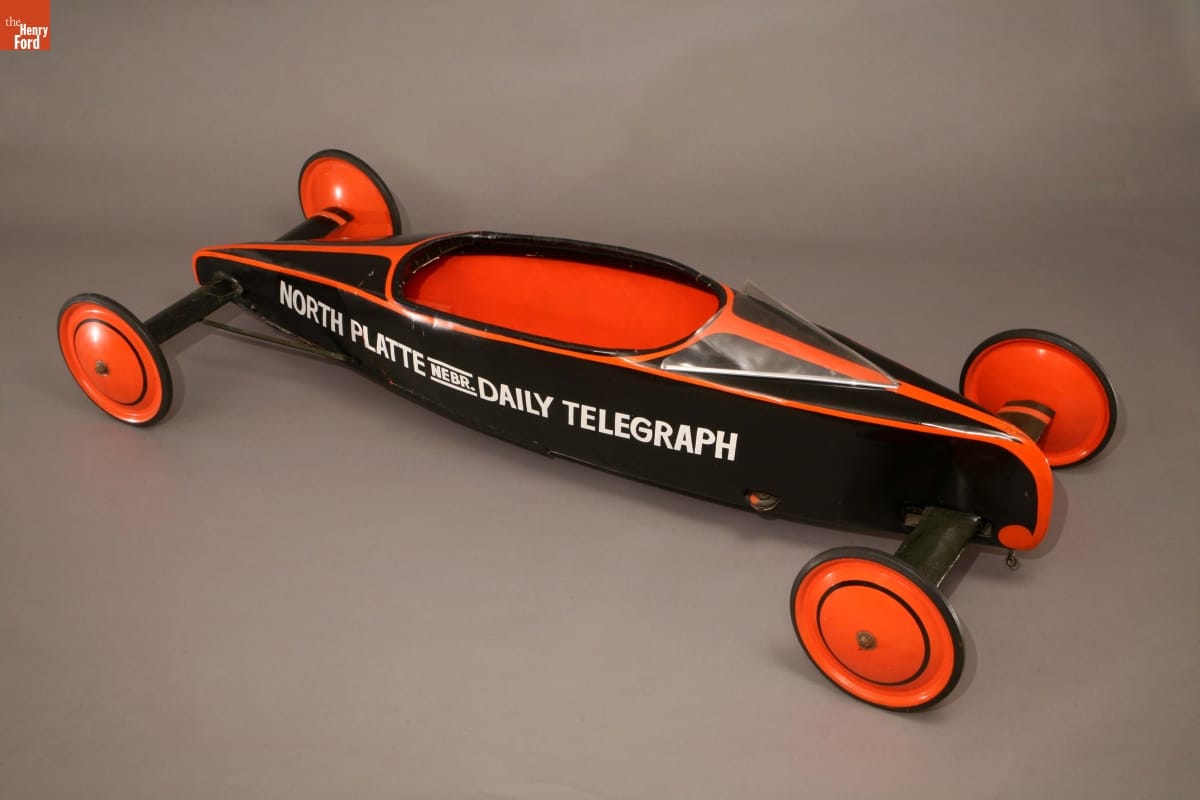
1939 Soap Box Derby Car
Mason Colbert placed third with this car in the 1939 All-American Soap Box Derby national championship in Akron, Ohio. The first official derby was held in 1934. Young contestants built their cars from soap boxes, orange crates, and baby carriage wheels. Over the years, designs became more elaborate and materials more sophisticated. But the "fuel" remained the same -- gravity.
View ArtifactOfficial Start of First NHRA Drag Racing Meet, Great Bend, Kansas, 1955
The National Hot Rod Association, established in 1951 to govern drag racing, held its first national championship meet in 1955. The event took place on an airport runway in Great Bend, Kansas. Drag races run like tournaments. Two cars at a time face off, the winner advances, and the loser is eliminated. The last remaining driver earns the grand prize.
View ArtifactThree Men Pushing a Barber-Warnock Special Race Car off the Track at Indianapolis Motor Speedway, probably 1924
Hale Barber and Clarence Warnock established the Barber-Warnock Ford dealership in Indianapolis in 1917 and were active supporters of the Indianapolis 500 race on a 2.5-mile oval track originally paved with brick and one of the most popular and well-known races in the country. In the mid-1920s, Barber-Warnock moved from fans and supporters to participants by sponsoring specially built Model Ts. In 1924, Barber-Warnock entered three "specials" built by the Chevrolet brothers -- Louis, Gaston, and Arthur -- under the Frontenac name. Although fairly powerful and fast, the "Fronty Fords" were no match for the rest of the field, finishing a disappointing 14th, 16th, and 17th.
View Artifact1907 Ford "666" Race Car, Driven by Frank Kulick
This is one of Henry Ford's least successful race cars. Built in 1907, its six-cylinder engine inspired the car's name, "666." There is no body or suspension, and the combination brake and clutch is controlled by a single lever. Driver Frank Kulick was badly injured when the car crashed at the Michigan State Fairgrounds that fall. "666" never raced again.
View Artifact1960 Buck & Thompson Slingshot Dragster
Sam Buck and Bob Thompson built this car in 1960. They bought the chassis as a kit, and the 1948 Ford engine was highly modified with special cylinder heads, crank, pistons, magneto, camshaft, and fuel injectors. In this style of dragster, popular from the mid-1950s through the early 1970s, the driver sat behind the rear wheels "like a rock in a slingshot."
View ArtifactHenry Ford Driving the 999 Race Car Against Harkness at Grosse Pointe Racetrack, 1903
Image originally published in the May 1903 issue of Munsey's Magazine captioned, "At full speed a trial brush between Messers [Henry] Ford (car to the left of the picture) and [Harry] Harkness." Less than a month before Ford Motor Company's founding, Henry Ford was still interested in automobile racing and the benefits to be gained in experimenting with parts of chassis, bodies, and engines that could be integrated into his future automobiles. Ford used trial races like this to test his experimental ideas.
View ArtifactDave Lewis's Race Car Stopped on the Board Track at Altoona Speedway, Tipton, Pennsylvania, 1925
In 1925, pit stops looked very different than those seen in today's motorsports. Pit crews were smaller and stops lasted much longer. Dave Lewis returned to the pit during this race and a broken connecting rod prevented him from finishing. He only made it through 36 laps out of 200, resulting in a last place finish.
View Artifact1984 March 84C-Cosworth Race Car
Tom Sneva set the fastest qualifying lap at the 1984 Indianapolis 500 with this car, but a broken rear suspension forced him out early during the actual race. The car's front and rear wings and underbody ground effects represent the aerodynamic advances that increasingly shaped race cars in the 1970s -- and continue to do so today.
View ArtifactLeon Duray Being Timed at Culver City Speedway, California, 1927
Leon Duray crossed the finish line in first place on March 6, 1927 at Culver City Speedway. From 1910-1930, most major American auto races were contested on tracks made of wood. These oval-shaped "board tracks" had high banked turns that allowed very high speeds but were also very dangerous.
View Artifact1933 Willys Drag Racer
When machinist George Montgomery started racing in 1953, all drag racers were amateurs with "real jobs" supporting their hobby. This car helped change all that. Montgomery bought an old Willys in 1958 and built a dragster so successful that promoters started paying him to run at drag strips nationwide. In 1966, Montgomery became one of drag racing's first full-time professional drivers.
View Artifact1902 Ford "999" Race Car, Built by Henry Ford
Henry Ford hired a fearless bicycle racer named Barney Oldfield to drive "999." Although he had never driven a car, Oldfield learned quickly and won his first competition. He went on to become America's first nationally famous racing hero, known for his thrilling exhibition races and the trademark cigar he chewed to protect his teeth in a crash.
View ArtifactDamaged Race Car After a Racing Accident, 1905-1915
Automobile racing has been a dangerous sport for drivers and fans. The thrill and excitement of pushing powerful machines to their limits at unheard of speeds drew drivers to the sport and fans to the roadsides and tracks. Sometimes, things could go very wrong as in this photo showing the aftermath of a car that broke through a wooden fence. It is not known how the driver, and fans, fared but it is safe to assume that everyone had a thrill that day.
View Artifact1987 Ford Thunderbird Stock Car, Raced by Bill Elliott
Bill Elliott set NASCAR's all-time speed record with this car when he qualified for the 1987 Winston 500 at Talladega at 212.809 miles per hour. By the 1980s, "stock cars" only looked stock. Underneath this Thunderbird sheet metal is a purpose-built steel tube frame, racing suspension and brakes, and a racing engine that no Ford dealer ever sold.
View Artifact

