
Lesson: The Study of Motion Using Artifacts
Share
share
Lesson 3 of "Physics, Technology and Engineering in Automobile Racing"
THF68329
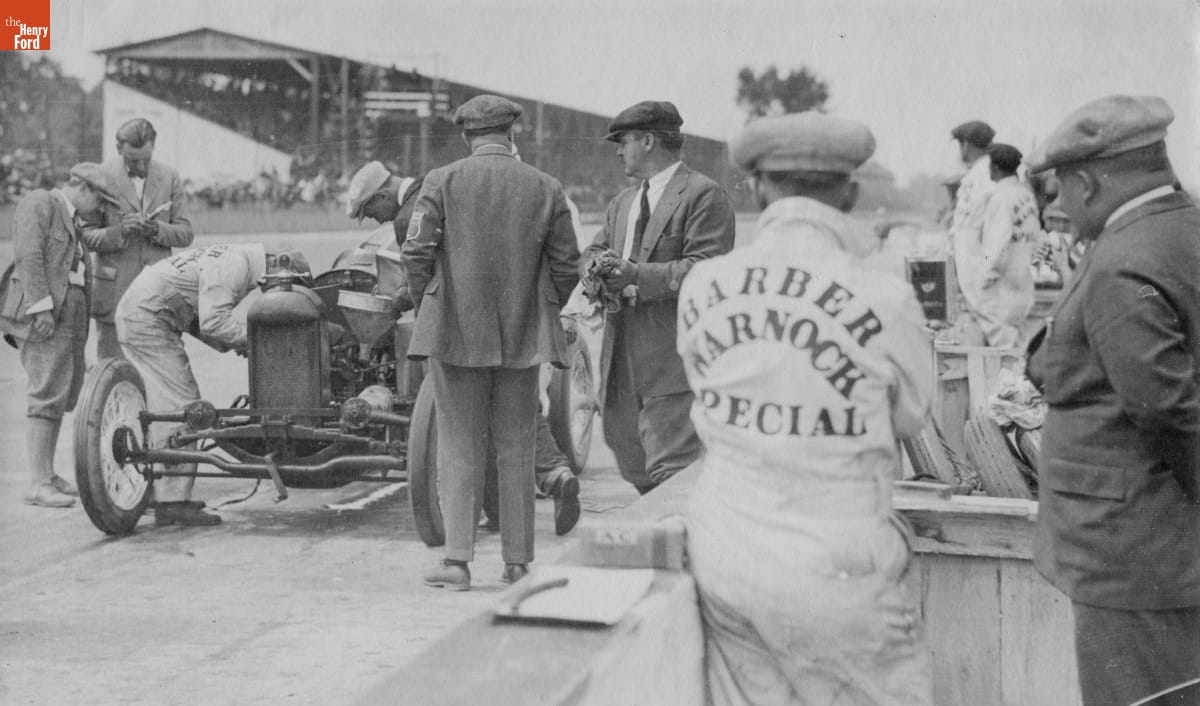
Barber-Warnock Special Race Car in Pit at Indianapolis Motor Speedway, 1924
When did Fords use Chevrolet parts? In the 1920s, when brothers Louis and Arthur Chevrolet made special overhead valve cylinder heads for Model Ts. Sold under the brand name Frontenac, they helped racers triple the horsepower of the stock Model T engine. Such "Fronty-Fords" became terrors on the small dirt tracks and in 1923 and 1924 Indianapolis auto dealer Barber-Warnock Ford decided to enter Fronty-Ford powered cars in the Indianapolis 500. Here we see one of the 1924 cars being serviced in the pits. A mechanic with a funnel adds oil, while another mechanic on the opposite side of the car makes an adjustment. Arthur Chevrolet, wearing a tie and a flat cap, wipes his hands in the middle of the picture. Three men in suits, possibly race officials, observe the scene. The Barber-Warnock cars finished fifth in the 1923 race and 14th, 16th, and 17th in 1924.
View ArtifactHenry Ford Driving the 999 Race Car Against Harkness at Grosse Pointe Racetrack, 1903
Image originally published in the May 1903 issue of Munsey's Magazine captioned, "At full speed a trial brush between Messers [Henry] Ford (car to the left of the picture) and [Harry] Harkness." Less than a month before Ford Motor Company's founding, Henry Ford was still interested in automobile racing and the benefits to be gained in experimenting with parts of chassis, bodies, and engines that could be integrated into his future automobiles. Ford used trial races like this to test his experimental ideas.
View ArtifactTiming Slip From Oswego Dragway, Used with Buck & Thompson Slingshot Dragster, 1963
Drag racing is racing in its simplest form. From a standing start, two cars race to the finish line one-quarter mile away. After the run, competitors receive a timing slip recording their top speed. Sam Buck and Bob Thompson received this slip at Oswego Dragway, near Chicago, in 1963. It verifies a top speed of 123.29 miles per hour.
View Artifact1902 Ford "999" Race Car, Built by Henry Ford
Henry Ford hired a fearless bicycle racer named Barney Oldfield to drive "999." Although he had never driven a car, Oldfield learned quickly and won his first competition. He went on to become America's first nationally famous racing hero, known for his thrilling exhibition races and the trademark cigar he chewed to protect his teeth in a crash.
View ArtifactOfficial Start of First NHRA Drag Racing Meet, Great Bend, Kansas, 1955
The National Hot Rod Association, established in 1951 to govern drag racing, held its first national championship meet in 1955. The event took place on an airport runway in Great Bend, Kansas. Drag races run like tournaments. Two cars at a time face off, the winner advances, and the loser is eliminated. The last remaining driver earns the grand prize.
View Artifact1987 Ford Thunderbird Stock Car, Raced by Bill Elliott
Bill Elliott set NASCAR's all-time speed record with this car when he qualified for the 1987 Winston 500 at Talladega at 212.809 miles per hour. By the 1980s, "stock cars" only looked stock. Underneath this Thunderbird sheet metal is a purpose-built steel tube frame, racing suspension and brakes, and a racing engine that no Ford dealer ever sold.
View Artifact

