
Occupational Tintypes
Share
share
Tintype photographs could be produced in a matter of minutes at a price most people could afford. Introduced in 1856, tintypes democratized photography--capturing unique glimpses of how everyday Americans looked and lived. Many people posed wearing their best outfits. Others sat for the photographer in their work clothes, holding objects that reflected their occupations. Work gave meaning to people's lives--it was part of one’s personal identity.
THF278410
Plasterer with his Tools, circa 1870
Most occupational tintypes were of men rather than women--it was a male-dominated workforce during much of the 19th century. This plasterer is "armed" with his trowel and plasterer's hawk, used to hold plaster while working.
View ArtifactSalesman Displaying his Wares, circa 1860
For his portrait, this drygoods salesman not only brought along "props"--thread, buttons, and fabric--from his retail establishment, but a "customer" as well.
View ArtifactThree Railroad Workers Holding Lanterns and Lunch Pails, circa 1883
The type of lanterns these men hold let us know that they work for a railroad. These workers brought along their lunchboxes for the photograph as well! With industrialization, more people worked at jobs that took them away from home all day.
View ArtifactTwo Textile Workers with Spindles of Yarn, circa 1870
These young women worked in a textile mill, tending power looms. By 1870, increasingly efficient looms had reduced the number of textile workers--who performed more work for lower wages.
View ArtifactYoung Cooper Holding a Hammer, circa 1899
This young man was a cooper--a tradesman who made wooden barrels for shipping products or storing materials.
View ArtifactTypesetter, Butcher, and Blacksmith with their Tools, circa 1880
These three young men posed for their tintype with the tools of their disparate trades--typesetter, butcher, and blacksmith. Perhaps they were brothers or friends. The blacksmith had the most challenging "visual aid" to bring to the studio-- a 200-pound anvil on a wood block!
View ArtifactMrs. Plumb and Friends Working on Clothing and Hats, circa 1885
Some women made a living using a traditionally-feminine skill--sewing. These women are shown working on hats and clothing. Could they be professional seamstresses and milliners? Or talented friends?
View ArtifactLetter Carrier in Uniform, circa 1885
Letter carriers--along with police officers and firefighters--enjoyed semi-professional status by serving on public payrolls. Many of these occupations had not existed a generation earlier, yet they became increasingly numerous and necessary to urban life in the later 19th century.
View ArtifactFirefighter in Uniform, circa 1885
This man's hat and clothing clearly identify him as a firefighter. He proudly wears his dress parade uniform, not the more practical version worn when on the job.
View ArtifactFarriers Fitting a Horseshoe, circa 1885
In an age when most transportation still depended on horses, farriers and blacksmiths had to keep these equine "engines" well shod. This occupational tintype is less common--taken outdoors rather than in a studio. It wouldn’t have been practical to pose the entire scene indoors!
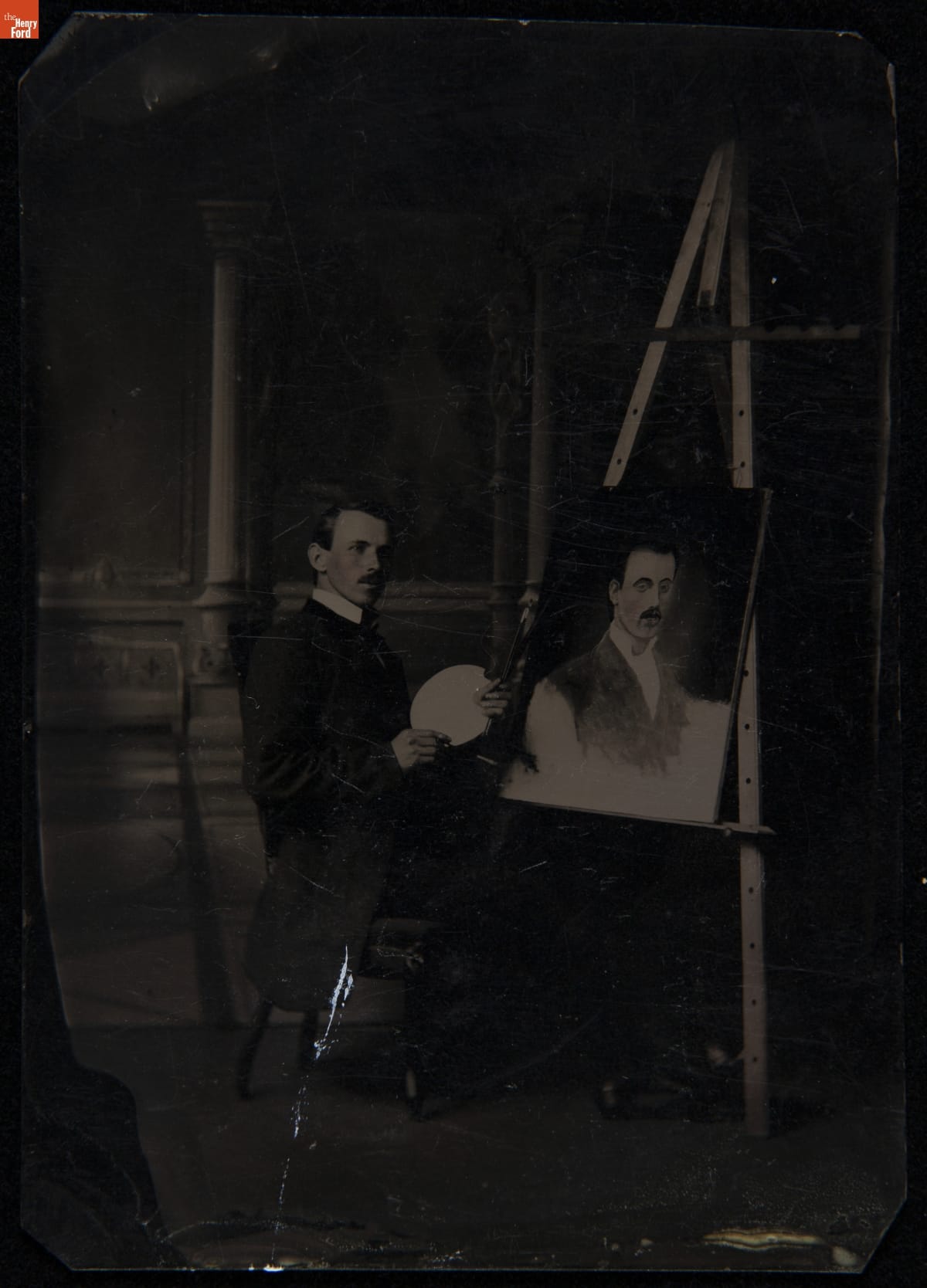
View ArtifactArtist Painting a Self-Portrait, 1890-1910
This "artsy" tintype image is a portrait within a portrait. The artist posed with brushes and palette, and his work-in-progress--his self-portrait.
View Artifact

