
Paperweights by Paul Stankard
Share
share
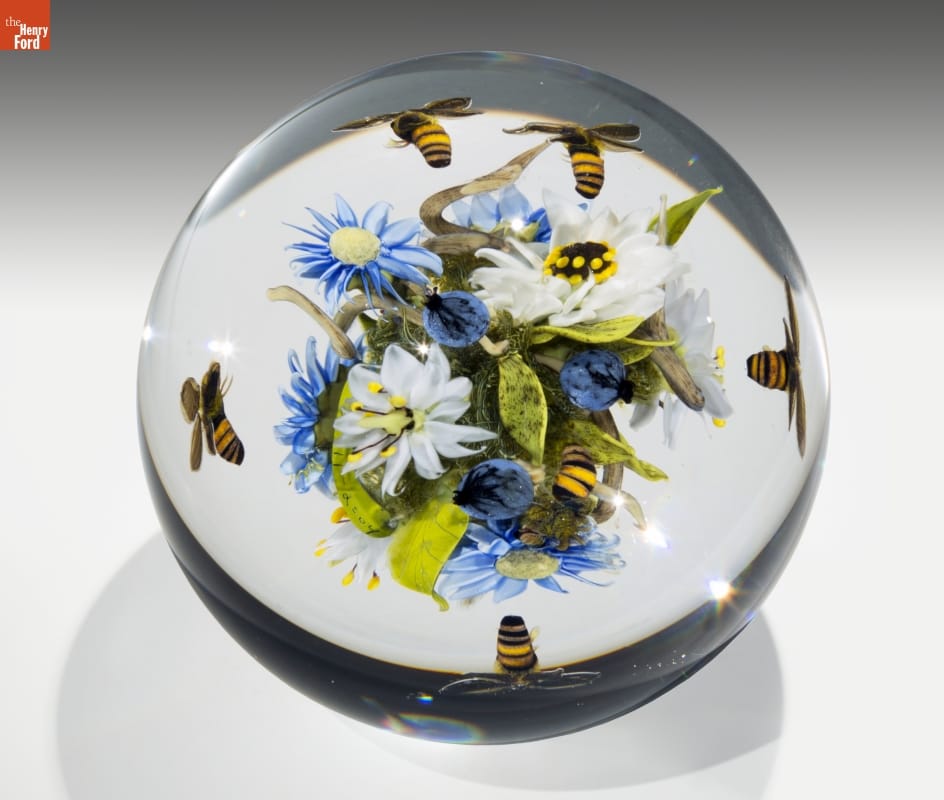
Paul Stankard is one of the founders of the Studio Glass movement of the 1960s and 70s. Most early Studio Glass artists began their careers creating paperweights and moved on to other forms. Stankard concentrated on creating the most technically sophisticated and beautiful paperweights he could imagine. Today, Stankard is acclaimed for his miniature worlds, consisting of imaginary botanicals, bees and sometimes human figures.
THF164995
Atomizer, 1964
Paul Stankard graduated from Salem Vocational Technical Institute (now Salem Community College) in Salem, New Jersey with a degree in Scientific Glassblowing in 1963. For the first ten years of his work career, Stankard worked as a glassblower for various chemical laboratories making scientific instruments, such as this atomizer. But Paul wanted more and he dreamed of being an artist.
View ArtifactMiniature Glass Elephants, 1966
When not working at chemical laboratories making scientific instruments, Paul Stankard began fashioning small flame worked novelties, such as this pair of elephants, at his home studio. He sold these giftware items to support a growing family and to provide a creative outlet for his glass working skills.
View Artifact"St. Anthony's Fire" by Paul J. Stankard, 1976
While working as a scientific glassblower in the late 1960s, Paul Stankard began to experiment making paperweights. He fashioned glass flowers and encased them in clear crystal. Failures did not stop him and successes followed. Supported by his family and encouraged by friends, dealers and other artists, Paul left the scientific glassblowing industry in 1972. This paperweight was one of his works displayed at his first one-man show.
View Artifact"Wild Rose Cube with Experimental Black Glass Lamination" by Paul J. Stankard, 1985
Paul Stankard never ceased to experiment with his art. Working with other glass artists, Paul explored the use of laminating a layer of colored glass to the clear crystal paperweight. In this early test, the laminated section filters and blocks incoming light and focuses the viewer's eye on the enclosed botanical creation.
View Artifact"Rose Hips Diptych C8" by Paul Stankard, 1994
Paul Stankard longed to elevate the paperweight to the level of fine art. In the 1980s and 90s, he placed his botanical creations in vertical columns, cubes and cylinders lifting them out of the traditional paperweight form. Paul sometimes organized his works into complex visual arrangements--in sets of twos (diptychs) or threes (triptychs)--creating a unified composition.
View Artifact"Ode to 9/11" by Paul Stankard, 2001-2002
This unique work by Paul Stankard commemorates the agony of the September 11, 2001 events. The beauty of his botanical creations are replaced by two sobbing faces, with shrapnel behind--artistic reminders of the horrific events.
View Artifact"Cylinder with Native Flowers, Honeybees, and Figures" by Paul J. Stankard, 2002
Paul Stankard pushed the physical boundaries of the paperweight form by experimenting with new shapes. Cubes, cylinders and orbs offered new possibilities for viewing his creations and advanced his artistic translation of nature. Paul experimented with the cylinder form but did not pursue its use.
View Artifact"Summer Bouquet with Honeybees" by Paul J. Stankard, 2004
Paul Stankard's innovative orbs allowed viewers a 360 degree perspective of his creations. The form challenged Paul artistically. He had to conceal imperfections and construction techniques while maintaining the organic credibility of his creation that would now be visible with unobstructed views.
View Artifact"Untitled (Orb)" by Paul Stankard, 2010
Paul Stankard's innovative orbs allowed viewers a 360 degree perspective of his creations. The form challenged Paul artistically. He had to conceal imperfections and construction techniques while maintaining the organic credibility of his creation that would now be visible with unobstructed views.
View Artifact"Flowers, Fruit, and Golden Orbs" by Paul J. Stankard, 2013
Paul Stankard never ceases to be creative. Color, form, and complex botanical arrangements are combined in his assemblages--an artistic culmination of his passion for nature and technical virtuosity.
View Artifact

