
Restoring Greenfield Village 2003
Share
share
Much of Greenfield Village looked quite different in 2002 from what you see today. The village was showing its age -- its crumbling infrastructure desperately needed repair. Yet replacing the underground systems also provided an opportunity to refresh and revise Greenfield Village itself. In September 2002, Greenfield Village closed to the public and restoration began. The transformed village reopened just nine months later.
THF18890
Richart Wagon Shop before Relocation during the Greenfield Village Restoration Project, June 2002
Prior to this, the Richart Wagon Shop stood across from the Detroit, Toledo, & Milwaukee Railroad Roundhouse.
View ArtifactWorkers Laying Conduit in Greenfield Village during Greenfield Village Restoration Project, 2003
The most dramatic part of Greenfield Village's makeover lies below ground. Workers removed entire roadways -- and every water main, sewer pipe, electric line, and natural gas line beneath them. They then replaced and upgraded thirty-five miles of underground systems and paved eleven miles of streets throughout Greenfield Village.
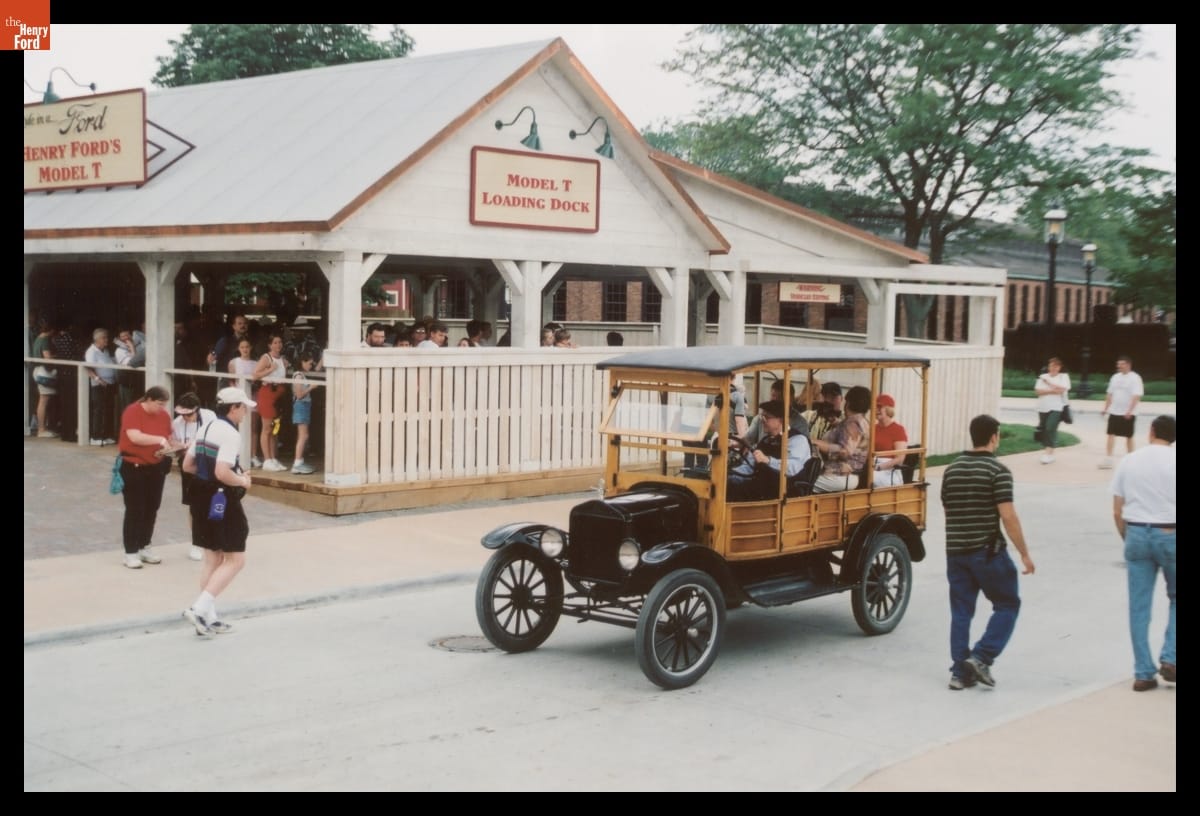
View ArtifactModel T Rides in Greenfield Village, 2003
Visitors now climbed into the expanded fleet of Ford Model Ts at the Loading Dock that debuted as part of the 2003 transformation, located at the rear of the Ford Motor Company building.
View ArtifactDr. Howard's Office before Relocation during the Greenfield Village Restoration Project, September 2002
Where was the Model T Ride located previously? Visitors purchased tickets at the Carousel building and then waited around the corner to climb into the small number of Model Ts then available. (The sign for the Model T ride appears at right.) At that time, Dr. Howard’s Office stood across the street.
View ArtifactTintype Studio, Phoenixville Post Office and the Hearse Shed before Relocation during the Greenfield Village Restoration Project, September 2002
Workers shifted the Greenfield Village Tintype Studio, the Phoenixville Post Office, and the Hearse Shed, placing them with other structures in the Main Street district.
View ArtifactPhoenixville Post Office
The Phoenixville Post Office moved to its new site near the Town Hall.
View ArtifactInterior of William Holmes McGuffey Birthplace in Greenfield Village, June 2003
In the Porches and Parlor district, the William Holmes McGuffey Birthplace received a fresh restoration of its log structure. Curators refurnished the building to more closely reflect the life of the McGuffeys' Scots-Irish community on the frontier of Western Pennsylvania.
View ArtifactMill Pond Site during the Greenfield Village Restoration Project, September 2002
The Liberty Craftworks district also received a striking makeover. As shown here, most of the crafts and trades buildings were already located in what became the new district, but a few more were added.
View ArtifactGunsolly Carding Mill and Thomas Edison Statue before Relocation during the Greenfield Village Restoration Project, September 2002
The Gunsolly Carding Mill, the dark red building, is shown here at the corner of Washington Boulevard and State Street in Greenfield Village before it was relocated to the Liberty Craftworks district. Workers also moved the Thomas Edison statue at this intersection (shown to the right of the building). Now it more appropriately resides near Edison's Menlo Park Laboratory complex in the Edison at Work district.
View ArtifactLoranger Gristmill before Relocation during the Greenfield Village Restoration Project, September 2002
The Loranger Gristmill moved to the Liberty Craftworks district from its previous location near the William Ford Barn. Here, the gristmill was powered by a steam engine visible through the large windows in the rear addition. Henry Ford loved steam engines, having operated them as a young man in Detroit, so he installed one.
View ArtifactWorkers Repaving Maple Lane in Greenfield Village, April 2003
Workers paved eleven miles of new roads and sidewalks in Greenfield Village in the months before its reopening, including this portion of Maple Lane near Cotswold Cottage. Daggett Farmhouse, Farris Windmill, and Plympton Family Home are shown in the distance.
View ArtifactHistorical Presenters outside Eagle Tavern, Greenfield Village, 2004
Other infrastructure work was visible above ground. Hundreds of new lampposts with distinctive designs to fit the look and feel of each district appeared throughout Greenfield Village. This village-wide lighting system made it easier to hold evening events at any time of the year.
View ArtifactContractors at the Re-Opening of Greenfield Village, 2003
In June 2003, visitors entered the reborn Greenfield Village. During the previous nine months, workers replaced 35 miles of underground systems, built 11 miles of new roads and sidewalks, added 350 lampposts, constructed three new buildings, and relocated ten historic buildings. It was the largest and most comprehensive physical rehabilitation in the village's history.
View Artifact

