
Robert Frost Home
Share
share
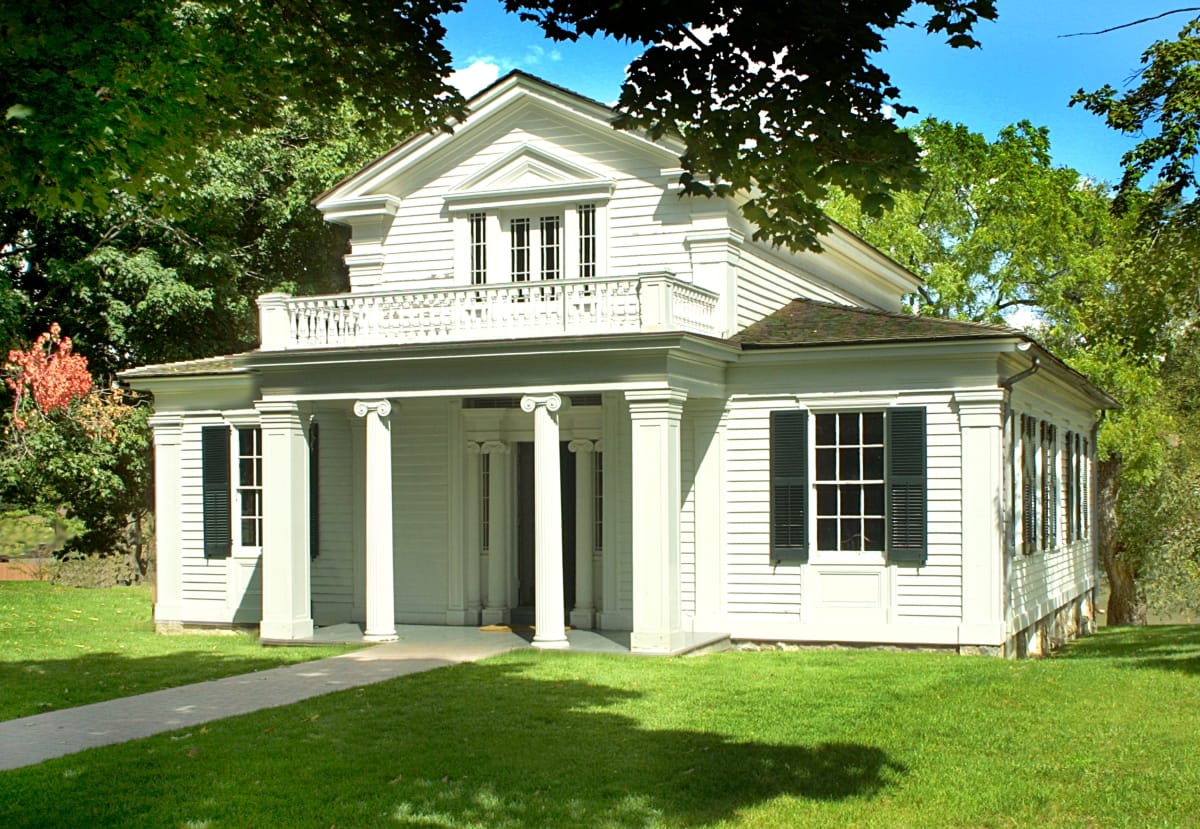
No former residents of this house were as famous or as internationally renowned as American poet Robert Frost (1874-1963). This house, discovered by Henry Ford on a drive through Ann Arbor, Michigan, became a stellar example of Greek Revival architecture in Ford's Greenfield Village, and it still exhibits furnishings from the period. Only within this century has its most celebrated resident reclaimed his rightful place.
THF139544
Portrait of Robert Frost, 1927
Robert Frost modernized American poetry for the 20th century, becoming one of its greatest exponents. He invoked stirring imagery of rural New England life to examine complex philosophical themes and had an extraordinary ability to express deeply insightful ideas in everyday language. Frost won four Pulitzer Prizes for his work and spoke at President John F. Kennedy’s 1961 inauguration.
View ArtifactRobert Frost Home
Robert Frost lived in this house while teaching at the University of Michigan at Ann Arbor in the mid-1920s.
View ArtifactRobert Frost Home at Its Original Site, Ann Arbor, Michigan, circa 1923
Robert Frost moved into this house in 1925. He selected it because it was away from the bustle of campus. The house provided comfort and solace. This home gave Frost "space" to create and a place to gather with his students. Frost loved it, and it suited his needs.
View ArtifactRobert Frost Home in Greenfield Village, circa 1937
This 1830s house is built in a style known as Greek Revival, a design that appealed to a young American nation. Following the Revolution, Americans saw themselves as the inheritors of democracy and looked back to Greek and Roman architecture for inspiration. It features a triangular portico, supported by columns, derived from ancient temples. Frost lived here until 1926 when he returned to Amherst, Massachusetts.
View Artifact"Ann Arbor House, Greenfield Village, Dearborn, Michigan," 1938
Henry Ford discovered the house in the mid-1930s while driving through Ann Arbor. He exclaimed that this was an exceptional example of Greek Revival architecture and needed to be part of his Greenfield Village. Ford instructed his architect to move the house and "improve" it by removing the porch roof and replacing it with an architecturally appropriate portico. For years, the house was referred to as the Ann Arbor House.
View ArtifactNoah Webster Home
The home joined other domestic structures in Greenfield Village, including the Noah Webster House, which came the previous year.
View ArtifactFirst Day of Kindergarten at Robert Frost Home in Greenfield Village, September 1937
Like nearly all the buildings in Greenfield Village, this house served as classroom space for children attending the Edison Institute School. This house served as the kindergarten.
View ArtifactRobert Frost Home in Greenfield Village, September 2007
Since the 1960s, the house has been decorated with furnishings from the early 1800s. The parlor is decked out in furniture from the Federal era, about 1800-1820. Robert Frost likely kept the parlor doors open to the dining room, creating a functional space to meet and interact with his students.
View ArtifactRobert Frost Home in Greenfield Village, September 2007
The dining room, adjoining the parlor, features Empire-era furnishings from 1825-1850. Here, in front of the fireplace, Robert Frost wrote "Spring Pools" in 1925.
View ArtifactRobert Frost Home in Greenfield Village, September 2007
This first floor bedroom was likely used as Robert Frost's private office.
View ArtifactRobert Frost Home in Greenfield Village, September 2007
Many visitors, especially poetry enthusiasts, are surprised by the presence of this house in Greenfield Village, unaware of Robert Frost's time in Ann Arbor. The house and its connection to one of the greatest 20th-century American poets fit nicely into The Henry Ford's mission of presenting stories of innovation.
View Artifact

