
Social Transformation
Share
share
Social transformation involves a shift in the collective consciousness of a society. It occurs when people create change through new patterns of behavior or social action. This can include political shifts, social movements, economic change, changing systems of beliefs and values, new patterns of racial relations, or a rethinking of personal and collective identities. This set explores socially transformative artifacts across our collection.
THF151145
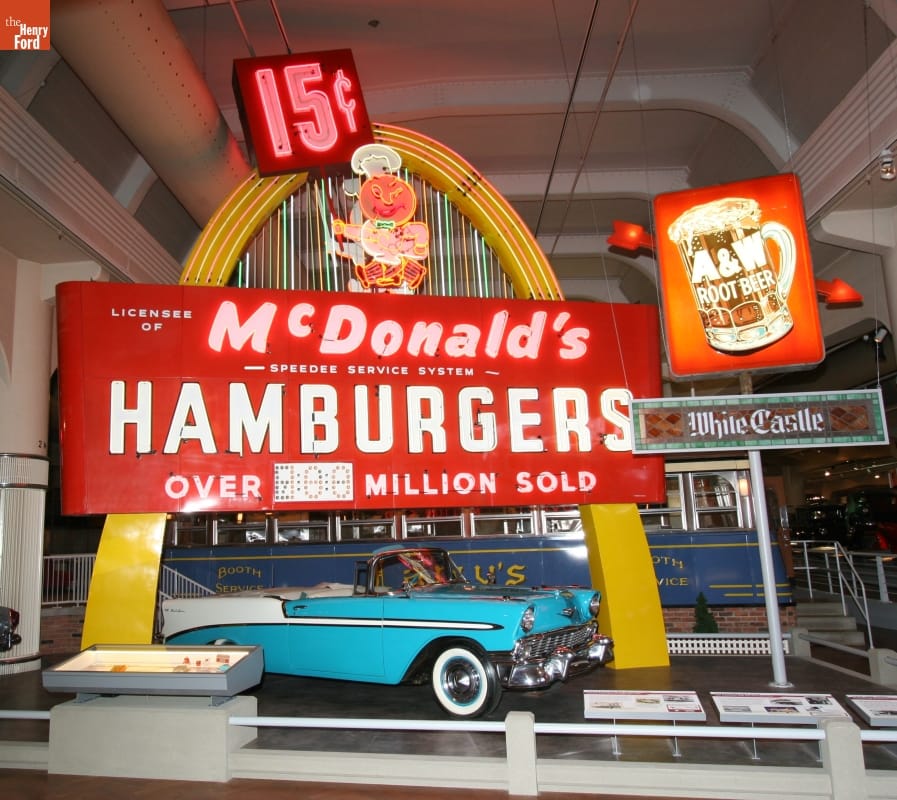
McDonald's Restaurant Sign, 1960
In 1948, the McDonald brothers transformed their Southern California drive-in restaurant with their radical new "Speedee Service System"--assembly-line production of a limited menu at drastically reduced prices. Richard McDonald created this sign design in 1952. In 1955, milkshake machine salesman Ray Kroc franchised the McDonald's concept--prompting numerous imitators and ultimately turning America into a "fast food nation."
View Artifact1939 Douglas DC-3 Airplane
The Douglas DC-3, introduced in 1936, carried 21 passengers -- enough to fly profitably without relying on subsidies from air mail contracts. While the DC-3's economy appealed to airlines, its rugged construction and comfortable cabin attracted passengers. More than any other aircraft, the DC-3 ushered in the era of dependable, long-distance air travel in the United States.
View Artifact1914 Ford Model T Touring Car, Given to John Burroughs by Henry Ford
This 1914 touring car is one of several Model T automobiles given to naturalist John Burroughs by his friend Henry Ford. Ford Motor Company experienced a milestone year in 1914. The automaker fully implemented the moving assembly line at its Highland Park plant, and it introduced the Five Dollar Day profit-sharing plan for its employees.
View ArtifactPope Columbia Safety Bicycle, 1889
New "safety" bicycles, like this Pope Columbia, touched off a bicycle craze in the 1880s and 1890s. More stable with two same-sized wheels and less expensive than the high-wheeled "ordinaries," safety bicycles allowed many Americans to discover the sheer joy of riding.
View Artifact"Uncle Tom's Cabin; or, Negro Life in the Slave States of America," 1852
The trials of an enslaved black family seeking freedom are told in the pages of Harriet Beecher Stowe's Uncle Tom's Cabin. The work of fiction became a national and international best-seller when first published in 1852. In one year, 1.5 million copies were sold in Great Britain. The book advanced anti-slavery sympathies throughout Europe and made Stowe an international celebrity.
View ArtifactBook, "Silent Spring," 1962
Silent Spring, by marine biologist Rachel Carson, sparked the environmental movements of the 1960s. It described how widespread pesticide use, in particular DDT, was harming and killing birds and other animals as well as threatening the health of humans. The book helped the general population understand the interconnected nature of ecosystems and how localized polluting affects larger natural systems.
View ArtifactBook, "The Constitutions of the United States, According to the Latest Amendments," 1800
At the turn of the nineteenth century, newly independent Americans celebrated the Declaration of Independence and the United States Constitution as embodiments of freedom and democracy. This book - a rare survivor from 1800 - includes the text of both founding documents, constitutions of the fifteen existing states, and the Northwest Ordinance, which regulated the Northwest Territory.
View ArtifactDr. Benjamin Spock's Pocket Book of Baby and Child Care,"1955
First published in 1946, pediatrician Benjamin Spock's book transformed childhood for generations of children. Instead of espousing the rigid doctrines of his day, Spock advocated a flexible, more compassionate approach to parenting--encouraging parents to trust their instincts, listen to and play with their children, and appreciate their individual differences. When Spock died in 1998, his book had sold nearly 50 million copies worldwide.
View ArtifactRosa Parks Bus
Inside this bus on December 1, 1955, Rosa Parks, a soft-spoken African-American seamstress, refused to give up her seat to a white man, breaking existing segregation laws. The flawless character and quiet strength she exhibited successfully ignited action in others. For this, many believe Rosa Parks's act was the event that sparked the Civil Rights movement.
View ArtifactButton, "Non-Violence is Our Strength," circa 1970
Cesar Chavez and Dolores Huerta founded the National Farm Workers Association in 1962. The organization later merged with the Agricultural Workers Organizing Committee to form the United Farm Workers (its logo is a stylized eagle seen on this button). Chavez died in 1993, and Huerta continued to serve as the Vice President until 1999.
View ArtifactButton, 10th Anniversary of Stonewall Riots, 1979
The Civil Rights movement of the 1960s inspired other groups of people to demand their equal rights. Members of the gay rights movement began actively voicing their opposition to discrimination in 1969 after the New York police department raided the Stonewall Inn -- a local gay bar. Riots ensued and a movement was born.
View ArtifactButton, "Black Liberation Malcolm X," 1968
Malcolm X was an articulate and charismatic spokesperson for the Nation of Islam, a movement that combined elements of Islam with black nationalism. He championed a radical, more assertive concept of racial pride than Martin Luther King, Jr., whose creed of non-violent action had defined the Civil Rights era. Malcolm X's doctrines laid the intellectual foundation for the Black Power Movement.
View ArtifactGeorge Washington's Camp Bed, 1775-1780
George Washington carried folding beds, tents, eating utensils, and other equipment to use while encamped on the field with his troops during the Revolutionary War. Washington likely used this bed when he traveled from his Newburgh, New York, headquarters in July 1783 -- as the war was winding down -- to tour upstate New York and the military installations located there.
View ArtifactDiners' Club Card, 1976-1977
Diners Club, founded in 1950, was the first to issue a credit card exclusively for travel and entertainment. With this card, members had access to a variety of restaurants, hotels, and car rental services. The card's success led to the growth of the credit card industry.
View ArtifactBirth Control Pill Dispenser, circa 1998
In 1960, the U.S. Food and Drug Administration approved the first oral contraceptive. The "Pill," as it was called, allowed women to gain control of their reproductive system. It made family planning more predictable and helped launch the sexual revolution of the 1960s. The personal and societal effects of hormonal birth control are still surfacing today.
View ArtifactZenith Royal Crusader Hearing Aid, circa 1965
The invention of transistors went beyond miniaturization of radio technology. This small transistor-powered hearing aid gathered sound waves and transmitted the sound to the earpiece placed within the wearer's ear. The packaging is as interesting as the small hearing aid device; it was carefully designed by the donor, Mel Boldt, to appeal to the style-conscious consumers in the 1960s.
View ArtifactHood Ornament, "Votes for Women," 1900-1920
Automobiles became significant in the later years of the long fight for women's suffrage, or equal voting rights. Suffragists organized automobile processions, complete with music and colorful decorations, to attract favorable press and rally support around the cause. Participating vehicles could be outfitted with hood ornaments like this one, which called for "Votes for Women" and held two small flags.
View ArtifactRobot, First Unimate Robot Ever Installed on an Assembly Line, 1961
Unimate robots were the world's first successful industrial robots. The units, designed by Unimation Inc., could perform tasks in manufacturing facilities that were difficult, dangerous, or monotonous for human workers. This is the first Unimate ever used on an assembly line. It was installed at the General Motors plant in Trenton, New Jersey, in 1961 to unload a die-casting press.
View ArtifactLevi Jeans, 1968
Denim jeans were the purview of the working class for nearly a century. By the 1960s, jeans--representing independence and the right to self-expression--were enthusiastically embraced by youth culture. The youth market for fashion and music--and the word "teenager"--had begun a spectacular takeoff during the 1950s. Wearing jeans would become a widespread fashion, part of a growing informality in dress.
View ArtifactProduct Label for Bottled Horseradish by Heinz & Noble, "Strictly Pure," 1872
H.J. Heinz prided himself on his "Strictly Pure" products, but many of his competitors used adulterants (inferior substitutes or additives) and false advertising. Recognizing that the reputation of the entire processed food industry was at stake, Heinz became an advocate of the Pure Food & Drug Act of 1906--the first of a series of Congress-enacted consumer protection laws.
View ArtifactPenicillin Medicine Bottle, 1948
Penicillin heralded the advent of antibiotics during World War II. When it became commercially available in 1945, it was seen as a wonder drug. This bottle is from 1948. Some bacteria developed a resistance to penicillin, and other antibiotics were developed.
View ArtifactMacintosh 512K Personal Computer, Model M0001W, 1985
In 1984, the Apple Macintosh became the first popular personal computer to feature the now-ubiquitous mouse and "graphical user interface" desktop. Despite the Mac's relatively high price, its user-friendly features helped it demystify computing for many people without a technical bent. This computer is a Macintosh 512k, released in 1985 with increased memory.
View ArtifactTempera Painting, "The Strike," by Arthur R. Lehmann, 1941
Arthur Lehmann created this painting while employed by the Works Progress Administration in Detroit. Lehmann chanced upon unionizing efforts at the Ford Rouge Plant in 1937, creating a sketch of workers picketing outside the plant gates. Ultimately, the workers were successful and in 1941 Ford became a union shop. In a meticulously personal style, Lehmann depicts the unionizing process in the finished painting.
View Artifact"Common Sense; Addressed to the Inhabitants of America," February 1776
Thomas Paine had tried many different jobs in England, but jumped at the chance to work in the printing business over in the American colonies. And there he found his voice. Not being a politician, he had nothing to lose with his little pamphlet. Although he made them sound like just "common sense," his arguments for independence were extremely radical at the time.
View ArtifactScot Towels, circa 1937
Paper towels, like paper cups, were first promoted for public use as a health measure, adopted for public washrooms during the early 20th century. By the 1950s, disposable paper towels made increasing inroads in the American kitchen, offering more convenience, cleanliness, and less maintenance than cloth. Yet, to some, disposable paper products would come to represent waste--and a threat to the environment.
View ArtifactMiller School--People--Item 03
During the mid-19th century, the idea of free public schooling became firmly established in America--making access to education available to more children. By the late 19th century, most kids aged 7 to 12 attended public school for a few years--many in one-room rural schools. America's educational structure would continue to grow, offering schooling from kindergarten to high school. By 1918, all states had made school attendance compulsory.
View ArtifactImmigrants Arriving at New York Harbor, circa 1917
To combat starvation in Europe, President Woodrow Wilson established the U.S. Food Administration in August 1917. This highly successful initiative delivered almost 34 million pounds of food to Europe during and after the war. This Administration's Yiddish-language poster, aimed at Jewish immigrants, begins, "Food will win the war -- You came here seeking freedom, now you must help to preserve it..."
View ArtifactAdvertising Poster, "Earth Day April 22, 1970"
Earth Day originated after an oil spill in January 1969 galvanized a nation-wide teach-in about the environment. Schools and communities across the United States participated on April 22, 1970. Posters like this promoted events coordinated by new organizations such as the Environmental Action Coalition.
View ArtifactPoster, "Farm Work: Rural Electrification Administration," 1935
The struggles of the Great Depression caused old ideas to be cast aside for new approaches. The modern design of this poster supports the message promoting the newly formed Rural Electrification Administration. The REA brought power to rural areas, transforming rural life, reducing isolation, and making a range of new products available for the farm and home.
View ArtifactPoster, "The Women's Liberation Movement," 1970
Women had finally won the right to vote by 1919. But they still lacked equal rights with men. In 1923, Alice Paul drafted an Equal Rights Amendment. Revised and updated many times, no official amendment has been approved. For many women in 1970 this poster featuring the female symbol and raised fist conveyed their frustration with inequality.
View Artifact"We the People Are Greater than Fear," 2016-2017
This poster was created by Shepard Fairey in response to the election of Donald Trump as US president. The diverse range of people depicted in the "We the People" series are aesthetically similar to Fairey's Barack Obama "Hope" poster. These images appeared on the back page of The Washington Post on inauguration day and were carried as signs at protests.
View ArtifactEngraved Copy of the 1776 Declaration of Independence, Commissioned by John Quincy Adams, Printed 1823
This is an exact, precise facsimile of one of America's greatest documents. It is one of two hundred copies commissioned by Secretary of State John Quincy Adams in 1820. It is an engraving made from the original document. Two copies each were given to the surviving signers and the rest distributed to Congress, state governments and colleges and universities.
View ArtifactPrint Portfolio, "We Shall Overcome," 1963
More than 250,000 civil rights advocates showed up at the 1963 March on Washington for Jobs and Freedom. This souvenir portfolio held a group of photo collages, each incorporating fragments of disturbing images from the movement. The artist intended these to symbolize man's inhumanity to his fellow man. Civil Rights activists hoped that they would stir people's emotions and incite action.
View ArtifactGeneral Electric "Monitor-Top" Refrigerator, circa 1934
The big news in the kitchen during the 1920s? Reliable, affordable electric refrigeration. As more homes had access to electric power, people replaced their messy wooden iceboxes with stylish, low maintenance, enameled porcelain electric refrigerators. In 1930, 10% of households had them -- by 1940, 56% did. General Electric's distinctive "Monitor Top" refrigerator was a big seller in the late 1920s and early 1930s.
View ArtifactJoint Resolution of the United States Congress, Proposing the 13th Amendment to Abolish Slavery, 1865
The 13th Amendment to the Constitution, not the Emancipation Proclamation, formally abolished slavery in the United States, settling the issue which had long plagued the nation. Congress adopted the Amendment in January 1865 and sent it to states, which ratified it in December. The word "Duplicate" at the top of this document indicates the bill had been passed by Congress but had not yet been ratified.
View ArtifactRocking Chair Used by Abraham Lincoln at Ford's Theater the Night of His Assassination, April 14, 1865
President Abraham Lincoln was sitting in this rocking chair during a production of Our American Cousin at Ford's Theatre in Washington, D.C., when he was assassinated on April 14, 1865. Henry Ford purchased the chair in 1929 for the Museum, where it remains one of the most revered objects associated with the "man who saved the Union."
View ArtifactSinger Sewing Machine, 1881
Before the sewing machine, making clothing was a time-consuming task. By hand, sewing a shirt took about 14 hours; with a machine, a little over an hour. Isaac Singer developed the first practical sewing machine for home use in the 1850s. Yet it was the Singer company's marketing strategies--an installment plan, advertising aimed at women, and foreign sales-- that would be its greatest innovation.
View ArtifactMusic Sheet, "Take Your Girlie to the Movies (If You Can't Make Love at Home)," 1919
By the 1920s, motion pictures became the dominant form of public entertainment--Hollywood and the movie industry reached new heights of popularity. When the first all-talking movies debuted in 1929, attendance nearly doubled. Shown in theaters nationwide, movies created a widely shared experience among moviegoers. Films influenced American culture at all levels, from manners and morals, to speech, fashions, and social and ethical values.
View ArtifactiPhone, 2007
The iPhone was the apotheosis of the cellphone as pocket computer--powerful technology in a sleek package. This handheld is a music player, a mobile phone, and an internet-enabled device in one, with a trendsetting touchscreen interface. The iPhone's release in 2007 was a well-choreographed media event, with potential buyers waiting in lines for hours at Apple stores across the country.
View ArtifactInternet in a Box, 1994
Newcomen Engine, circa 1750
This is the oldest known surviving steam engine in the world. Named for its inventor Thomas Newcomen, the engine converted chemical energy in the fuel into useful mechanical work. Its early history is not known, but it was used to pump water out of the Cannel mine in the Lancashire coalfields of England in about 1765. The engine was presented to Henry Ford in 1929.
View ArtifactSteam Locomotive "Sam Hill," 1858
This 1858 Rogers steam locomotive is typical of those used in the United States in the second half of the 19th century. Its flexible wheel arrangement, high power output, and light weight were well suited to the tight curves, steep grades, and hastily constructed track that characterized American railroads. This locomotive struck an agreeable balance between practicality, safety, and economy.
View ArtifactGE Console Television, Model HM-225, 1939
1939 was a year of "firsts" in television. Introduced to the mass public at the 1939 World's Fair, Roosevelt's presidential speech at the opening ceremony was the first to be televised. The HM-225 was among examples exhibited in General Electric's pavilion at the Fair. Its art deco inspired case demonstrated the how new technology could be integrated into domestic space.
View ArtifactThrostle Spinning Frame, circa 1835
Spinning frames spin cotton fiber into yarn and then wind it onto a bobbin. This throstle spinning frame could simultaneously spin 64 strands of yarn. (Throstle -- an old name for a song thrush -- refers to the bird-like sounds the machine made.) Machines like this helped produce the large quantities of yarn that growing industrial weaving operations needed in the early and mid-1800s.
View ArtifactFordson Tractor, 1917-1918, Used by Luther Burbank
The Fordson tractor, manufactured by Henry Ford and Son, Inc., was the first lightweight, mass-produced tractor that was affordable to the average farmer. Through this and other efforts, Henry Ford sought to relieve farmers of the burden of heavy labor. Ford gave this Fordson, the first production model, to fellow innovator Luther Burbank, creator of hundreds of new plant varieties.
View ArtifactMontgomery Ward & Company, Descriptive Illustrated Price List No. 28, Fall and Winter 1880
The growth of factories during the 19th century initiated a steady flow of mass-produced, affordable consumer goods--helping Americans increasingly enjoy a rising standard of living. The advent of mail order catalogs and rural free delivery in the late 19th century made these goods increasingly available to rural customers--opening a world of new material possibilities. Catalogs broadened the merchandise selection for city people as well.
View ArtifactTransatlantic Cable, 1858
This cable is part of a display of transatlantic telegraph cables dating from 1858-1928. This cable section was part of the first Transatlantic cable from 1858, laid from Heart's Content, Newfoundland, Canada to Valencia, Ireland.
View ArtifactRCA Victor Transistor Radio with Case, 1950-1960
The size of radios shrank following the advent of transistor technology. Even the smallest vacuum tubes were bulky, and their power consumption ensured the need for large batteries. Transistor radios made of lightweight plastics were cheap and truly portable. With the addition of an earphone a radio such as this allowed the listener to enjoy a completely personal listening experience.
View ArtifactRemington Desk Typewriter, Model No. 12, 1923
Sholes & Glidden introduced the first practical typewriter in 1874. By the 1880s, there were several companies mass producing these machines, including rifle manufacturer Remington & Sons. Typewriters were part of the "information explosion" that included technologies like the phonograph and telephone. They modernized offices by helping workers--increasingly women--reproduce and organize information more neatly and quickly than handwriting.
View ArtifactHoover "Model 150" Vacuum Cleaner, 1936-1939
Industrial design pioneer Henry Dreyfuss created Hoover's 1936 Model 150 upright vacuum cleaner. It had a magnesium chassis and a Bakelite plastic hood, making it more lightweight. Henry Dreyfuss was a leading proponent of streamlined design--a modern, rounded, aerodynamic form which increasingly shaped 1930s household appliance design. Dreyfuss stressed "designing for people"--developing products that not only looked good, but also worked well.
View Artifact

