
Art Deco in Henry Ford Museum of American Innovation
Share
share
"Art Deco" refers to the artistic movement prominent during the inter-war period. The 1925 Exposition Internationale des Arts Décoratifs et Industriels Modernes in Paris was the launching point for the movement, as well as the inspiration for its name. The aesthetic was widely adopted, both geographically and across disciplines. The following diverse collection of Art Deco artifacts are on display in Henry Ford Museum of American Innovation.
THF101939
Texaco Service Station, circa 1960
A combination of several design disciplines (styling, package design, product design, and graphic design), Walter Dorwin Teague's Texaco station suggested consistency, simplicity, and cleanliness -- a strong corporate identity that enabled Texaco to stand out in a highly competitive marketplace.
View ArtifactTHF159907
Rohde Modular Desk, 1934-1941
In the early 1930s, industrial designer Gilbert Rohde spurred the American furniture industry's transition from historical revivals to a modern aesthetic. Rohde is known for his transformative influence on -- and longtime association with -- Herman Miller Inc., whose name became synonymous with modernism. This desk, part of his popular Laurel series for Herman Miller, was intended for both domestic and commercial purposes.
View ArtifactTHF2638
1939 Douglas DC-3 Airplane
The Douglas DC-3, introduced in 1936, carried 21 passengers -- enough to fly profitably without relying on subsidies from air mail contracts. While the DC-3's economy appealed to airlines, its rugged construction and comfortable cabin attracted passengers. More than any other aircraft, the DC-3 ushered in the era of dependable, long-distance air travel in the United States.
View ArtifactTHF83268
Rohde Sideboard, 1941-1942
In the early 1930s, industrial designer Gilbert Rohde spurred the American furniture industry's transition from historical revivals to a modern aesthetic. By 1941, he believed that improved economic conditions justified the reintroduction of restrained decorative elements to modern furniture. This sideboard, part of the high-end Paldao series, features clean lines, antique-finish brass pulls, and leatherette upholstered legs.
View ArtifactTHF75723
Dymaxion House
Buckminster Fuller was a multi-disciplinary designer. This house, his re-thinking of human shelter, was rooted in Fuller's understanding of industrial production -- particularly methods developed in the automobile industry and especially those advocated by Henry Ford for whom Fuller had immense admiration. More an engineering solution than a home, the structure was prototyped but never produced.
View ArtifactTHF90982
1937 LaSalle Coupe
This 1937 LaSalle coupe combined utility, comfort, and style. The LaSalle cruised at 50 miles per hour. Plush upholstery, heater, radio, watertight windows, and room for luggage added comfort. And General Motors' Styling Section, headed by Harley Earl, added streamlined and Art Deco touches to complete the package.
View ArtifactTHF17032
Sparton Radio Model 558-B, 1937
This 1937 Sparton radio was designed by Walter Dorwin Teague, a designer renowned for his use of streamlined forms. A study in contrasts -- the blue mirrored finish and curved sled-like base suggest speed while the five jutting parallel panels appear almost architectural -- this expensive and glamorous radio had a limited market during the Great Depression.
View ArtifactTHF90597
1936 Lincoln Zephyr Sedan
Automobiles, like other everyday objects, underwent streamlining in the 1930s. The 1936 Lincoln Zephyr joined aerodynamic styling with attractiveness. Its flowing teardrop shape suggests motion. Its V-shaped grille slices the air. Headlights blend smoothly into the front fenders. Rear fenders hug the body and fender skirts hide the rear wheels. Even the taillights are streamlined. The Zephyr was a streamlining success.
View ArtifactTHF88363
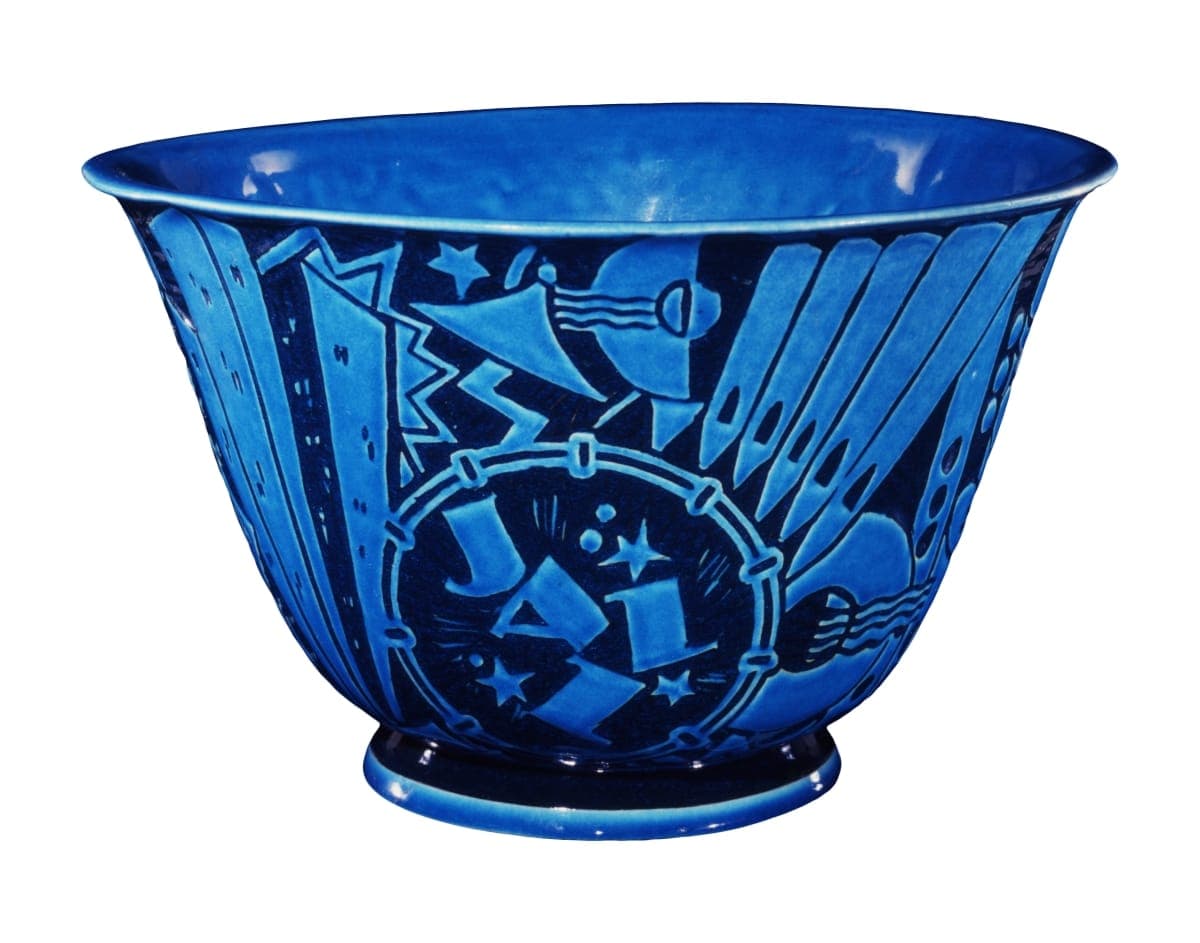
Jazz Bowl, circa 1931
24-year-old-artist Vilktor Schreckengost designed a punch bowl in 1930 depicting New Year's Eve festivities in New York City as a celebration of the Jazz Age. He was commissioned by Eleanor Roosevelt who was so pleased with it that she ordered two more copies. Three versions were produced; this is the third version, intended for mass-production, dubbed "The Poor Man's Jazz Bowl".
View ArtifactTHF90811
1937 Cord 812 Convertible
The 1937 Cord's swooping fenders, sweeping horizontal radiator grille, and hidden headlights were unlike anything else on American highways. And although it wasn't the first, Cord was the only front-wheel-drive production car available in America for the next three decades.
View ArtifactTHF201973
Souvenir Ticket for A Century of Progress International Exposition, Chicago, Illinois, 1934
World's fairs during the 1930s offered people a prosperous outlook rather than bleak economic realities of the Great Depression -- if they could attend. Images on this ticket book show the buildings of the Chicago's Century of Progress International Exhibition of 1934, highlighted by sun rays.
View ArtifactTHF151586
Alencon Model Shelf Clock, 1936
The General Electric Company made this simple yet elegant clock in 1936. Designers of this Art Moderne style clock employed color, simple lines and geometric shapes (the arc, oval and circle) and used old materials in new ways (blue mirrored glass forms the body of the clock). This clock could have decorated many modern Americans' homes in the 1930s.
View ArtifactTHF156178
Dresser, 1933-1937
Architects and designers showcased their modern innovations in the "Homes of Tomorrow" exhibition at the 1933 Chicago World's Fair. Pioneering modernist and industrial designer Gilbert Rohde furnished the "Design for Living Home," where he debuted lines of streamlined furniture. Herman Miller manufactured Rohde's furniture for the exhibition and then for sale to the public, stamping each piece with a tag declaring it "world fair furniture."
View ArtifactTHF77241
Lamy's Diner, 1946
World War II veteran Clovis Lamy ordered this 40-seat diner from the Worcester Lunch Car Company, a premier New England diner builder. In April 1946, Lamy operated the diner in his home town of Marlborough, Massachusetts. Local factory workers ate lunch there and those returning from a movie or show dropped in for dinner. Lamy sold the business in 1949.
View Artifact

