
Jewish Innovators and Traditions from The Henry Ford's Collections
Share
share
In 2018, our curators looked at The Henry Ford’s rich collections from a Jewish lens and unveiled fascinating stories of innovation, design, entrepreneurship, and cultural traditions.
THF2603
Coffee Pot Stand Made by Benjamin Halsted and Myer Myers, 1756-1758
In a rare partnership of colonial craftsmen, Jewish silversmith Myer Myers and silversmith Benjamin Halstead collaborated to create this coffeepot stand around 1756. The initials "CJ", engraved on the bottom, establish the owner as Charity Johnson, wife of Samuel Johnson, the first president of King's College (now Columbia University). This stand was part of a coffee set created for Mrs. Johnson.
View ArtifactTHF129316
Covered Jug, 1755-1765
Master silversmith Myer Myers created this ewer, or covered jug, for Samuel Johnson, the first president of King's College (now Columbia University) and his wife Charity in the mid-to-late 1750s. A well-respected silversmith and a leader within colonial New York City's small Jewish community, Myer Myers crafted silver objects for many of New York's elite families as well as his synagogue, Congregation Sherith Israel.
View ArtifactTHF210379
Letter from Alexander Hamilton to Aaron Burr, 1786
After the Revolutionary War, New York City attorneys Alexander Hamilton and Aaron Burr began a decades-long rivalry that ended in 1804 when Burr mortally wounded Hamilton during a duel. In the 1780s, Hamilton represented Jewish merchant Solomon Simson in a case against Ebenezer Jones, a Revolutionary War-era privateer represented by Burr. In this letter, Hamilton informed Burr of the time and place of the trial.
View ArtifactTHF163888
Chess Set by Gianni Toso, 1988
Gianni Toso comes from a long line of Venetian glass artists. Although not of the Jewish faith, Toso lived in the Jewish quarter of Venice. During the 1967 Middle East war he became so passionate about the Jewish state that he converted to Orthodox Judaism. He settled first in Israel, and later in New Jersey. He is famous for his flameworked chess sets that whimsically represent Rabbis battling Venetian Catholic monks.
View ArtifactTHF189998
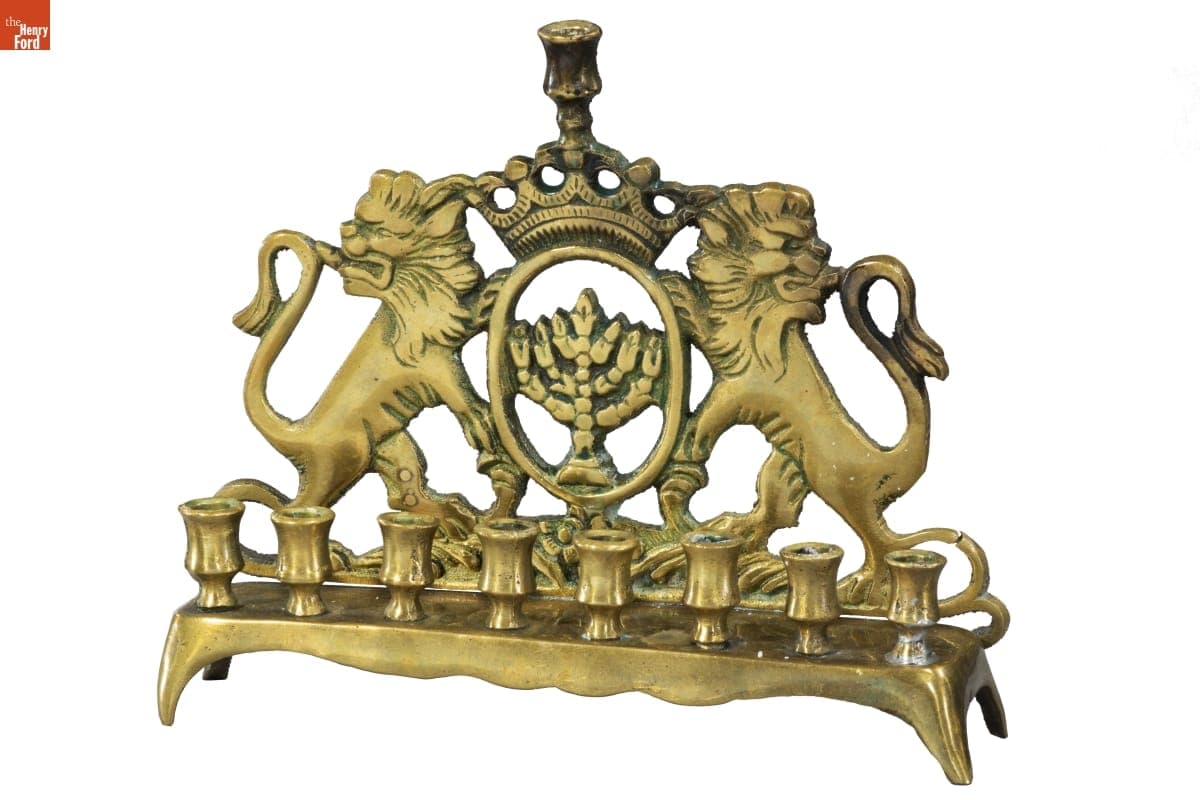
Hanukkah Lamp, 1900-1920
The eight-day festival of Hanukkah (also spelled Chanukah) has become a somewhat elaborate holiday in America, but centuries-old traditions like lighting the menorah remain central to the celebration. This brass menorah was a family heirloom, passed down through three generations and used each year during Hanukkah. The menorah's design incorporates traditional Jewish cultural symbols.
View ArtifactTHF289914
Letter from Edward D. Ingraham to Joshua I. Cohen, April 3, 1852
Joshua Cohen (1801-1870), a member of a prominent Jewish family from Baltimore, Maryland, assembled one of the finest collections of colonial and Continental currency. He began collecting around 1830 and corresponded and traded with other well-known 19th-century collectors. Cohen's collection contains currency created by renowned American printers and includes bills found in the papers of President George Washington.
View ArtifactTHF113667
Auction Catalog for Thomas Jefferson's Library, 1829
This catalog points to Joshua Cohen's passion to collect, but he was more than a collector. Cohen graduated from the University of Maryland where he studied medicine -- he specialized in diseases of the ear. He was also a charter member of the Maryland Historical Society. In the 1820s, Cohen joined with family members and others in Baltimore's Jewish community to challenge the Maryland law that barred Jews from the full rights of citizenship.
View ArtifactTHF150961
L. Miller & Son Store Display of Wood Chisels and Folding Rulers, 1923-1928
Louis Miller, a Russian Jewish immigrant to Chicago, started and operated L. Miller & Son hardware. A highlight of his store (located in an East European immigrant neighborhood) was an elaborate and extensive tool and hardware display that literally showcased the store’s stock: not only great salesmanship but also a benefit to customers with a language barrier.
View ArtifactTHF172897
John Deere Model B Tractor, 1941
Industrial designer Henry Dreyfuss worked for tractor and agricultural implement manufacturer, Deere & Company, between 1937 and 1968. His first project involved “styling” the popular Model B tractor. Dreyfuss acquired Design Patent #112,365 in November 1938 for the unified radiator cover and hood that set the Model B apart from tractors by rival producers.
View ArtifactTHF3967
Secretary Desk, 1720-1780
This 18th-century desk was owned by the Adler family of Frankfurt, Germany. With the rise of the Nazi regime during the 1930s, harassment increased for this Jewish family until, on Kristallnacht ("Night of the Broken Glass") in 1938, their home was ransacked. The Adlers managed to leave Germany with only a few possessions. This heirloom became a symbol of the family's survival as they carved out new lives in America.
View ArtifactTHF169013
"Fancy Free" Fabric Swatch Designed by Ruth Adler Schnee, 1949
Trained as an interior architect, Ruth Adler Schnee began her pioneering foray into textile design with an entry into the Chicago Tribune's "Better Rooms for Better Living" interior design competition. Unable to locate suitable fabrics, she designed her own and this ad hoc textile she designed drew attention. She promptly taught herself to screen print and began to sell her own designs.
View ArtifactTHF169007
"Pins and Needles" Fabric Swatch Designed by Ruth Adler Schnee, 1949-1964
A garden in need of weeding. Snowflakes under a microscope. A stack of firewood. Adler Schnee took inspiration from the world around her, both the fantastic and the mundane. She created strikingly modern abstract and often organic forms. For this design, named "Pins and Needles" by her husband Eddie, Adler Schnee was motivated by sewing supplies strewn across her table.
View ArtifactTHF240754
Henry Ford, Albert Kahn, Mr. Martin, and Charles Sorensen in Ford Engineering Laboratory, April 1942
Industrial architect Albert Kahn (1869-1942) first collaborated with Henry Ford in 1908 when Kahn began design work on Ford Motor Company's Highland Park plant. Further commissions included Ford’s Rouge plant (1917), its Engineering Laboratory (1923), and its Willow Run bomber plant (1941). Kahn also counted Packard, General Motors, Hudson, Studebaker, and Chrysler among his clients.
View ArtifactTHF152188
Ford Rotunda by Philip Lyford, 1933-1934
Ford and General Motors both commissioned Kahn to design pavilions for the 1933-1934 "Century of Progress" World's Fair in Chicago. For Ford, Kahn created a streamlined pavilion anchored by a large rotunda. "Teeth" lined the rotunda's exterior walls and gave the building the appearance of a giant gear. A globe in the center of the rotunda symbolized Ford’s worldwide operations.
View ArtifactTHF109401
Aerial View of Ford Rotunda, Ford Rouge Plant and Administration Building, Dearborn, Michigan, 1936
Ford Motor Company was so pleased with Kahn's rotunda that, following the fair, the automaker moved the building to its headquarters in Dearborn, Michigan. The Ford Rotunda became an orientation center for visitors on factory tours, and a display space where the company showcased its latest models. Sadly, an accidental fire destroyed the Ford Rotunda in 1962.
View ArtifactTHF173102
Matzo Ball Soup Mix Box, 1998-2008
In 1888, Behr Manischewitz began baking matzo, a special unleavened bread, in Cincinnati, Ohio. His operation grew quickly, as Manischewitz incorporated new machinery and other improvements that revolutionized the baking process. Throughout the twentieth century, the Manischewitz Company expanded its product line and applied innovative methods for production, packaging, distribution, and marketing to become one of America's largest kosher brands.
View ArtifactTHF90042
1906 Rapid Bus
This "Rapid Bus" evolved from an earlier gasoline-powered commercial vehicle developed by Jewish brothers Max and Morris Grabowsky in Detroit. In 1906, it was one of 20 commercial vehicle models produced by the Rapid Motor Vehicle Company -- with Max as Vice-President and Morris as Secretary. The bus could shuttle travelers between hotels and railroad depots or be used for sightseeing.
View ArtifactTHF207818
Rapid Sightseeing Bus, circa 1907
As automobiles moved away from the horseless carriage look, early motorized buses like this maintained the styling of the stagewagons that preceded them. Tourists visiting Philmont, New York, viewed the sights from this bus made by the Rapid Motor Vehicle Company. This bus evolved from an earlier gasoline-powered commercial vehicle developed by Jewish brothers Max and Morris Grabowsky in Detroit.
View ArtifactTHF111652
The Jewish home beautiful : written by Betty D. Greenberg and Althea O. Silverman, 1955
The National Women's League of the United Synagogue (now the Women's League for Conservative Judaism) published thirteen editions of "The Jewish Home Beautiful" between 1941 and 1975. This popular cookbook included traditional recipes along with detailed instructions for table settings and other entertaining suggestions. A common wedding gift, "The Jewish Home Beautiful" helped preserve and advance Jewish customs in mid-twentieth-century America.
View ArtifactTHF173150
"Chatty Cathy" Talking Doll, circa 1963
The Mattel Toy Company, owned by Elliott and Ruth Handler, developed some of the biggest-selling toys in American history. Chatty Cathy, with its pull string mechanism connected to a simple photograph record inside the doll, was the first successful talking doll. Introduced in 1960, the doll "spoke" eleven phrases. By 1963, eighteen phrases. Chatty Baby and Charmin' Chatty dolls followed, as well as pull-string talking puppets and soft toys.
View ArtifactTHF66330
Barbie Doll Dressed in "Busy Girl" Outfit, 1960-1961
Mattel's Ruth Handler noticed that her daughter Barbara preferred to play make-believe with paper dolls of adult women, rather than baby dolls. Inspired, Ruth created Barbie--named after her daughter--in 1959. A fashion model doll with a great wardrobe and interesting accessories, Barbie let young girls imagine a future of teenage freedom. Barbie's cultural impact was huge--sales of baby dolls declined. By 1965, Mattel was a Fortune 500 company.
View ArtifactTHF173095
Toy "Dippy Dumper" Truck, 1935-1940
Louis Marx and Company delighted generations of children with brightly colored, affordable mechanical wind-up tin toys. This comical "Dippy Dumper" toy features Popeye the Sailor, a popular 1930s cartoon character with great appeal for children. Louis Marx recognized the advantage of selling his toys to the chain and department stores that were emerging as toy outlets in the 1920s. His engaging toys and marketing savvy led to immense success.
View ArtifactTHF138900
Roy Rogers Rodeo Ranch, 1952-1955
Louis Marx and Company's well-made, affordable toys delighted generations of children. Beginning in the late 1940s, Marx created a series of themed playsets with lithographed tin environments and many highly detailed plastic figures and accessories. Some were based on popular television shows, like this Roy Rogers Rodeo Ranch set. Marx's playsets caught on quickly. By the 1950s, the company was the largest toy manufacturer in the world.
View Artifact

