
John Burroughs: American Naturalist
Share
share
John Burroughs was a keen observer of the natural world. He hiked the woods around his native Catskills home, fished the streams, listened to birdsongs, and cataloged the world he found there in essays that influenced others to find that same love of nature. While other naturalists celebrated towering mountains, scenic vistas, and the untamed wilderness, Burroughs urged his readers to find grandeur in the local, accessible, and familiar.
John Burroughs' Cradle, Photographed at His Birthplace, September 29, 1918
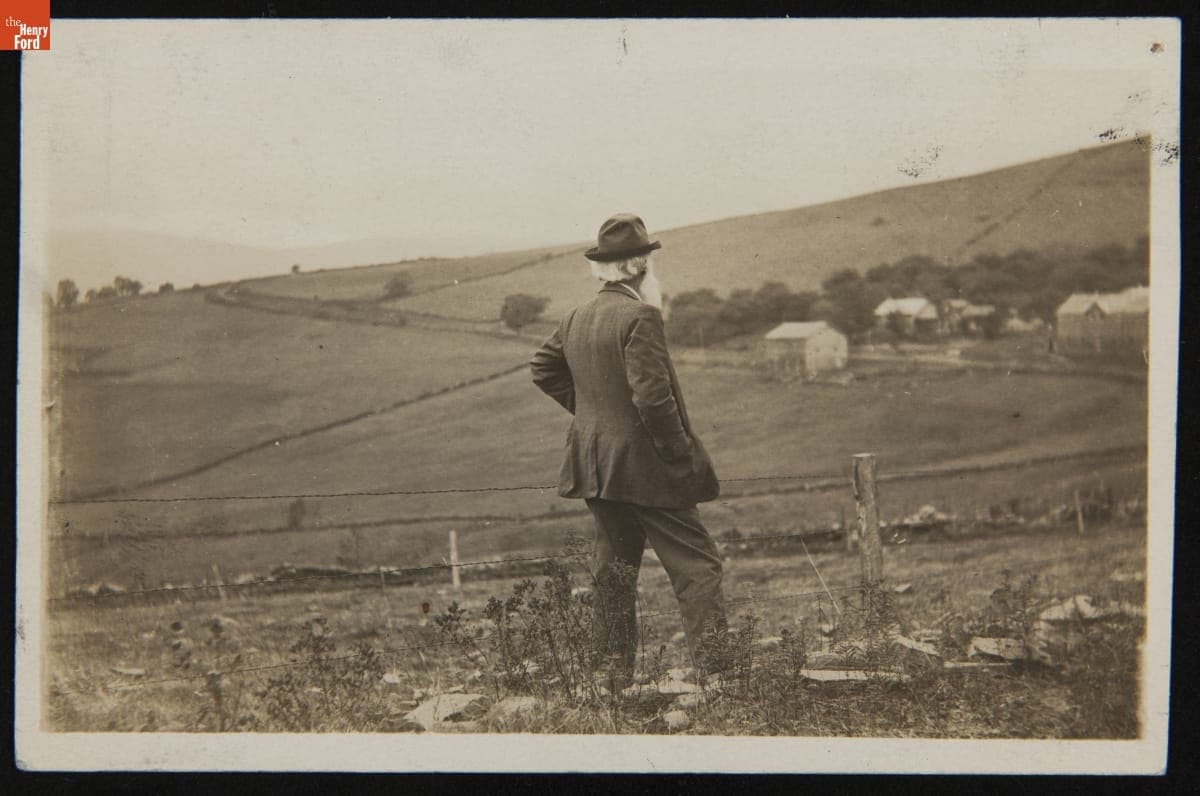
Burroughs was born in 1837 on his parent's farm outside Roxbury, New York. He was the seventh of ten children and like other farm children he shared the daily farm chores. Memories of his rural boyhood life stayed with Burroughs as he grew and turned into a famed nature writer.
View ArtifactJohn Burroughs at His Birthplace, Roxbury, New York, circa 1915
Burroughs would remember his hard work on the farm, but idealized the meadows, pastures, woods, and surrounding landscapes: the rock outcroppings and mountains, the rivers and streams, and the animals and birds that inhabited his youth. The Catskill Mountains were a familiar place--a place to where he would inevitably return.
View Artifact"Old Stone Jug" School Once Attended by John Burroughs, Roxbury, New York, 1944
Burroughs began his formal education at the local rural school. He was not the best student, but at the age of 12 an influential teacher, Mr. Oliver, helped him acquire "a genuine love of learning." After graduating, Burroughs wanted to continue his education by attending nearby preparatory schools. His family could not pay, so Burroughs left home and went to work as a teacher in Ulster County, New York.
View ArtifactLetter of Recommendation as a Teacher for John Burroughs from T. B. Pearson, Hedding Literary Institute, 1855
Teaching for short periods, Burroughs earned enough money to attend local prep schools. Courses taken at these schools strengthened his teaching credentials and exposed him to the literary works of writers like Ralph Waldo Emerson.
View ArtifactJohn Burroughs and Ursula Burroughs at Woodchuck Lodge, 1910-1915
Back teaching in Ulster County, Burroughs met Ursula North. The two married in 1857. The marriage was filled with tensions from the beginning--but would last for nearly 60 years.
View ArtifactPortrait of Ralph Waldo Emerson, circa 1865
During the late 1850s, Burroughs began to write magazine and journal articles to supplement his meager income from teaching. These articles tended to emulate the perspectives and styles of his literary heroes. One editor even believed Burroughs plagiarized from Emerson. Burroughs would eventually find his own voice, grounded in what he understood, prized, and loved--the natural world.
View ArtifactThe U.S. Patent Office, circa 1869
During the Civil War, Burroughs headed to Washington, DC, to find work. There, he met another of his literary heroes, poet Walt Whitman. Whitman was in the city tending wounded soldiers. Many of these soldiers were boarded in government buildings that had been turned in hospitals, like the U. S. Patent Office. Burroughs found work as a clerk at the Treasury Department--a job that lasted nearly ten years.
View ArtifactJohn Burroughs Picking Flowers, 1905-1915
In 1871, while still a government clerk, Burroughs penned his first book of nature essays, Wake-Robin. In this book, Burroughs describes his forays through his native Catskills and the woodlands near Washington, DC. His descriptions of birds, flowers, trees, creeks, and meadows reveals his--and humankind's--relationship with nature. The book was a success.
View ArtifactJohn Burroughs Putting up a Bluebird House at Riverby, 1902
Burroughs did not stay long in Washington after publishing Wake-Robin. In 1873, he purchased a 9-acre farm on the west bank of the Hudson River in New York and built a house. He called it Riverby.
View ArtifactInterior of John Burroughs' "Slabsides" Retreat, West Park, New York, 1917
In 1895, Burroughs built a small rustic cabin about a mile away from Riverby. He called this retreat Slabsides. Here, Burroughs would write some of his best-known essays. He would also entertain many famous Americans in this one-room cabin: Henry Ford, Theodore Roosevelt, and naturalist John Muir to name a few.
View ArtifactPocket Compass, Used by John Muir in His Travels in Canada, 1864-1866
Burroughs had met John Muir a few years before he built Slabsides. The two became friends, but it was a difficult friendship for both to navigate. John Muir was a man of the West. He was an environmental activist and strong-willed in his opinions--especially when it came to geology and the power of glaciers. Muir was also a traveler and considered himself a resident of the universe.
View ArtifactPortrait of John Burroughs, 1905
John Burroughs was a man of the East. A champion of the nearby landscape, and seemingly uninterested in the larger (geologic) forces that Muir espoused. Though well-traveled, Burroughs always yearned to be back in his beloved Catskills.
View ArtifactJohn Muir and John Burroughs in Pasadena, California, 1909-1912
But Burroughs and Muir did have some things in common. They were born a year apart: Burroughs in 1837, Muir in 1838. Both had been teachers when younger. And both were successful fruit farmers, but farming alone would make neither of them happy. More significant was their influence on how Americans viewed the world around them. Both helped create a new generation of naturalists and environmentalists.
View ArtifactJohn Burroughs' Album of Pressed Wildflowers Gathered during the Harriman Alaska Expedition, 1899
A mutual friend of Burroughs and Muir was railroad magnate E. H. Harriman. In 1899, Harriman funded an expedition to explore the coast of Alaska. He enticed Burroughs to serve as the expedition's official historian. Burroughs and 40 other scientists and naturalists (including John Muir) spent several months exploring the Alaskan coast. But Burroughs longed for home and the familiar surroundings of the Catskill Mountains of New York.
View ArtifactPresident and Mrs. Theodore Roosevelt with John Burroughs at Slabsides, 1903
Theodore Roosevelt was a friend of both Burroughs and Muir. Roosevelt visited Burroughs' home on several occasions. And Burroughs joined Roosevelt on a trip to Yellowstone National Park in 1903.
View ArtifactJohn Burroughs Statue, "Summit of the Years," in "Burroughs' Grotto" at Fair Lane, circa 1930
John Burroughs and Henry Ford first met in 1913--though Ford had been an admirer for some years. The two bonded over their love of birds. Ford dedicated a shrine to his friend on his Dearborn estate, Fair Lane. The "Burroughs Grotto" had a heated bird pool and a statue of the famed naturalist.
View ArtifactThomas Edison, John Burroughs, Henry Ford, and Harvey Firestone on a "Vagabonds" Camping Trip, 1918
John Burroughs also accompanied Henry Ford, Thomas Edison, and Harvey Firestone on several camping trips in the late 1910s. Though this group of friends called themselves "Vagabonds," they camped in style, served by support staff that cooked, cleaned, set up tents, and packed up the vehicles at each stop. These trips provided the four friends time to commune with nature, explore their personal interests, and act like boys again.
View ArtifactJohn Burroughs at Woodchuck Lodge, circa 1915
Burroughs spent the summers during the last years of his life in a house originally built by his older brother in the 1860s. The house was located near Burroughs' birthplace, and he could easily walk to "Boyhood Rock" where he played when he was a child. Burroughs called this summer retreat "Woodchuck Lodge" for the overabundance of groundhogs or woodchucks found in the area.
View ArtifactBoyhood Rock, Burial Place of John Burroughs, Roxbury, New York, 1925
In the winter of 1920-21, Burroughs traveled to Southern California with some family and friends. While there, the aging and ailing Burroughs fell seriously ill. On the return trip to New York, John Burroughs passed away. He was buried near Boyhood Rock on April 3, 1921--his 84th birthday.
View Artifact

