
Cars Inspired by Racing
Share
share
Auto racing pushes drivers and cars to their limits, advances new technologies, and entertains loyal fans. It also sells cars. Manufacturers have applied racing-inspired names to brands and models for more than a century. Some of these cars had horsepower and speed worthy of their lofty labels, but others simply suggested a connection to a great racing track, series, or personality. For many buyers, that was enough.
THF228703
Gil Andersen, #10 Stutz, May 1911
Gil Andersen drove a Stutz in the 1911 Indianapolis 500 -- the very first Indy 500. Harry Stutz built Andersen's car in less than five weeks. Andersen finished the race in 11th place, but with an impressive average speed of 68.25 mph. If not for tire troubles, Andersen likely would have finished even better.
View ArtifactTHF103924
Stutz Radiator Emblem, circa 1920
Harry Stutz and Henry Campbell formed Stutz Motor Company following the race. On the strength of Andersen's Indy performance, the firm adopted the slogan, "The Car That Made Good in a Day." The Stutz Motor Company's most famous model, the Bearcat, debuted for 1912 -- arguably America's first true sports car.
View ArtifactTHF277330
Race Driver Louis Chevrolet, circa 1913
Swiss-born racing driver Louis Chevrolet immigrated to the United States in 1900. Chevrolet built an impressive career, competing four times in the Vanderbilt Cup and four times in the Indianapolis 500. But he is best remembered for co-founding Chevrolet Motor Company with Billy Durant in 1911.
View ArtifactTHF103930
Chevrolet Automobile Emblem, circa 1930
Louis Chevrolet wanted to build big, expensive automobiles, but Billy Durant wanted a little entry-level car to compete with Ford's Model T. Durant won the argument and Chevrolet left his eponymous car-making business before its prosperous merger with General Motors in 1918. The company didn't make Louis Chevrolet rich, but it turned his name into a household word.
View ArtifactTHF91333
1915 Chevrolet Royal Mail Roadster
Some early Chevrolet models, like the 1915 Royal Mail Roadster, had the sleek appearance of a race car -- right down to the fuel tank behind the seats. The 24-horsepower, four-cylinder engine wasn't going to win any serious races, but the Royal Mail Roadster at least looked the part. For some customers, that's all that mattered.
View ArtifactTHF141858
Race Car Driver Eddie Rickenbacker, 1912-1917
Before he became America's greatest flying ace in World War I, Eddie Rickenbacker drove race cars. He competed in 42 major events and earned seven victories. Rickenbacker made five appearances in the Indianapolis 500. He earned his personal-best Indy finish in 1914 when he placed tenth.
View ArtifactTHF150744
Rickenbacker Radiator Emblem, circa 1925
Eddie Rickenbacker formed Rickenbacker Motor Company in Detroit in 1922. The company built mid-priced cars over six model years. Mr. Rickenbacker purchased Indianapolis Motor Speedway in 1927. He owned and operated the track for 18 years -- though he paused racing activities there during World War II. Rickenbacker sold the speedway to Tony Hulman in 1945.
View ArtifactTHF130893
William Clay Ford in 1953 Indianapolis 500 Pace Car, Ken Schuntz in "999" Racer, Ford Test Track, April 1953
Pace cars are an Indianapolis 500 tradition dating back to 1911. The pace car leads the grid into the race start, and returns to the track during caution laps to keep the field moving in an orderly fashion. For many years, different makes were featured on a revolving basis. Ford was given the honor for 1953 -- the automaker's 50th anniversary.
View ArtifactTHF87498
1953 Ford V-8 Pace Car, Used at Indianapolis 500 Race
Ford prepared a Sunliner V-8 convertible that was driven by William Clay Ford, Henry Ford's grandson, at Indy. Following the race and its associated ceremonies, Ford Motor Company gifted the original pace car to The Henry Ford. The company also built 2,000 replicas for public sale. Other manufacturers sold their own pace car replicas in future years.
View ArtifactTHF146992
Ferrari 250 GTO Driven by David Piper and Lucien Bianchi in the Daytona 2000 km Race, February 1964
Ferrari dominated sports car racing in the early 1960s with its 250 GTO. "GTO" came from the Italian "Gran Turismo Omologato" -- a grand tourer race car homologated, or approved, for competition. Powered by a 2,953-cubic-centimeter V-12 engine (roughly 250 cubic centimeters per cylinder), the 250 GTO won GT world championships in 1962, 1963 and 1964.
View ArtifactTHF90699
1965 Pontiac Tempest LeMans GTO Hardtop
Racing purists scoffed when Pontiac appropriated the GTO designation for its muscle car, introduced for 1964. But horsepower-happy buyers didn't seem to mind. In its first years, Pontiac's GTO wasn't its own model but an option package for the Tempest LeMans. And "LeMans" was yet another racing name, taken from France's famed 24-hour endurance race.
View ArtifactTHF144788
Program, 23e Grand Prix de Monaco (23rd Grand Prix of Monaco), May 1965
Racers and fans rank the Grand Prix of Monaco alongside the 24 Hours of Le Mans and the Indianapolis 500 as one of the three most important automobile races in the world. Its prestige comes from its long history -- the first Monaco Grand Prix was held in 1929 -- and its glamorous location on the streets of Monte Carlo.
View ArtifactTHF139691
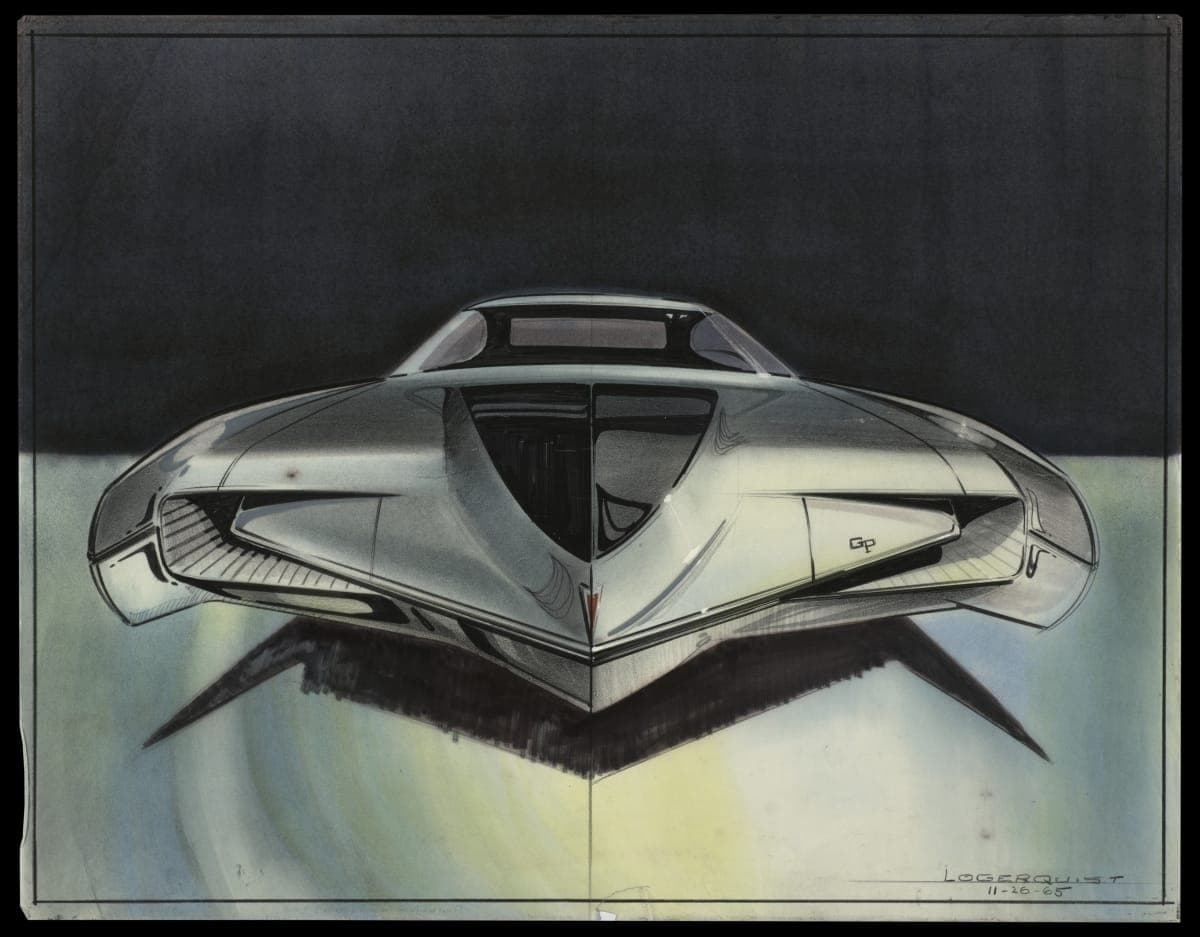
Rendering of Proposed Pontiac Grand Prix Design by Don Logerquist, November 1965
Pontiac used the "Grand Prix" name on a series of coupes and sedans built from 1962 through 2008. Grand Prix racing was a direct predecessor of today's high-speed, high-tech Formula One series. As "Prix" (French for "prize") suggests, Grand Prix racing had its origins in France in the 1890s.
View ArtifactTHF128690
Dan Gurney Driving Mercury Cougar, Green Valley Trans-Am Race, Texas, April 1967
Dan Gurney earned victories in Indy car, sports car, stock car, and Grand Prix races, and he designed and built cars for his own All American Racers team. Gurney also drove Mercury Cougars in the Trans-Am racing series -- a series specially created by the Sports Car Club of America (SCCA) for sporty pony cars like Mustang, Camaro and Cougar.
View ArtifactTHF90058
1968 Mercury Cougar Coupe
The Mercury Cougar debuted for 1967 as an upscale version of its corporate-cousin Ford Mustang, which had kicked off the whole pony car craze in 1964. The Cougar's XR7-G package added a hood scoop, sun roof, and special trim. The racing connection? That "G" stands for Gurney -- as in Dan Gurney.
View ArtifactTHF132644
1977 Pontiac Sales Brochure, "Pontiac. The Mark of Great Cars. 1926-1977"
Pontiac introduced its own pony car, the Firebird, in 1967. Two years later, Pontiac applied the "Trans Am" name to its top-level Firebird. GM paid a five-dollar royalty to SCCA for each Trans Am sold. Ironically, the Trans Am didn't initially compete in Trans-Am races -- its 6.6-liter engine exceeded SCCA's 5-liter displacement limit.
View ArtifactTHF124906
Carroll Shelby at the 12 Hours of Sebring Race, March 27, 1965
Carroll Shelby's competitive driving career was cut short by a heart condition, but that didn't stop him from becoming one of America's most influential race car designers and entrepreneurs. Shelby played a key role in Ford Motor Company's campaign against Ferrari at Le Mans, helping Ford earn victories in 1966 and 1967.
View ArtifactTHF113083
Postcard Showing 1968 Ford Mustang Shelby GT 500KR
During its Le Mans effort, Ford Motor Company tapped Carroll Shelby's expertise and name recognition to create a series of special high-performance Shelby Mustangs. The 1968 GT500KR featured a 335-horsepower, 428-cubic-inch Cobra Jet V-8 engine. The "KR" stood for "King of the Road."
View ArtifactTHF220840
Bobby Unser Collection--Photographs--Racing--1975 Indy--Item26
Over his 32-year competitive driving career, Bobby Unser earned two national championships in open-wheel cars, 13 wins at the Pikes Peak International Hill Climb, and three victories at the Indianapolis 500. Unser's second Indy win came in 1975 when a torrential downpour cut the race short after 174 of the 200 laps were completed.
View ArtifactTHF220972
Bobby Unser Collection--Photographs--Racing--1975 Miscellaneous--Item19
Since 1936, Indianapolis 500 winners have received a copy of that year's pace car -- in addition to a cash prize and lucrative endorsement opportunities. Bobby Unser got a Buick Century Custom V-8 for his soggy 1975 victory. The Century Custom also served as pace car at the 1975 Pikes Peak International Hill Climb.
View ArtifactTHF287126
"How Blessed I've Been," Clip from Interview with Mario Andretti, June 20, 2017
Mario Andretti fell in love with motorsport during a boyhood visit to the Autodromo Nazionale di Monza, Italy's most celebrated racing circuit and one of the best-known tracks in the world. Years later, Andretti clinched the Formula One World Drivers' Championship at Monza in 1978 -- the triumph of a lifetime for a young boy not afraid to dream big.
View ArtifactTHF206512
Sales Brochure, "Monza," 1977
Chevrolet first used the "Monza" name to designate a premium package available on the compact Corvair. It later became a model name in its own right for a sporty Chevy subcompact built from 1975 to 1980. Chevrolet Monzas competed in sports car races through the late 1970s -- though equipped with Corvette engines.
View ArtifactTHF146966
Program, Tenth Annual Daytona 500, February 1968
The Daytona 500, held each February at Florida's Daytona International Speedway, is the most important race in NASCAR. For drivers and teams, it's a return to the hallowed ground where NASCAR was formed by Bill France, Sr., in 1947-48. For fans, it's a week-long party filled with driver autograph sessions and qualifying races leading up to the main 500-mile event.
View ArtifactTHF150720
Dodge Daytona Dashboard Emblem, 1984-1989
"Daytona" was such an appealing model name that both Studebaker and Dodge used it. Studebaker applied it to a sporty version of its compact Lark from 1962 to 1966. Dodge first used "Daytona" on a performance version of the 1969 Charger -- which actually competed in its namesake race -- and later on a hatchback built from 1984 to 1993.
View ArtifactTHF131636
Dave MacDonald Driving Corvette at Pomona Raceway, July 1962
Racers dismissed the first Chevrolet Corvettes with their six-cylinder engines and Powerglide automatic transmissions. But attitudes changed when a V-8 and a manual shift joined the options list for 1955. By the early 1960s, Corvettes were regular class winners in sports car and endurance competitions.
View ArtifactTHF272443
Interior Concept for Indy Corvette Show Car, circa 1985
Given Corvette's sports car racing pedigree, it first seems odd that this concept car took its name from the heart of American open-wheel racing: Indianapolis. But the mid-engine Corvette Indy was originally equipped with a power plant based on the V-8 developed by Chevy and Ilmor Engineering for Indy car competition -- hence the name.
View ArtifactTHF126228
Official Timing Stand, Bonneville Salt Flats, Utah, 1956
Located in northwest Utah on the site of an ancient lake, the Bonneville Salt Flats have been a haven for land speed racers since the 1930s. At 46 square miles, the Flats offer plenty of open, level terrain. Conditions are usually right for racing only from mid-August through October, when the hard, white salt forms a solid running surface.
View ArtifactTHF150656
Pontiac Bonneville Nameplate, circa 1990
Given Pontiac's longtime position as General Motors' performance brand, it's not surprising that the division employed so many racing-influenced model names. "Bonneville" appeared on various Pontiacs -- mostly premium full-sized sedans -- from 1957 to 2005. Before that, it had been used on a Pontiac concept car built for the 1954 GM Motorama.
View Artifact

