
The Rouge
Share
share
Images and artifacts from Ford's landmark factory.
THF92065
Eagle Boat Built by Ford Motor Company, circa 1918
To combat German submarine attacks on U.S. cargo ships during World War I, Henry Ford suggested the mass production of submarine chasers. Ford Motor Company accepted a government contract to build these "Eagle Boats" and began production at its partially developed industrial complex along the Rouge River in 1918. By late 1919, Ford had completed 60 Eagle Boats for the U.S. Navy.
View ArtifactTHF117578
Fordson Tractor Assembly Line at the Ford Rouge Plant, May 1923 - 1
Ford Motor Company's River Rouge Plant was conceived as a site for the mass manufacture of Fordson tractors. For a time, it was actually called the Fordson Plant. This photograph shows a tractor assembly line at the Rouge in 1923. To make way for production of the Model A in 1928, tractor assembly was discontinued and relocated to Cork, Ireland.
View ArtifactTHF156225
Ford Model T 4-cylinder Automobile Engine, 1924
This is the first Model T engine built at Ford's Rouge factory. The Rouge never built complete Model Ts, but it did make nearly every part that went into them. The parts were shipped back to Ford's Highland Park plant for assembly into finished cars. Not until the Model A, introduced in 1927, were cars fully built at the Rouge.
View ArtifactTHF15858
Blast Furnace, 1924 - 1
In 1924-25 the Ford Motor Company ran a series of sixteen dramatic advertisements in the Saturday Evening Post and Country Gentleman magazines. The effectiveness of the ads was due in large part to the specially commissioned artwork that accompanied the descriptive text. This painting, one of two created for the 11th ad, conveys the heat and scale of the Rouge blast furnace operation.
View ArtifactTHF118364
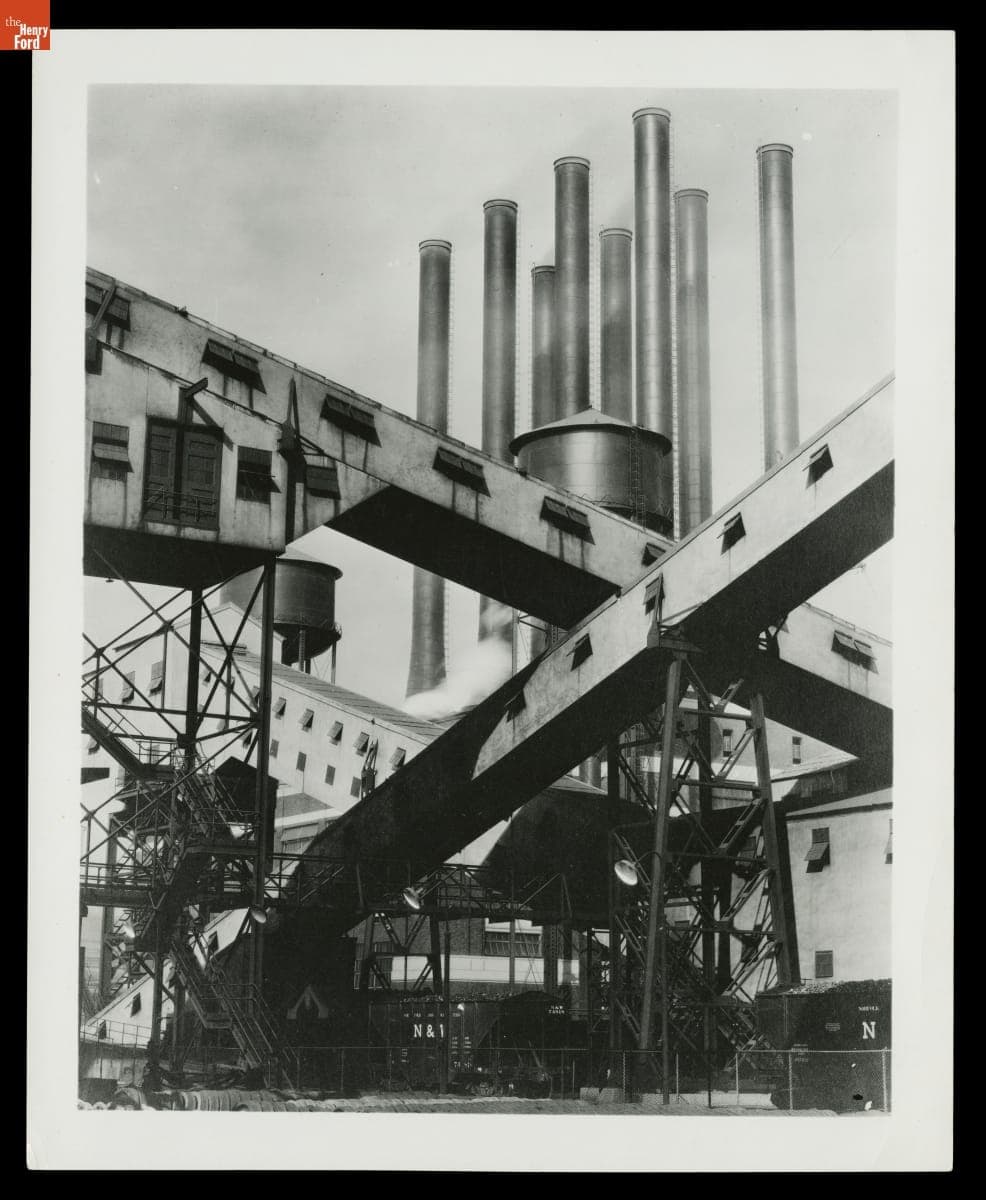
Criss-crossed Conveyors at Ford Rouge Plant, 1927
In 1927, Ford Motor Company commissioned Charles Sheeler to do a series of documentary photographs of its River Rouge industrial complex near Dearborn, Michigan. The conveyors moved coal and coke to the pulverizing building and screening stations. Coke made from coal was used in the steelmaking process of the blast furnaces. This vigorous photograph shows Sheeler's ability to form a compelling image from a complicated scene.
View ArtifactTHF95639
Final Assembly of Ford Model A Cars at the Rouge Plant, Dearborn, Michigan, 1928
The 1928 Model A was the first automobile completely built at the Rouge, Ford Motor Company's massive factory complex in Dearborn, Michigan. While Model T engines and parts had been manufactured at the Rouge for several years, final assembly of the cars themselves remained at Ford's Highland Park plant. The Model A brought new significance to the growing Rouge factory.
View ArtifactTHF117391
Aerial View of Ford Motor Company Rouge Complex, Dearborn, Michigan, 1930
This aerial view shows Ford Motor Company's sprawling Rouge plant--the largest, most efficient manufacturing complex of its time. Ford established its administrative headquarters here in 1928, around the same time the company began manufacturing automobiles from start to finish at the plant. The Rouge became not only central to Ford's operation but an icon of modern industrial efficiency.
View ArtifactTHF122719
1931 Ford Victoria Coupe on Assembly Line at Rouge Plant, 1931
In the final stages of assembly, the body of a 1931 Ford Model A is lowered onto its chassis. Ford's assembly line resembled a river system. Smaller lines or "streams" fed components -- frames, engines, wheels, bodies -- to the larger final line. All the parts came together in this main "river" line where the car took shape in its completed form.
View ArtifactTHF94856
Henry Ford and Edsel Ford at Ford Rouge Plant, 1933 - 1
The world's largest integrated factory, the Ford River Rouge Complex, was completed in 1928. It quickly became an icon of modern industrial efficiency. The vast Rouge Plant serves as a backdrop for Henry Ford -- founder of Ford Motor Company -- and his son Edsel Ford -- Ford Motor Company president -- in this 1933 photograph.
View ArtifactTHF145073
Blind and Visually Impaired Workers at the Ford Rouge Plant, 1934
Henry Ford believed in providing employment opportunities to individuals with disabilities. Workers who were blind or visually impaired could sort ammeter gauges or assemble valve bushings by feel, for example, while workers with amputations could operate push-button machines with no difficulty. It was estimated that Ford Motor Company employed as many as 13,000 people with disabilities in 1927.
View ArtifactTHF98597
Assembling Ford V-8 Engines at Ford Rouge Plant, Dearborn, Michigan, 1934
Henry Ford's last great automotive innovation was his introduction of a low-priced V-8 engine for 1932. Starting under $500, it was an exceptional value. Ford Motor Company's V-8 outsold its four-cylinder engine by a wide margin, and the four-cylinder unit was retired for 1935. The 1932 V-8 engine design remained in production until 1953.
View ArtifactTHF98601
Ford Rouge Plant Administration Building from the Ford Rotunda, Dearborn, Michigan, 1936
The Rouge plant's growing importance to Ford Motor Company was confirmed in 1928 when the automaker moved its administrative headquarters from Highland Park to the Rouge's grounds. The four-story administration building, designed by Albert Kahn and faced with white limestone, housed purchasing, sales, advertising, and accounting offices, in addition to office suites for Henry Ford and Edsel Ford.
View ArtifactTHF98102
Dropping Engine into Chassis on Final Assembly Line, Ford Rouge Plant, 1936
Ford Motor Company's assembly line was, in fact, a series of separate assembly lines. Engines, like this V-8, were put together in one stream. Frames were fitted with axles, wheels and driver controls in another. Bodies were assembled in another stream. All these lines flowed into the final assembly line where the major components were combined into complete automobiles.
View ArtifactTHF94846
Ford Service Department Men Confront UAW Organizers during the Battle of the Overpass, May 26, 1937 - 1
Ford Motor Company refused to recognize the United Auto Workers (UAW) labor union. On May 26, 1937, men from Ford's Service Department (left) attacked labor organizers (right) Robert Kanter, Walter Reuther, Richard Frankensteen, and J.J. Kennedy on a pedestrian overpass at Ford's Rouge Plant. This "Battle of the Overpass" came to symbolize the struggle to unionize Ford. The UAW ultimately succeeded in 1941.
View ArtifactTHF98130
Conveyors with Radiator Grilles on Assembly Line at Ford Rouge Plant, 1937
Quality control is an important element in any factory. Here, workers at Ford's Rouge plant inspect radiator grilles for defects. Flawed grilles are removed from the overhead conveyor, repaired, and then returned to the stream to make their way toward the main chassis assembly line.
View ArtifactTHF112274
Soybean Processing Building at the Ford Rouge Plant, Dearborn, Michigan, 1940
Starting in 1931, Henry Ford invested much money and research into soybeans. Ford viewed the crop as a bridge between agriculture and industry, and he used soybean oil and soybean-based plastics in Ford Motor Company vehicles. At the Rouge's processing building, soybeans were crushed and mixed with hexane -- a chemical that extracted the soybean oil.
View ArtifactTHF113889
Ford Rouge Plant Pictorial Flow Chart, "Complete Car Can Be Built in 28 Hours," 1940 - 2
This diagram illustrates how Ford Motor Company's massive River Rouge Plant turned coal, iron ore, limestone, rubber, and sand into iron, steel, tires, glass, and finished automobiles.
View ArtifactTHF93754
Tank Assembly Changeover at Ford Motor Company Rouge Plant, Gear and Axle Building, Dearborn, Michigan, 1943
Ford Motor Company repurposed its assembly lines to meet military manufacturing needs during World War II. The last peacetime automobile rolled out of Ford's massive River Rouge plant in 1941, and focus shifted to the wartime production of aircraft engines and military vehicles. The Rouge manufactured M-4 tanks through 1943 and continued producing M-4 engines and armor plates until war's end.
View ArtifactTHF126947
Ford Employee R. L. Walker Buying a War Bond at the Rouge Plant, Dearborn, Michigan, 1943
Ford Motor Company and its employees contributed to Allied efforts in World War II in numerous ways. The company built trucks, tanks, aircraft engines, gliders, and B-24 bomber airplanes. Ford workers purchased war bonds with their earnings, either independently or through a payroll deduction program.
View ArtifactTHF729135
Poster Showing an Aerial View of "The Rouge--World's Most Famous Plant," 1947
Completed in 1928, Ford Motor Company's River Rouge Complex was the largest, most efficient manufacturing complex of its time. It quickly became an icon of modern industrial production. This poster depicts the vast Rouge Plant just after World War II, when Ford added an aircraft engine plant, armor-plate building, magnesium smelter and foundry, and naval training station for defense contract work.
View ArtifactTHF123108
Henry Ford II Driving the First 1949 Ford off Assembly Line at Rouge Plant, 1948
Ford beat General Motors and Chrysler to the market with the first all-new postwar car from the Big Three. The 1949 Ford was a personal triumph for company president Henry Ford II. It represented his successful efforts to rebuild the automaker after the deaths of his father, Edsel Ford, and grandfather, Henry Ford.
View ArtifactTHF222406
Brochure, "The Ford Rotunda, Fifty Years Forward on the American Road" 1953 - 1
Ford Motor Company brought its central Rotunda building from the 1934 Century of Progress Exposition back to Dearborn and, from 1936 to 1962, recreated the excitement of a World's Fair exposition on its home turf. This souvenir book commemorated Ford's 50th Anniversary in 1953. The Ford Rotunda reopened then, with renovations that included a geodesic dome designed by Buckminster Fuller.
View Artifact

