
Highlights from the Gwinn Dairy Collection
Share
share
David Gwinn, president of Philadelphia's Pennbrook Milk Company, began assembling objects, books, and archival material related to the dairy industry in 1934. His collection grew to become the most comprehensive in the United States. These highlights from the Gwinn Dairy Collection, donated to The Henry Ford in 1971, help trace the long and rich history of dairying.
THF171822
Cowbell
Bells fastened around the necks of cows, sheep, or goats have been used for thousands of years. The clanging bells help farmers or herders locate their livestock in large fields or hilly terrain and find those lost in inclement weather.
View ArtifactTHF704004
A Treatise on Milch Cows, 1846
For millennia, people have taken some of the milk cows produce for their calves and used it for their own families. This book describes different breeds of cattle dairy farmers might include in their herds. Shorthorn cows were ideal for many farm families because they provided both milk and meat. Jersey cattle gave milk rich in butterfat. Other popular breeds included the Holstein, Ayrshire, Guernsey, and Dutch Belted.
View ArtifactTHF171741
Milk Pail
Tin-plated sheets of iron or steel, commonly called "tin," was the dominant material for utilitarian items in 19th-century America. In addition to being lightweight, inexpensive, easy to clean, non-toxic, and durable, tinware resisted corrosion. It was the material of choice for dairying containers like milk pails, pans, and cans.
View ArtifactTHF191259
Vase, 1830-1850
The milkmaid is an age-old figure associated with dairying in Western culture. Many people believed dairy cows responded better to the supposedly gentler touch and kinder demeanor of women and girls. This vase represents the stereotypical image of the sweet and dedicated milkmaid and reflects a nostalgia for rural times before the rise of industrialized urban centers.
View ArtifactTHF59789
Milking Machine, circa 1865
Dairy farmers sought labor-saving technologies to address labor shortages and growing herd sizes during the early 20th century. The American Cow Milker was an early attempt to speed up the milking process and increase production. Its success was limited, but later, improved milking machines would become the industry standard.
View ArtifactTHF703418
"View of Cow Stables Attached to the Distillery" from Frank Leslie's Illustrated Newspaper, May 15, 1858
Milk purity became a major concern as cities swelled in the mid-1800s. Scathing reports exposed New York City's "swill milk" scandal in 1858. Whiskey distillers kept dairy cows in cramped sheds and fed them leftover mash, which sickened them and tainted their milk. The milk--masked with other ingredients and marketed as "pure"--made urban consumers ill and even killed many infants.
View ArtifactTHF171797
Churn, circa 1850
Some producers watered down their milk or sold milk contaminated with dirt, dust, or other adulterants. Feeding babies tainted cow's milk was once a common cause of infant mortality. Consumers' concerns about milk purity prompted both regulation and changes in marketing. Questions remained about which dairies could be trusted, but most branded their products as "pure."
View ArtifactTHF191352
Vaqueria Tres Monjitas Milk Bottle, circa 1935
Dealers once measured milk from large cans into customers' smaller containers. Due to concerns about milk purity, dairies began adopting sanitary glass bottles in the 1860s. They quickly became an industry standard. This bottle was used by Vaqueria Tres Monjitas, a dairy company founded in Puerto Rico in 1918.
View ArtifactTHF704119
Pure-Pak Carton for Foremost Homogenized Mellow Milk, circa 1953
Disposable paper milk containers were first patented as early as 1909 and became popular in the 1930s.
View ArtifactTHF703431
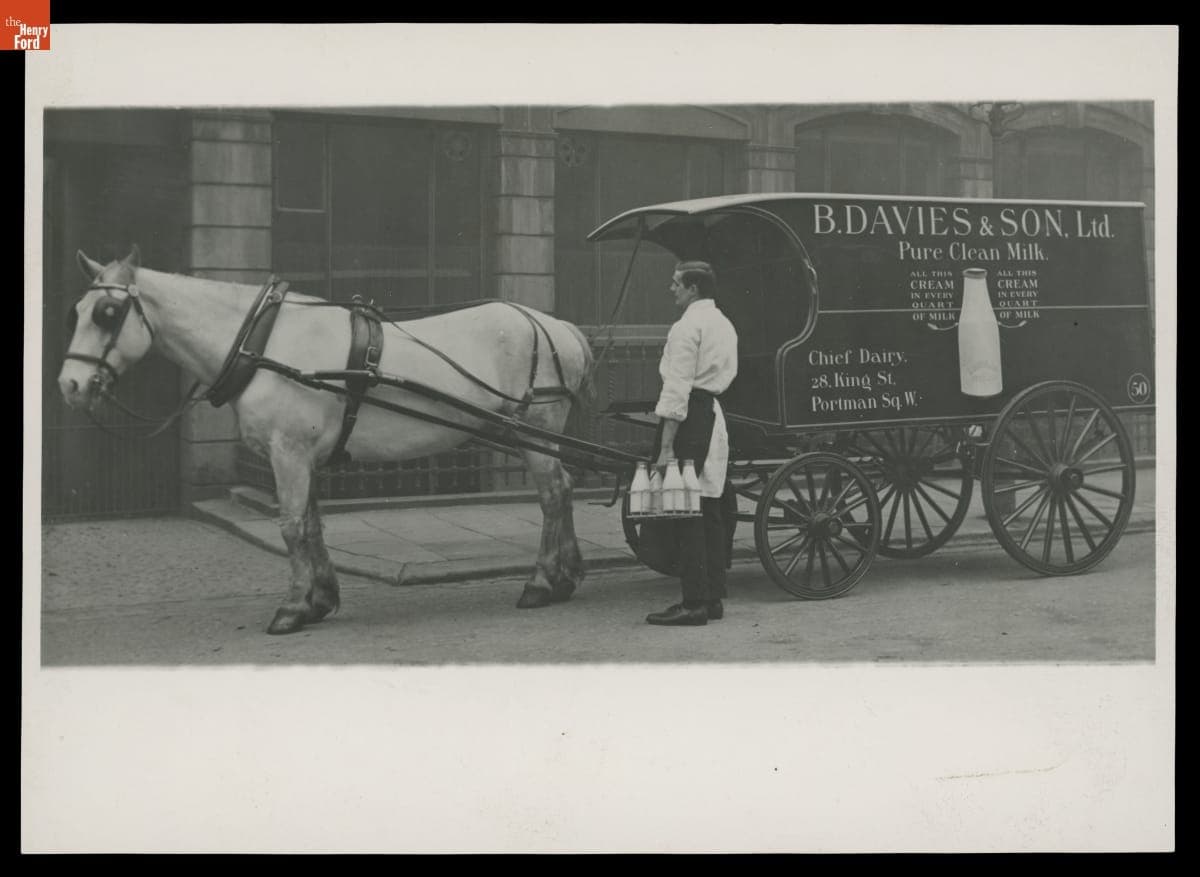
"Pure Clean Milk," B. Davies & Son, Ltd. Milk Delivery Wagon, circa 1911
Horse-drawn wagons delivering milk and other dairy products to customers became a common sight.
View ArtifactTHF703436
Milk, Cream & Ice Store, 1890-1905
Increasingly, customers could also shop at stores carrying or even specializing in dairy products.
View ArtifactTHF703467
Mack Truck Used by Pennbrook Milk Company, circa 1950
Horses were well suited to the frequent stops on a delivery route, but trucks provided greater range at lower cost. Motorized trucks replaced horse-drawn dairy delivery wagons in the early 20th century. This one was used by David Gwinn's dairy in Philadelphia, Pennsylvania.
View ArtifactTHF172092
Royal P-5 Cream Separator, circa 1925
This machine separated cream -- the essential ingredient in butter -- from fresh milk. Before these devices were introduced in the late 1870s, people placed fresh milk in a shallow pan and waited many hours for the cream to rise. Cream separators used centrifugal force to speed things up, revolutionizing the butter making process.
View ArtifactTHF705087
Aquatint, "Woman Churning Butter," 1806
To make butter, cream must be agitated. Typically, farm women used churns to complete this labor-intensive chore.
View ArtifactTHF126761
Butter Churn, circa 1900
Manufacturers developed countless new and improved churns during the 19th century, attempting to ease the burden of making butter. Users placed cream inside the barrel of this churn, closed the lid, turned the crank and... kept turning! "The Favorite," as the company named it, relied on an end-over-end motion to agitate the cream.
View ArtifactTHF65711
Ice Cream Maker, circa 1890
Ice cream, a favorite dairy product, wasn't readily available until the late 1800s, when ingredients became affordable and inventors patented labor-saving crank-and-dasher devices. The Chambersburg Liquid Freezer Company made this ice cream maker about 1890. Ice chilled the interior tin as it churned cream and sugar to create a sweet treat.
View ArtifactTHF171758
Creamery Package Mfg. Co. Sediment Tester, circa 1915
In the early 20th century, commercial dairies began to combine factory production with improved transportation, refrigeration, pasteurization, and packaging methods to make fresh, pure milk available throughout the United States. Testing equipment like this helped producers ensure their milk was free of dust and dirt.
View ArtifactTHF703465
Men Working in Hawthorn-Mellody Farms Dairy Processing Plant, circa 1960
Commercial dairies continued to expand, using the latest manufacturing technology to turn out dairy products in mass quantities. But the age-old relationship between humans and the animals whose milk they extracted and processed remained the same--and it endures to the present.
View ArtifactTHF703471
Grocery Store Dairy Case Stocked with Pennbrook Milk Company Products, circa 1950
By the middle of the 20th century, consumers could choose from an array of commercially made dairy products at grocery stores around the country. This photograph depicting a Pennbrook Milk Company display represents David Gwinn's work in the dairy industry and efforts to preserve its history through his collection.
View Artifact

