
Driving in the 1970s: Big Problems, Small Cars
Share
share
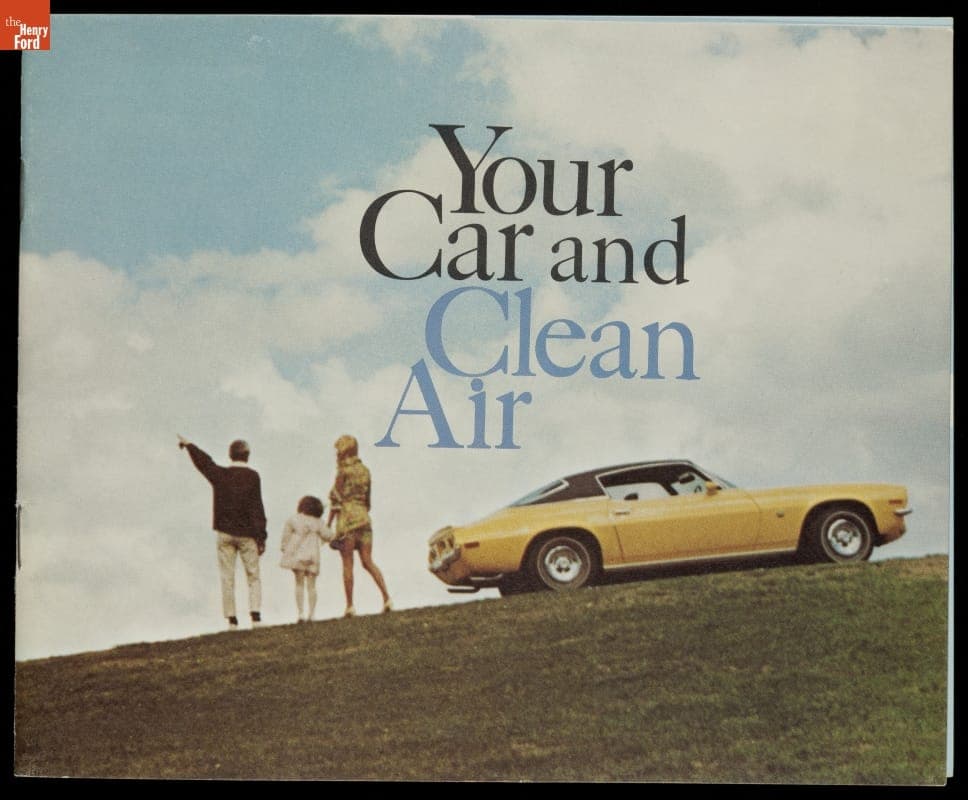
An oil crisis and growing environmental concerns in the 1970s compelled Americans to reconsider their driving habits. Facing gas shortages, high fuel prices, and emissions regulations, many consumers opted for smaller, more fuel-efficient vehicles.
"Your Car and Clean Air," 1970 - 1
By 1970, the date of this Ford Motor Company booklet, automobile companies were reassuring their customers that they were engaging in intensive research programs to eliminate "offending" emissions, by then widely recognized as a significant source of air pollution.
View ArtifactAMC Hornet Gas Cap, 1970-1977
Higher gas prices increased the popularity of locking gas caps, which prevented thieves from siphoning gas out of fuel tanks with hoses.
View ArtifactNew York State Emission Inspection Sticker, 1976
State-mandated car safety inspections began to include emissions checks by the late 1970s.
View ArtifactTexaco Gasoline Economy Calculator, 1974
Although not new, mileage calculators became much more popular during the gasoline crisis in the 1970s. In addition to calculating miles per gallon, this Texaco giveaway contains a mileage record on the back with the advice, "Conserve While You Consume."
View ArtifactNewsweek Magazine for September 17, 1973, "Arab Oil Squeeze" - 1
In October 1973, the Arab nations of OPEC (Organization of Petroleum Exporting Countries) placed a five-month embargo on oil shipped to the United States -- considered an "enemy of the Arab cause" for supplying military aid to Israel during the so-called Yom Kippur War. The previous month, Libya nationalized foreign oil companies and the Arab oil squeeze was on.
View ArtifactDiagram of a Car's Catalytic Converter System, 1974
As auto companies were increasingly pressured to comply with more stringent government regulations, the catalytic converter emerged as a popular device that both improved fuel economy and reduced emissions. Noxious by-products of combustion passed from the engine through the catalytic converter, where chemical reactions converted the emissions to less toxic substances.
View Artifact"Discover a New Horizon. Plymouth Horizon," 1978
According to this sales brochure, the new horizon for 1978 was a Plymouth Horizon. The car had front-wheel drive, maximized its interior space, and provided needed fuel economy. Plymouth offered luxury options, too. The Horizon and its twin, the Dodge Omni, were Motor Trend's "Car of the Year" for 1978.
View Artifact1978 Dodge Omni Sedan - 3
This little car was a reaction to the high gasoline prices brought on by the 1973 Arab oil embargo and the new fuel economy standards passed by Congress in 1975. It, and its twin the Plymouth Horizon, were the first American cars to adopt a front-wheel-drive, hatchback configuration that was common in Europe. Motor Trend magazine named them "Car of the Year."
View Artifact"The Clean Air Quest," Ford Motor Company, Dearborn, Michigan, 1973 - 1
The Ford Motor Company, and other car companies, publicized their commitment to comply with 1970 clean air standards. This booklet, produced by Ford, contains articles about air pollution causes, federal legislation, alternative power sources, and ways for the public to help.
View Artifact1977 Volkswagen Sales Brochure, "VW Breaks the 50 MPG Barrier" - 1
As Americans turned to more energy-efficient cars than the American auto companies were turning out, they found that the Volkswagen Rabbit -- a small front-wheel-drive replacement for the VW Beetle available to Americans by the mid-1970s -- delivered superb fuel economy. Specifically, it was the diesel-powered Rabbit that averaged 52 mpg on the highway (and 39 mpg in the city).
View ArtifactHandbill Advertising the Comuta-Car, circa 1980
This advertisement for the Comuta-Car promoted its energy savings and pollutions control. These factors however could not convince enough people to purchase the vehicle.
View ArtifactGeneral Motors Publication, "Progress toward pollution-free cars," 1970
In 1970, General Motors released this brochure about its automotive emissions research. The brochure provided background information about air pollution challenges, a progress report, and GM's plans to achieve its goals.
View Artifact1980 Comuta-Car Electric Runabout - 4
The Comuta-Car, and its predecessor the CitiCar, were electric cars designed for limited use in cities. Sharp increases in gasoline prices in the 1970s persuaded some 4,000 people to buy the tiny vehicles. But every time the price of fuel spiked, it always fell again, and demand for specialized urban electrics always fell along with it. Will the time for such cars ever come?
View Artifact"Dodge Omni Totes the Tots, Hits Night Spots," 1977
Car brochures have evolved from straightforward product catalogues into polished creative sales tools. Their quality paper, rich color, inventive formats, and sophisticated graphic design all contribute to a buyer's developing impression of a car in a showroom. Advertising might entice people to a dealership, but brochures extend and deepen the relationship between vehicle and potential buyer.
View ArtifactGasoline Mileage Meter, circa 1974
Although not new, mileage calculators became much more popular during the gasoline crisis in the 1970s. In addition to calculating miles per gallon, this Skelly giveaway contains a mileage record on the back, proclaiming it is "The New Champ!" in fuel economy.
View Artifact1977 Honda Civic Sedan and Hatchback, "What the World is Coming To"
Oil crises brought a jump in gas prices -- and a surge in small car sales -- in the 1970s. Japanese automaker Honda was well positioned to meet the demand. Its compact Civic managed 40 miles per gallon on the highway. Honda sold some 39,000 cars in the U.S. in 1973. Annual sales soared to more than 353,000 by 1979.
View Artifact

