
Roadside Taverns
Share
share
Road-weary travelers depended on roadside taverns for food and lodging. Taverns also served local patrons as sites for socializing, entertainment, or public celebrations.
THF204127
Broadside, "Philadelphia and Baltimore Regular Land Stages," 1788
This small advertising broadside from 1788 gives the schedule of trips and rates of fare for a stage-coach line that ran between the "Indian Queen" Tavern in Philadelphia, Pennsylvania, and Captain Philip's in Baltimore, Maryland.
View ArtifactTHF204133
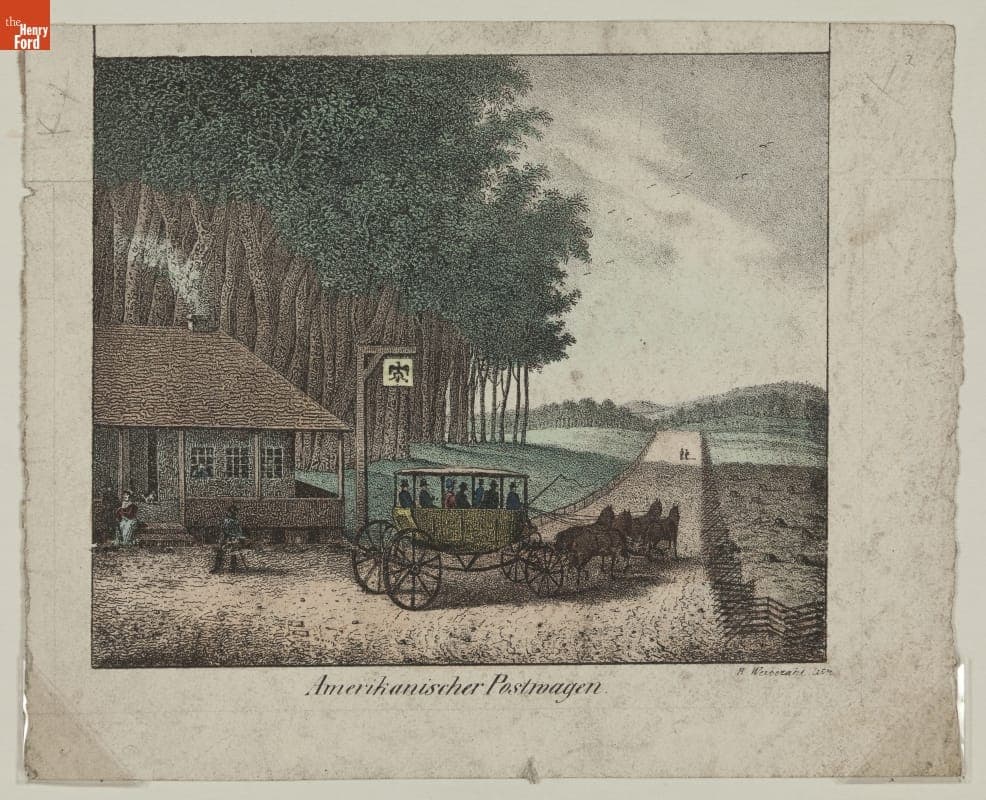
"Amerikanischen Postwagen" (American Stage Coach, 1800-1810), Lithograph, circa 1815
Stage wagons were light and open, though not as comfortable as later Concord stagecoaches. They could go about five miles per hour, barring bad weather or road obstructions. The gaily painted signboards of roadside taverns beckoned weary travelers, promising rest, meals, and a chance to catch up on news. Stage wagon drivers used the stop to care for their horses.
View ArtifactTHF204157
Waybill for Piles Stagecoach Line from Vincennes, Indiana to St. Louis, Missouri, circa 1825
This circa 1825 waybill lists the distances in miles between taverns along Piles' stage coach line between Vincennes, Indiana, and St. Louis, Missouri.
View ArtifactTHF1918
Eagle Tavern
This stagecoach tavern was built in 1831 in Clinton, Michigan, 50 miles west of Detroit. Taverns dotted the American countryside during the first half of the 1800s, a period of massive migration, new settlement, and rapid change in a young America. From 1849-1854, farmer Calvin Wood operated this tavern, offering food, drink, and accommodations to travelers who passed through his village.
View ArtifactTHF123849
Menu from Eagle Tavern, Greenfield Village, circa 1985, "Bill of Fare"
In the late 1920s, Henry Ford moved the Eagle Tavern to Greenfield Village. The building was used in various ways until the 1980s, when it was reinterpreted as an 1850s stagecoach tavern. Staff researched period foods, recipes, and menus to develop the Eagle Tavern menu, which included food and drink appropriate for a roadside tavern of the era.
View ArtifactTHF200586
Stage Coaches and Conestoga Wagons in Front of an Inn (Photograph of a Drawing), circa 1840
In the 1800s, long-distance travelers often rode public coaches "in stages," jostling along rough country roads with mail, freight, and other passengers. Every few hours, the coach would stop to change horses. Inns served as popular stagecoach stops where weary travelers could find meals, lodging, and conversation. This illustration depicts a variety of traffic at the Fairview Inn near Baltimore, Maryland.
View ArtifactTHF204148
Copperplate Engraving, "Mansion House," 1842-1847
Built by Samuel D. Hubbard around 1827, the Mansion House served as a stagecoach stop providing meals and lodging to weary travelers passing through Middletown, Connecticut. The hotel also catered to local residents as a site for meetings and public celebrations. One notable party commemorated builder Samuel Hubbard's 1852 appointment to the office of United States Postmaster General.
View ArtifactTHF120729
Mail Coaches Changing Horses at a New England Tavern, 1855
This wood engraving depicts a typical mid-19th-century travel scene. Traveling by stagecoach meant being jostled on rough country roads and stopping every few hours to change horses. Travelers squeezed into coaches and roadside inns with strangers.
View ArtifactTHF119232
The Wayside Inn, Sudbury, Massachusetts, circa 1885
An 1862 stay at the old Howe Tavern in Sudbury, Massachusetts, inspired Henry Wadsworth Longfellow's popular poem Tales of a Wayside Inn. The former stagecoach stop continued to operate as a boarding house but soon began to attract tourists. Literary fans and curious travelers arrived eager to experience what they called "Longfellow's Wayside Inn" for themselves.
View ArtifactTHF126122
The Botsford Inn, Farmington, Michigan, circa 1900
In the 1800s, long-distance travelers often rode public coaches "in stages," jostling along rough country roads with mail, freight, and other passengers. Every few hours, the coach would stop to change horses. This tavern and meeting place on Michigan's Grand River plank road catered to coach traffic, serving as a stagecoach stop and providing meals and lodging to weary travelers.
View Artifact

