
The Ford V-8
Share
share
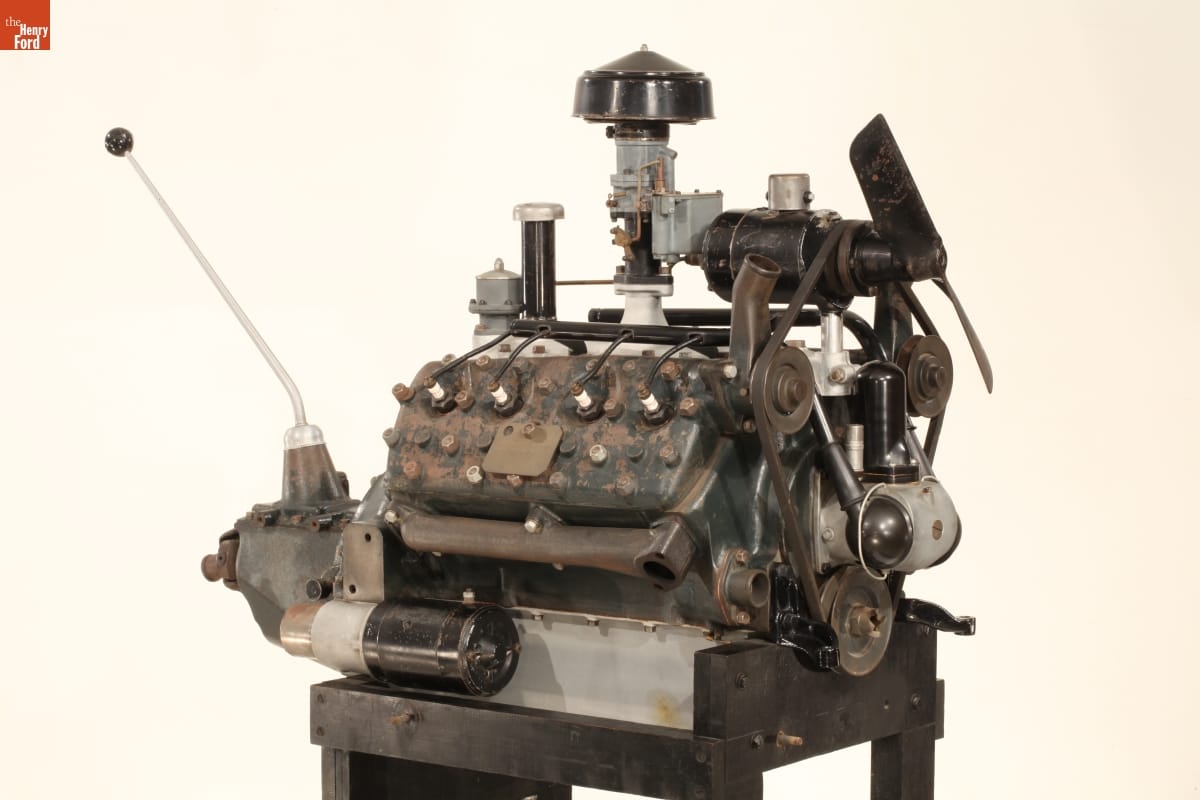
Ford introduced its V-8 in 1932, bringing a big engine to the low-price field.
THF207113
"How to Hop Up Ford & Mercury V-8 Engines," 1951
How do you go fast if you can't purchase a powerful engine? The size and weight of a stock V-8 engine built by Ford and Mercury offered racers an affordable option. And rodders could eke out more horsepower by relying on this book.
View Artifact"The Only Car under $2395 with a V-8 Engine," Artwork for Ford Advertisement, 1933
Henry Ford's V-8 engine was compact and powerful. It was light enough and cheap enough to put into his inexpensive automobiles. The 1932 Ford with a V-8 engine cost between $460 and $600, depending on options. Its closest price competitor with a V-8 engine was the 1932 LaSalle, which cost about four times as much at $2395.
View ArtifactLetter from John Dillinger to Henry Ford in Praise of the Ford V-8 Car, May 16, 1934
Did John Dillinger write to Henry Ford praising the industrialist's "wonderful car"? In 1934, Ford Motor Company received this letter apparently signed by Dillinger. Federal handwriting experts, however, concluded that the signature was not that of the fugitive gangster. Dillinger's tribute to Ford vehicles may never be confirmed because in July 1934 Public Enemy Number One was gunned down by U.S. agents.
View ArtifactLetter from Clyde Barrow to Henry Ford Praising the Ford V-8 Car, 1934
On April 13, 1934, Ford Motor Company received this unusual product testimonial. In it notorious bank robber Clyde Barrow extolled the virtues of Ford V-8s as getaway cars. Handwriting analysts have questioned the letter's authenticity, but it is the sort of thing the publicity-seeking Barrow might have written.
View ArtifactAssembling Ford V-8 Engines at Ford Rouge Plant, Dearborn, Michigan, 1934
Henry Ford's last great automotive innovation was his introduction of a low-priced V-8 engine for 1932. Starting under $500, it was an exceptional value. Ford Motor Company's V-8 outsold its four-cylinder engine by a wide margin, and the four-cylinder unit was retired for 1935. The 1932 V-8 engine design remained in production until 1953.
View ArtifactEmployee in the Rouge Plant Foundry Machine Shop, Working on Ford V-8 Cylinder Blocks, 1934
Engineers at Ford's Highland Park plant had fine-tuned the moving assembly line. With this experience in hand, Ford created the "B" Building at its new River Rouge complex with extensive conveyer systems to accommodate the flow of parts and assembly processes. These line workers assemble Ford's radical V-8 engines, the first 8-cylinder engines available for inexpensive cars.
View ArtifactHenry Ford and Edsel Ford with One Millionth Ford V-8 Automobile, 1934
Ford's low-priced V-8 engine, introduced in 1932, had a difficult start. In addition to problems perfecting the engine's one-piece cast block, the Ford V-8 debuted in one of the worst years of the Great Depression. While the company routinely built more than a million cars a year in the 1920s, it wasn't until 1934 that the one millionth V-8 appeared.
View Artifact1932 Ford V-8 Cabriolet
The 1932 Ford automobile combines the attractive facelift of the 1931 Model A with the world's first low-priced, cast-in-one-piece V-8 engine. Powered by Henry Ford's latest personal engineering triumph, his "en block", or one piece, V-8 engine, the 1932 Ford outperformed all other popular competitors. The vehicle's improved proportions and styling reflected Edsel Ford's, Henry's son, genius for design.
View ArtifactHenry Ford Stamping the First Ford V-8 Engine, 1932
Henry Ford and Ford Motor Company revolutionized the automobile market again in 1932 with the introduction of the company's V-8 engine. By casting the engine's block as single piece, Ford kept manufacturing costs down and made the engine affordable to more motorists. The venerable engine remained in production until 1953.
View ArtifactHenry Ford with the First Ford V-8 Engine, March 26, 1932
When the V-8 went into production in 1932, Henry Ford and Ford Motor Company once again revolutionized the automobile market. Although the Ford V-8 was not the first production V-8 in automotive history, it was the first compact (because of the V alignment of the eight cylinders) and powerful engine that was available to the general auto buying audience. Henry Ford personally oversaw the design and development of the V-8 with a selected team of engineers located not in the state-of-the-art Ford Engineering Laboratory, but in Thomas Edison's Fort Myers Laboratory recently relocated from Florida to Henry Ford's Greenfield Village. It is believed that Henry Ford used the building, tools, and machines that Thomas Edison had used to help inspire the engineers and designers.
View ArtifactThe 1932 Ford V-8 Compared with Conventional V-8 Engines
This 1932 brochure illustrates the difference between the Ford V-8, with the cylinders and crankcase cast as a single block of iron, and a traditional V-8, built by bolting separate cylinders onto the crankcase.
View ArtifactFord V-8 Engine Block, 1930-1931
When Chevrolet introduced a six-cylinder engine in 1929, Ford's four-cylinder seemed outdated. So, Henry Ford decided to go Chevy two cylinders better and build a V-8. Ford engineers tried many different versions of the new engine. This experimental cylinder block was cast in 1930 or 1931.
View ArtifactPhotographic Print, View of Ford V-8 Engine Parts, September 9, 1932
These molded sand shapes -- called cores -- were essential to casting the cylinder blocks for Ford V-8 engines. Automobile engines are mostly hollow inside. The cores were necessary to create voids in the final casting for the crank, pistons, valve gear, cooling water, and lubricating oil.
View Artifact1932 Ford Catalog, "The 8-Cylinder Ford"
Car brochures have evolved from straightforward product catalogues into polished creative sales tools. Their quality paper, rich color, inventive formats, and sophisticated graphic design all contribute to a buyer's developing impression of a car in a showroom. Advertising might entice people to a dealership, but brochures extend and deepen the relationship between vehicle and potential buyer.
View ArtifactAdvertisement for the 1932 Ford V-8 Car, "Announcing the New Ford V-8 Cylinder"
Henry Ford and Ford Motor Company revolutionized the automobile market again in 1932 with the introduction of the company's V-8 engine. By casting the engine's block as single piece, Ford kept manufacturing costs down and made the engine affordable to more motorists. The venerable engine remained in production until 1953.
View Artifact1932 Ford V-8 Engine, No. 1
Henry Ford and Ford Motor Company revolutionized the auto industry once again in 1932 with the introduction of a low-priced V-8 engine. By casting the crankcase and cylinder banks as a single unit, Ford cut manufacturing costs and could offer its V-8 in a car starting under $500. Ford's original V-8 design remained in production, with modifications, until 1953.
View ArtifactSales Brochure,"The Outstanding Chevrolet of Chevrolet History," 1929
Chevrolet introduced its 1929 line of low-cost vehicles with its new six-cylinder engine in this catalog. The engine was a direct challenge to Ford's four-cylinder Model A. Drivers could now afford a powerful six-cylinder vehicle "in the price range of the four!"
View Artifact1929 Chevrolet International Sedan
The big improvement to Chevrolet's 1929 models was the reintroduction of a six-cylinder engine. The "stove bolt six" -- so named for the engine's quarter-inch bolts similar to those used in woodstoves -- was Chevrolet's first six-cylinder with overhead valves. Chevy advertised the car as "a six in the price range of the four," and the larger engine prompted Ford to introduce its V-8 for 1932.
View ArtifactFord X-8 Engine, 1920-1925
This odd looking X-shaped engine has two banks of four cylinders arranged around a central crankshaft. This X-8 layout fascinated Henry Ford and in 1920 he launched a secret project to build such an engine. But the X-8 turned out to be a flawed concept, and Ford finally abandoned the project in 1926.
View ArtifactThomas Edison's Fort Myers Laboratory
This well-equipped laboratory enabled Edison to carry on his investigations even as he seemed to seek a break from business and other matters. The first building to be completed in Greenfield Village, it had a second experimental life, offering seclusion to a select group of Ford Motor Company engineers tasked with developing the Ford V-8 engine in the early 1930s.
View Artifact

