
Featured on The Henry Ford's Innovation Nation: Season 1
Share
share
These key artifacts appeared on the first season of The Henry Ford’s Innovation Nation. For episode information, please visit https://www.thehenryford.org/explore/innovation-nation/episodes.
THF1973
Menlo Park Laboratory
When Edison moved to Menlo Park, New Jersey, in spring of 1876 the laboratory building contained his entire operation -- a handful of collaborators, office, library, and machine shop as well as laboratory. As the scale of Edison's investigations grew so did the complex, but this building -- dedicated to experimental activities -- was always understood to be the heart of the enterprise.
View ArtifactRosa Parks Bus
Inside this bus on December 1, 1955, Rosa Parks, a soft-spoken African-American seamstress, refused to give up her seat to a white man, breaking existing segregation laws. The flawless character and quiet strength she exhibited successfully ignited action in others. For this, many believe Rosa Parks's act was the event that sparked the Civil Rights movement.
View ArtifactViolin, "The Siberian," by Antonio Stradivari, 1709
In the 1920s, Henry Ford purchased several exquisite Italian violins, including this 1709 Stradivari. From the 1680s until the 1730s, Antonio Stradivari was the leading stringed-instrument maker in Cremona, Italy--an important center of stringed instrument production. Ford's 1709 violin was made during Stradivari's "golden era." It got its name--"the Siberian"--because it was once owned by a Russian amateur violinist who lived in Siberia.
View ArtifactDetroit Toledo & Milwaukee Roundhouse
Steam locomotives required constant maintenance from an army of skilled and unskilled workers, and the roundhouse is where that work took place. This roundhouse was built in 1884 in Marshall, Michigan, for the Detroit, Toledo & Milwaukee Railroad. Today it services the locomotives and equipment of Greenfield Village's Weiser Railroad.
View Artifact1939 Sikorsky VS-300A Helicopter
Igor Sikorsky, as a young man in Russia, tried unsuccessfully to build a helicopter in 1909. He went on to build fixed-wing aircraft but returned to helicopters in 1938. Within three years, he had developed the first practical helicopter in the United States: the VS-300A.
View ArtifactNoah Webster Home
Noah Webster and his wife Rebecca had this comfortable New Haven, Connecticut, home built in their later years to be near family and friends, as well as the library at nearby Yale College. While living in this house, Webster published his famous American Dictionary of the English Language in 1828. His dictionary aimed to capture distinctively American words and spellings for the first time.
View ArtifactNewcomen Engine, circa 1750
This is the oldest known surviving steam engine in the world. Named for its inventor Thomas Newcomen, the engine converted chemical energy in the fuel into useful mechanical work. Its early history is not known, but it was used to pump water out of the Cannel mine in the Lancashire coalfields of England in about 1765. The engine was presented to Henry Ford in 1929.
View ArtifactWright Cycle Shop
Wilbur and Orville Wright operated their bicycle business in this building from 1897 to 1908 in Dayton, Ohio. The brothers sold and repaired bikes, and they even produced models under their own brands. It was also in this shop that the Wright brothers built their earliest flying machines, including the 1903 Flyer that became the first successful heavier-than-air, powered, controlled aircraft.
View ArtifactApple 1 Computer, 1976
This is one of the first 50 Apple 1 computers. Apple 1s were the first pre-assembled personal computers; Steve Wozniak assembled this one in Steve Jobs's family home. Before the release of the Apple 1, owning a personal computer meant building it yourself. Wozniak's refined engineering skills, coupled with Jobs's bold marketing abilities, led to a revolutionary and affordable product--as well as a successful company.
View ArtifactEagle Tavern
This stagecoach tavern was built in 1831 in Clinton, Michigan, 50 miles west of Detroit. Taverns dotted the American countryside during the first half of the 1800s, a period of massive migration, new settlement, and rapid change in a young America. From 1849-1854, farmer Calvin Wood operated this tavern, offering food, drink, and accommodations to travelers who passed through his village.
View ArtifactSteam Locomotive "Sam Hill," 1858
This 1858 Rogers steam locomotive is typical of those used in the United States in the second half of the 19th century. Its flexible wheel arrangement, high power output, and light weight were well suited to the tight curves, steep grades, and hastily constructed track that characterized American railroads. This locomotive struck an agreeable balance between practicality, safety, and economy.
View ArtifactEdison Patent Model of Electric Distribution System, 1887
Dymaxion House
Buckminster Fuller was a multi-disciplinary designer. This house, his re-thinking of human shelter, was rooted in Fuller's understanding of industrial production -- particularly methods developed in the automobile industry and especially those advocated by Henry Ford for whom Fuller had immense admiration. More an engineering solution than a home, the structure was prototyped but never produced.
View Artifact1997 General Motors EV1 Electric Coupe
This was the most serious attempt to build an all-purpose electric car since the 1920s. General Motors built 1,117 cars between 1996 and 1999, leasing them to a loyal group that willingly adjusted to battery power's limitations. But GM concluded there were too few electric enthusiasts to support large-scale production and recalled all the cars by the end of 2003. EV1 users objected loudly, but to no avail.
View ArtifactSoybean Lab Agricultural Gallery
Constructed in Greenfield Village, this building was an experimental soybean research laboratory during the 1930s. Henry Ford was looking for ways that farmers could use crops for industrial purposes, especially in the manufacture of car parts. Special equipment was designed here to process soybeans into oil and meal. Today, this building houses agricultural implements from the museum's collections.
View ArtifactReplica of the 1903 Wright Flyer
This copy of the 1903 Wright Flyer faithfully replicates the original aircraft. On December 17, 2003, the replica attempted to duplicate the Wright brothers' first flight at Kill Devil Hills, North Carolina, exactly one hundred years after that historic feat. The attempt was foiled by bad weather, though the replica flew successfully in earlier tests.
View Artifact1903 Oldsmobile Curved Dash Runabout
When it inspires a song, you know it's popular. This Olds was the bestselling car in America from 1902 to 1905. Automobiles had an emotional appeal. A driver in 1901 said that controlling a car satisfied "an almost universal sense, the love of power." Despite the attraction, cars were not a significant player in the transportation world. In 1903 some 4,000 people bought Oldsmobiles, but more than 900,000 bought buggies and carriages.
View ArtifactHeinz House
Enterprising Henry J. Heinz began his successful business by bottling horseradish in the basement of his parents' home in Sharpsburg, Pennsylvania. From this house, he sold a growing variety of pickles and relishes to neighbors before moving his operation to Pittsburgh. This house currently features an exhibit on the H.J. Heinz Company's innovative business practices and marketing techniques.
View ArtifactChristian Dior Evening Dress, Worn by Elizabeth Parke Firestone to the Reopening of the Vienna Opera House, 1955
Elizabeth Parke Firestone's refined sense of fashion reflected years of interest in clothing design and collaboration with world-renowned couturiers. Firestone requested this custom gown from the Paris design house of Christian Dior for the November 5, 1955, Vienna Opera House reopening. Later that month, Firestone--wearing the blue-grey ball gown with metallic embroidery and iridescent rhinestones--was featured in LIFE magazine.
View ArtifactFirestone Barn
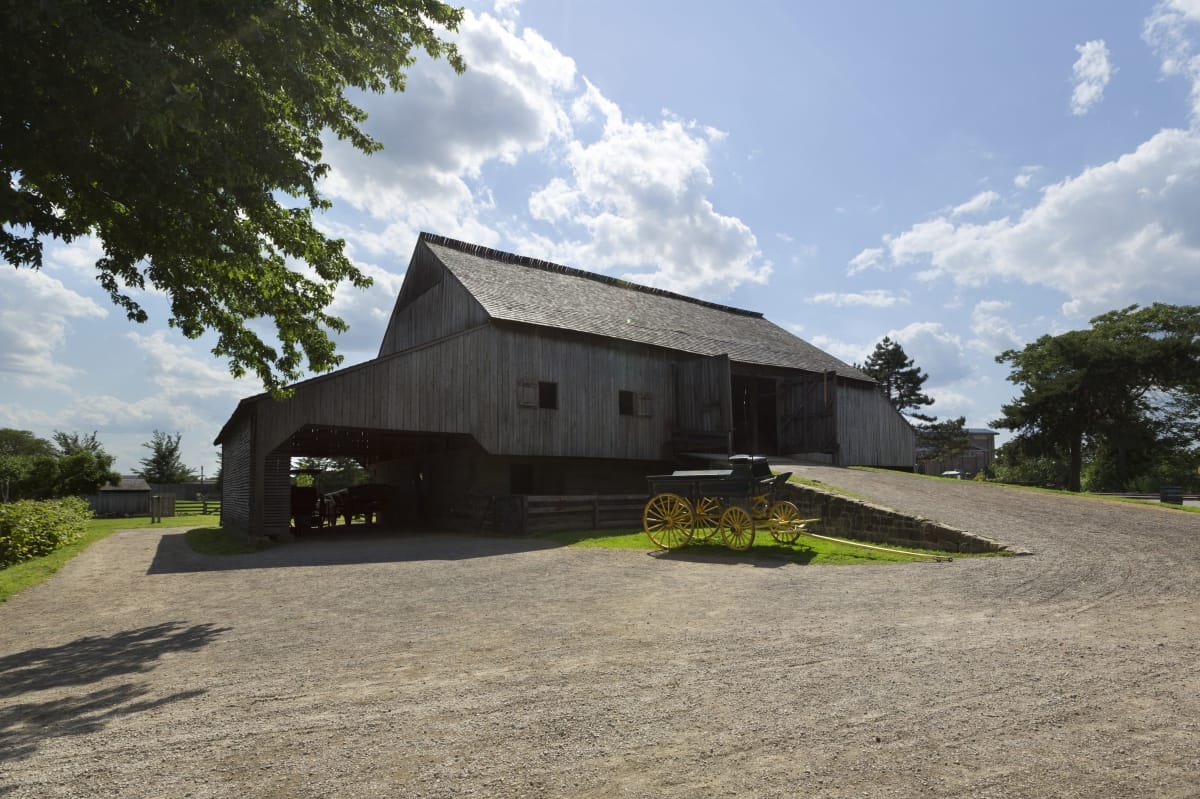
The Firestone barn is a Pennsylvania-German bank barn, an American barn type with Swiss origins. They are called bank barns because the barn is built into a bank, allowing wagons to be driven into the upper floor. Bank barns combined multiple farm functions under a single roof. Livestock were kept in the lower floor, crops on the upper floor.
View Artifact1916 Woods Dual-Power Hybrid Coupe
In 1916, gasoline was cheap, and no one cared about tailpipe emissions. But this hybrid wasn't about fuel prices or pollution. Woods Motor Vehicle Company built it to capture new customers. Sales of the company's electric cars were falling as more people chose gasoline-burning cars. The Dual-Power supposedly combined the best of both, but customers disagreed. The car and the company disappeared in 1918.
View ArtifactLogan County Courthouse
Between 1840 and 1847, Abraham Lincoln tried cases here as a traveling lawyer. Visiting once or twice a year, he worked mostly on cases resolving neighbors' disagreements over land, contracts, and debts. As Lincoln traveled, people got to know him because he always took time to talk to them. This helped him earn votes later when he went into politics.
View Artifact1961 Lincoln Continental Presidential Limousine Used by John F. Kennedy
President John F. Kennedy was assassinated in this car on November 22, 1963. The midnight blue, un-armored convertible was rebuilt with a permanent roof, titanium armor plating, and more somber black paint. The limousine returned to the White House and remained in service until 1977. The modified car shows the fundamental ways in which presidential security changed after Kennedy's death.
View ArtifactAllegheny Steam Locomotive, 1941
The Chesapeake & Ohio Railway's massive Allegheny, introduced in 1941, represents the peak of steam railroad technology. Among the largest and most powerful steam locomotives ever built, it weighed 1.2 million pounds with its tender and could generate 7,500 horsepower. Just 11 years later, C&O began pulling these giants from service. Diesel-electric locomotives proved more flexible and less expensive.
View ArtifactExploded Ford Model T, Originally Manufactured in 1924
There were more than 10,000 parts in a Ford Model T. Henry Ford's moving assembly line required that each one of those parts be manufactured to exact tolerances and be fully interchangeable with any other of its kind. By splitting a car's construction into a series of distinct small steps, the assembly line yielded enormous gains in productivity.
View Artifact

