
Day of Courage: Civil Rights
Share
share
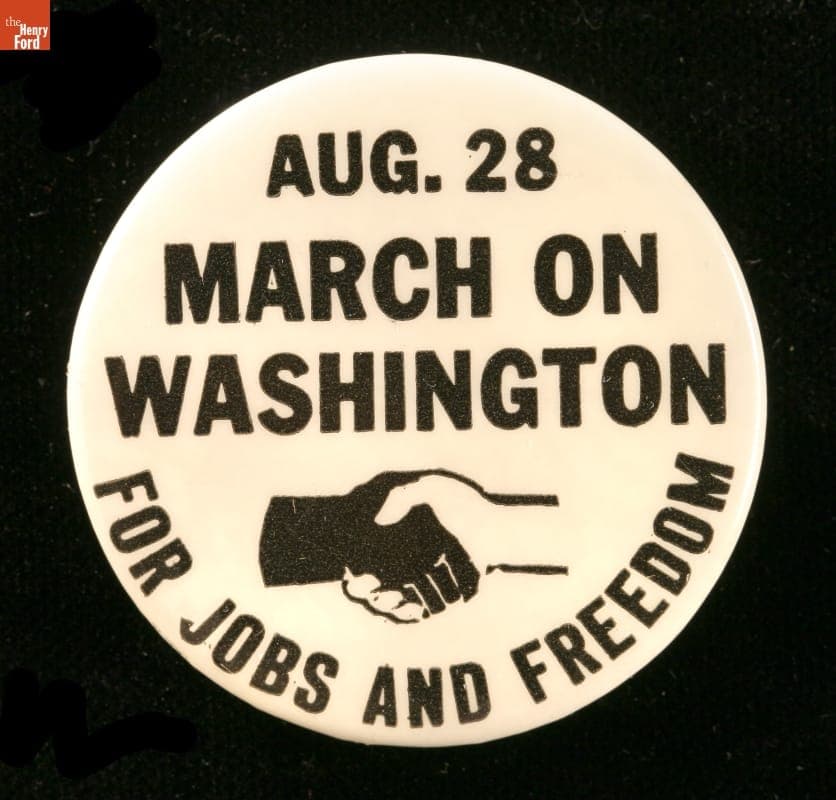
Button, March on Washington for Jobs and Freedom, 1963 - 1
More than 250,000 civil rights advocates showed up at this peaceful march to support unity, jobs, and a new Civil Rights bill being proposed by President Kennedy. Television viewers nationwide watched African Americans and whites march together, united behind a common cause. Songs and speeches at this march included Martin Luther King, Jr.'s famous "I Have a Dream" speech.
View ArtifactButton, "I am a Civil Rights Marcher," 1963
More than 250,000 civil rights advocates showed up at this peaceful march to support unity, jobs, and a new Civil Rights bill being proposed by President Kennedy. Television viewers nationwide watched African Americans and whites march together, united behind a common cause. Songs and speeches at this march included Martin Luther King, Jr.'s famous "I Have a Dream" speech.
View ArtifactButton, The March for Freedom, 1963
More than 250,000 civil rights advocates showed up at this peaceful march to support unity, jobs, and a new Civil Rights bill being proposed by President Kennedy. Television viewers nationwide watched African Americans and whites march together, united behind a common cause. Songs and speeches at this march included Martin Luther King, Jr.'s famous "I Have a Dream" speech.
View Artifact"March on Washington for Jobs and Freedom, August 28, 1963. Lincoln Memorial Program"
More than 250,000 civil rights advocates -- both African American and white -- showed up at this peaceful march to support unity, jobs, and a new Civil Rights bill being proposed by President Kennedy. This was the program for the day held at the Lincoln Memorial, along with a map of the site where the march began and ended.
View ArtifactButton, "Emancipation March on Washington," 1963
More than 250,000 civil rights advocates showed up at this peaceful march to support unity, jobs, and a new Civil Rights bill being proposed by President Kennedy. Television viewers nationwide watched African Americans and whites march together, united behind a common cause. Songs and speeches at this march included Martin Luther King, Jr.'s famous "I Have a Dream" speech.
View ArtifactPennant, March on Washington for Jobs and Freedom, 1963
More than 250,000 civil rights advocates showed up at this peaceful march to support unity, jobs, and a new Civil Rights bill being proposed by President Kennedy. Television viewers nationwide watched African Americans and whites march together, united behind a common cause. Songs and speeches at this march included Martin Luther King, Jr.'s famous "I Have a Dream" speech.
View ArtifactCongress of Racial Equality Periodical, "CORE-LATOR," No. 77, Summer, 1959
The Congress of Racial Equality (CORE), founded in 1942, pioneered nonviolent civil rights activism. Members organized and participated in sit-ins, freedom rides and other nonviolent actions during the Civil Rights era. This newsletter informed members about a sit-in in Miami, Florida.
View Artifact"1964 Civil Rights Bill... Its Pattern... Its Architects"
Some of those opposed to civil rights during the 1960s tried to discredit the movement and its leaders. The Alabama Legislative Commission to Preserve the Peace produced this document to expose potential communist threats. This brochure spoke out against the 1964 Civil Rights Bill as a threat to America and the American way of life.
View Artifact"Liberation, An Independent Monthly," Vol. 1, No. 2, April 1956
On December 1, 1955, Rosa Parks refused to give up her seat to a white man on a bus in Montgomery, Alabama. Her courageous act of protest sparked the Civil Rights movement. This publication from April 1956 contains details and a timeline of the months following Parks's arrest. Its cover depicts African Americans boycotting the bus line in nonviolent protest.
View ArtifactButton, "I Won't Live with Jim Crow: Civil Rights Congress," circa 1948 - 1
The term "Jim Crow" implied the systematic practice of discriminating against and segregating African Americans, especially in the American South, from the late 19th to the mid-20th centuries. The Civil Rights Congress (1946-1956) became a brief force in civil rights battles. However, with its ties to the American Communist Party, it became victim to Cold War anticommunism and government repression.
View ArtifactButton, "Abolish Poll Tax: 100% Democracy," circa 1950
By 1900, most southern states required citizens to pay a tax to vote. Poll taxes were one way to keep Blacks and many poor whites from voting. Though some states repealed their poll tax laws by 1950, five still clung to them. The passage of the 24th Amendment to the U. S. Constitution in 1964 and subsequent court rulings abolished the discriminatory practice.
View ArtifactButton, March on Washington for Jobs and Freedom, 1963 - 2
More than 250,000 civil rights advocates showed up at this peaceful march to support unity, jobs, and a new Civil Rights bill being proposed by President Kennedy. Television viewers nationwide watched African Americans and whites march together, united behind a common cause. Songs and speeches at this march included Martin Luther King, Jr.'s famous "I Have a Dream" speech.
View ArtifactRecord Album, "March on Washington: The Official Album," 1963
More than 250,000 civil rights advocates -- both African American and white -- showed up at this peaceful march on August 28, 1963, to support unity, jobs, and a new Civil Rights bill being proposed by President Kennedy. This LP record includes speeches by ten Civil Rights leaders heard at the Lincoln Memorial that day.
View ArtifactBrochure, "Mississippi Boycott Manual," 1965
Allies of desegregation could support the civil rights movement by boycotting southern companies and products. In 1965, the Albany (New York) Chapter of the NAACP promoted a boycott of Mississippi goods. This manual listed the companies and products its members should avoid. It was hoped that the loss of customer dollars would help put an end to that state's segregationist policies.
View ArtifactBrochure, "The South Comes North," 1948-1950
The Committee for Cooperation with the New South sought to change the discriminatory and segregationist policies in the post-World War II South. With this brochure, the committee targeted Northerners to back their cause. Supporters were urged to donate a dollar or more to aid progressive Southerners who promoted voter registration, "Negro liberation" and the interests of sharecroppers.
View ArtifactCongress of Racial Equality Handbill, "Don't Buy at Woolworth," 1960
In 1960, four African-American students sat down at a Woolworth lunch counter in Greensboro, North Carolina, and were refused service. This poster, produced by the Congress on Racial Equality (CORE), urged Americans to boycott the national five-and-dime chain. It was hoped that the loss of customer dollars would spur company officials to end the segregationist policies found in its southern stores.
View ArtifactFreedom in the Air: A Documentary on Albany, Georgia, 1962
Released in 1962, this album gave voice to local civil rights leaders and demonstrators in their struggle to desegregate Albany, Georgia. African-Americans in Albany had begun to challenge segregation policies in 1961. Though momentum waned when large numbers of marchers and demonstrators were jailed, Albany's African-American community continued to challenge -- and eventually change -- local segregation laws.
View Artifact

