
Henry Ford: $5 Day
Share
share
This Expert Set was compiled in 2013 to commemorate the 150th anniversary of Henry Ford’s birth.
THF94858
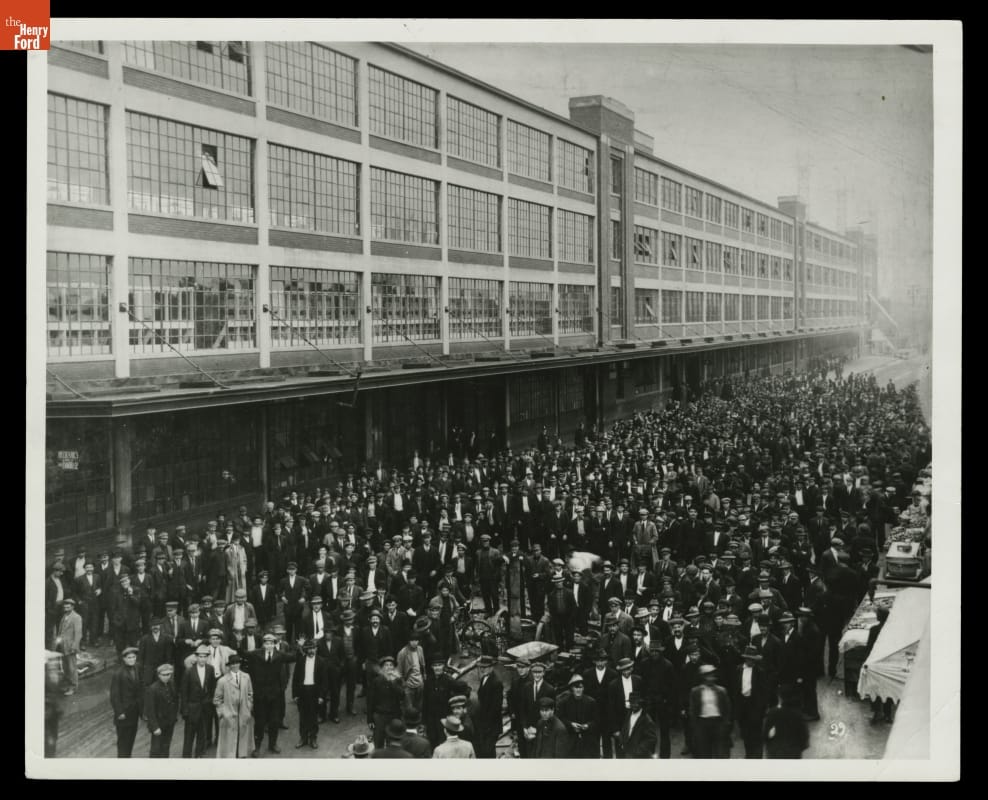
Crowd of Applicants outside Highland Park Plant after Five Dollar Day Announcement, January 1914
Ford workers disliked the new assembly line methods so much that by late 1913, labor turnover was 380 percent. The company's announcement to pay five dollars for an eight-hour day compared to the previous rate of $2.34 for a nine-hour day made many workers willing to submit to the relentless discipline of the line in return for such high wages.
View ArtifactLetter to Henry Ford from the Wife of an Assembly Line Worker, 1914
Letter written to Henry Ford from the wife of an assembly line worker, January 23, 1914. The woman writes asking Henry Ford to investigate the situation on the assembly lines in the factories with regard to working conditions. She is angry about the treatment her husband receives on the job.
View ArtifactNewspaper Article, "Gold Rush is Started by Ford's $5 Offer," January 7, 1914
Ford's $5 Day was huge news across the country. Never before had any employer offered this much money for unskilled work. The plan came with numerous strings attached, including rather intrusive company investigations to insure that workers would not spend their money on riotous living (as defined by Ford Motor Company) but workers accepted the intrusion because the money was so good.
View ArtifactFord Motor Company Publication: "Helpful Hints and Advice to Ford Employes," 1915
In 1914, Henry Ford took the radical step of paying workers $5 per day for a 40-hour work week; he called this compensation "profit-sharing." Ford's turnover problem disappeared. In addition, Ford workers could buy the cars they produced, benefitting the company. However, profit-sharing required employees to conduct their lives in a certain manner. The requirements are outlined in this pamphlet.
View ArtifactNewspaper Article, "Henry Ford Gives $10,000,000 in 1914 Profits to His Employes"
When Henry Ford introduced the moving assembly line in 1913 he loved it but his employees didn't. The work was boring and relentless, and worker turnover was high. To get workers to stay, Henry more than doubled their pay, from $2.34 per day to $5 per day. It was headline news in Detroit and around the country.
View Artifact"Factory Facts from Ford," 1915
This pamphlet covers topics about Ford Motor Company and highlights the Ford Sociological Department. The department was created to ensure that employees, many of whom were non-English-speaking immigrants, did not squander their $5 per day wages. Investigators monitored the personal and work lives of employees. In addition, the department provided hygiene instruction, financial and legal advice, and an English-language school.
View ArtifactFord Motor Company Meeting Minutes Book, 1911-1919
These few paragraphs from the January 5th meeting of Ford's Board of Directors announcing the a $5.00 a day wage for an eight hour work day brought thousands of workers to Detroit and sent shock waves through the upper echelon of the automobile industry.
View ArtifactFord Motor Company Clipping Book, Volume 2, January 6-10, 1914
Henry Ford's office kept a file of newspaper articles from across the country that covered Ford Motor Company and other topics of interest to Henry. These pages are from the days following Ford's announcement of the $5 per day profit sharing plan in January 1914. While Ford's primary objective was to reduce employee turnover, the $5 day was also excellent publicity.
View Artifact

