
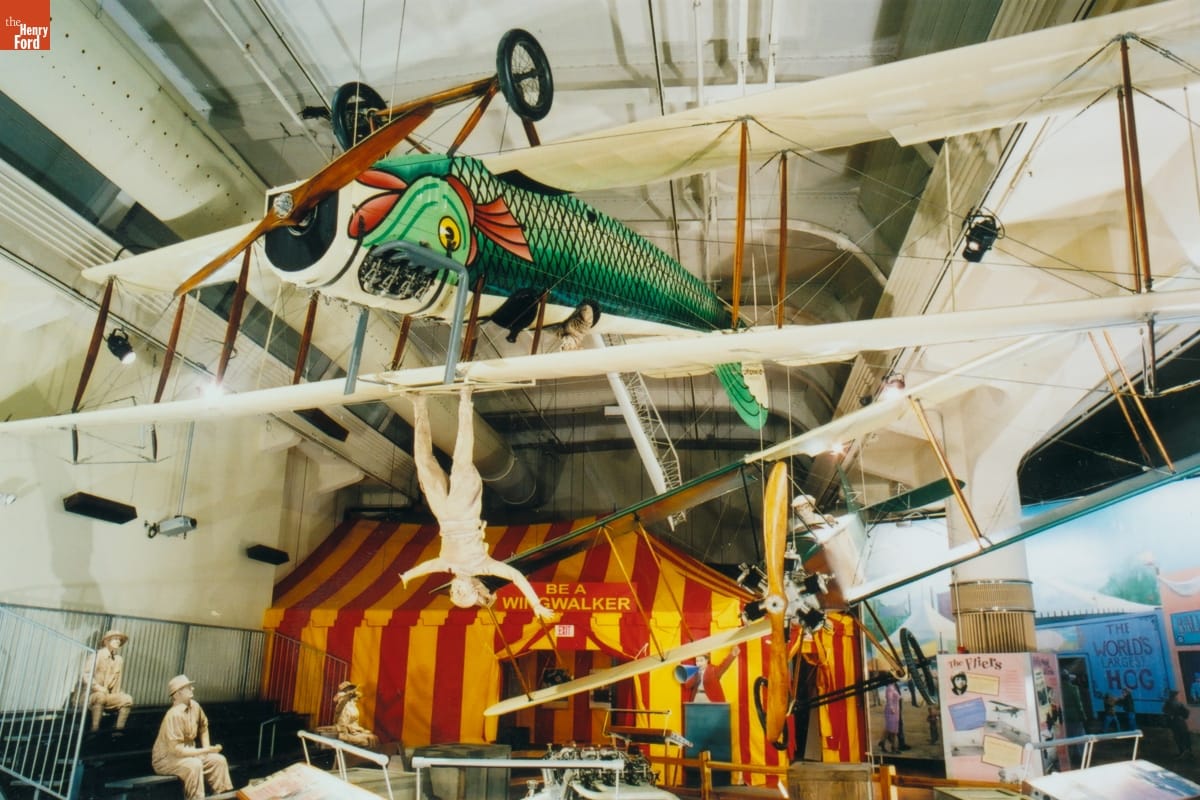
1917 Curtiss JN-4D "Canuck" Biplane
THF39670 / 1917 Curtiss JN-4D "Canuck" Biplane
01
Artifact Overview
The Curtiss JN-4 "Jenny" was the U.S. Army's primary training aircraft in the World War I era. After the war, surplus Jennys formed the core of America's barnstorming fleet. The JN-4D variation employed a control stick rather than the wheel used in the standard version. The JN-4D originally was built for the Canadian market, explaining its "Canuck" nickname.
Artifact Details
Artifact
Airplane
Date Made
1917
Place of Creation
Location
at Henry Ford Museum in Heroes of the Sky
Object ID
48.17.1
Credit
From the Collections of The Henry Ford. Gift of Ray C. Dahlinger.
Material
Metal
Wood (Plant material)
Cloth
Leather
Color
Olive (Color)
Yellow (Color)
Black (Color)
Dimensions
Height: 9.83 ft
Width: 43.648 ft
Length: 27.3 ft
Keywords |
|---|
02
Related Content
 Set
SetFeatured on The Henry Ford's Innovation Nation: Season 7
- 26 Artifacts
The Curtiss JN-4 "Jenny" was the U.S. Army's primary training aircraft in the World War I era. After the war, surplus Jennys formed the core of America's barnstorming fleet. The JN-4D variation employed a control stick rather than the wheel used in the standard version. The JN-4D originally was built for the Canadian market, explaining its "Canuck" nickname. Set
SetBarnstormers
- 20 Artifacts
Barnstorming aerial performers thrilled audiences in the 1920s with death-defying "aerobatic" stunts. Equipped with war-surplus airplanes and steely nerves, they toured the country giving many Americans their first in-person experiences with aviation. Most barnstormers barely eked out a living, but a few found wealth and fame. By decade's end, aging aircraft, fading novelty, and growing government regulation largely ended the barnstorming era. article
Getting into the Air: Alexander Graham Bell’s Aerial Experiment Association
In 1907, inventor Alexander Graham Bell assembled a small team of talented young men in the Aerial Experiment Association to try to solve the problem of flight.