
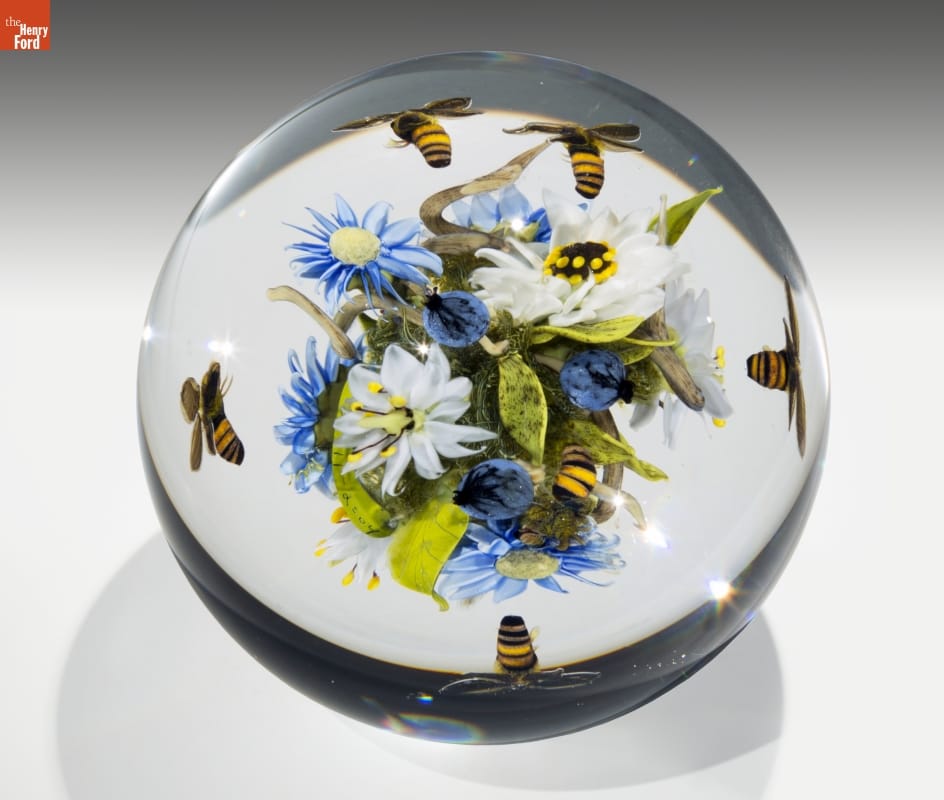
"Flowers, Fruit, and Golden Orbs" by Paul J. Stankard, 2013

THF165048 / "Flowers, Fruit, and Golden Orbs" by Paul J. Stankard, 2013
01
Artifact Overview
Paul Stankard is one of the founders of the Studio Glass movement of the 1960s and 70s. Most early Studio Glass artists began their careers creating paperweights and moved on to other forms. Stankard concentrated on creating the most technically sophisticated and beautiful paperweights he could imagine. Today, Stankard is acclaimed for his miniature worlds, consisting of imaginary botanicals, bees and sometimes human figures.
Artifact Details
Artifact
Assemblage (Sculpture)
Date Made
2013
Creators
Place of Creation
Location
at Henry Ford Museum in Davidson-Gerson Modern Glass Gallery
Object ID
2016.34.17
Credit
From the Collections of The Henry Ford.
Material
Glass (Material)
Color
Black (Color)
Colorless
Multicolored
Dimensions
Height: 7 in
Width: 8.125 in
Length: 3 in
Inscriptions
etched on bottom:
Paul J. Stankard / 2013
Keywords |
|---|
02
Related Content
 Set
SetPaperweights by Paul Stankard
- 10 Artifacts
Paul Stankard is one of the founders of the Studio Glass movement of the 1960s and 70s. Most early Studio Glass artists began their careers creating paperweights and moved on to other forms. Stankard concentrated on creating the most technically sophisticated and beautiful paperweights he could imagine. Today, Stankard is acclaimed for his miniature worlds, consisting of imaginary botanicals, bees and sometimes human figures. article
Studio Glass Expert on Display: Paul Stankard
Paul Stankard is one of the founders of the Studio Glass movement of the 1960s and 1970s, and you can see examples of his work in Henry Ford Museum's newest exhibit, the Davidson-Gerson Modern Glass Gallery. article
Now Open: Davidson-Gerson Modern Glass Gallery
This month, the story of the Studio Glass Movement becomes a permanent exhibit in Henry Ford Museum with the opening of the Davidson-Gerson Modern Glass Gallery. article
Flowers: Deep Roots
Learn how growing, selling, and buying flowers fit into the agricultural, cultural, and economic landscape of 19th-century Detroit.