
Art Glass
Share
share
Dating from the late 19th century through the early 20th century, art glass is primarily decorative glass. Makers of art glass employed newly-developed technologies for producing vibrant colors and surface textures. This is most famously seen in the iridescent surfaces of Louis Comfort Tiffany and his contemporaries, although art glass took many shapes and forms.
THF168764
Favrile Bowl, 1916
Art Glass is ornamental and decorative glass dating from the mid-to-late 19th century through the early 20th century. Makers of Art Glass employed newly developed technologies for producing vibrant colors and surface textures. This is most famously seen in the iridescent surfaces of Louis Comfort Tiffany and his contemporaries, although Art Glass took many shapes and forms.
View ArtifactTHF167758
Burmese Caster, 1885-1895
Art Glass is ornamental and decorative glass dating from the mid-to-late 19th century through the early 20th century. Makers of Art Glass employed newly developed technologies for producing vibrant colors and surface textures. This is most famously seen in the iridescent surfaces of Louis Comfort Tiffany and his contemporaries, although Art Glass took many shapes and forms.
View ArtifactTHF125910
Electric Chandelier, 1906
This chandelier came from a house at 67 East Kirby Street, Detroit, now the Hellenic Museum of Michigan. The Flemish Renaissance house was designed by architect John Scott and commissioned by Emory Leyden Ford. Unrelated to the Dearborn Fords, Emory Ford made his fortune in the chemical and cement business. Married in 1905, he built this house in 1906. By 1912 he relocated to Grosse Pointe.
View ArtifactTHF167604
Favrile Flower Frog, circa 1916
Art Glass is ornamental and decorative glass dating from the mid-to-late 19th century through the early 20th century. Makers of Art Glass employed newly developed technologies for producing vibrant colors and surface textures. This is most famously seen in the iridescent surfaces of Louis Comfort Tiffany and his contemporaries, although Art Glass took many shapes and forms.
View ArtifactTHF167600
Goblet, 1924-1931
Glassmaker Emil Larsen came to Durand Art Glass with experience from Tiffany Studios and Quezal Art Glass. In fact, Larson first produced "Peacock Feather" patterned goblets at Quezal. At Durand, these goblets were produced in blue, green and in this case, ruby. During the late 1920s, Peacock Feather glassware became synonymous with glass made by Durand Art Glass.
View ArtifactTHF168531
Lalique "Victoire" Hood Ornament, 1928-1930
Rene Lalique created some of the most striking automobile mascots or hood ornaments. Lalique's elegant, molded-glass models enhanced the front of any luxury vehicle. The mascots could also be lit from below making them all the more impressive. These decorative mascots became a symbol of the car owner's wealth, status, and good taste.
View ArtifactTHF167773
Kerosene Lamp, circa 1880
Art Glass is ornamental and decorative glass dating from the mid-to-late 19th century through the early 20th century. Makers of Art Glass employed newly developed technologies for producing vibrant colors and surface textures. This is most famously seen in the iridescent surfaces of Louis Comfort Tiffany and his contemporaries, although Art Glass took many shapes and forms.
View ArtifactTHF167589
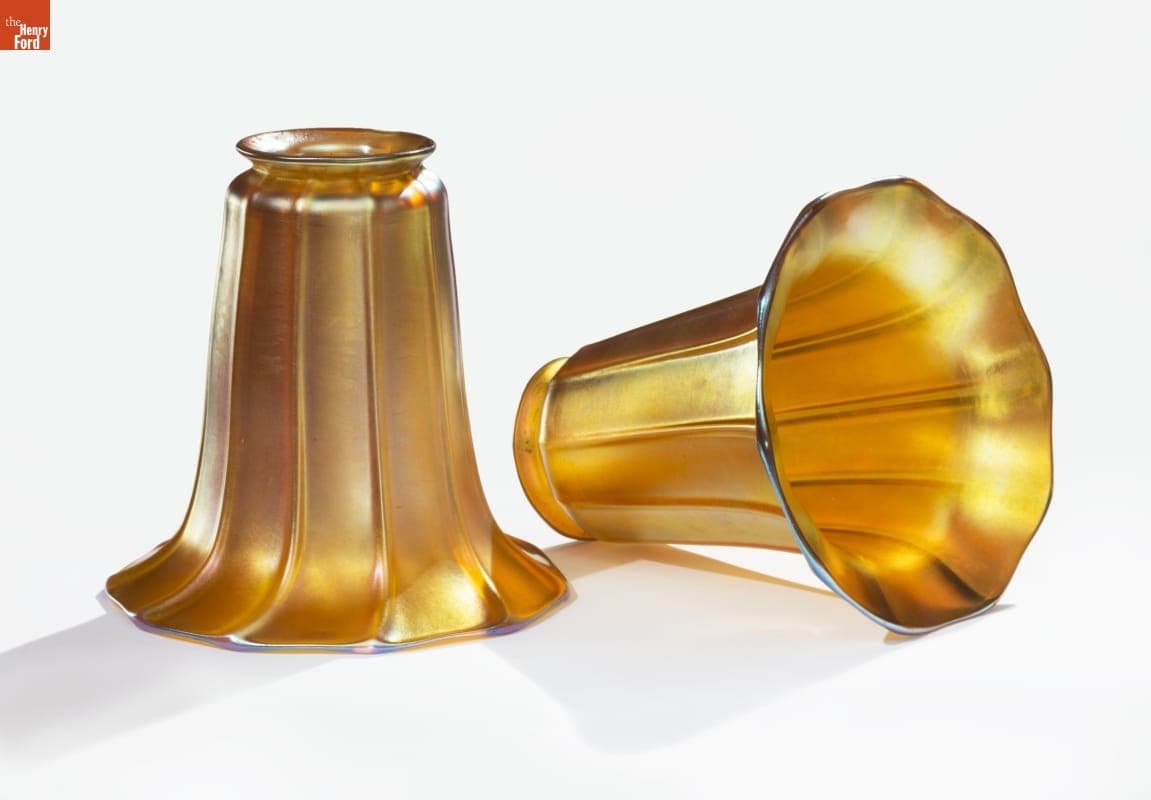
Lampshade, 1900-1920
Art Glass is ornamental and decorative glass dating from the mid-to-late 19th century through the early 20th century. Makers of Art Glass employed newly developed technologies for producing vibrant colors and surface textures. This is most famously seen in the iridescent surfaces of Louis Comfort Tiffany and his contemporaries, although Art Glass took many shapes and forms.
View ArtifactTHF167597
Lampshades, 1905-1910
Art Glass is ornamental and decorative glass dating from the mid-to-late 19th century through the early 20th century. Makers of Art Glass employed newly developed technologies for producing vibrant colors and surface textures. This is most famously seen in the iridescent surfaces of Louis Comfort Tiffany and his contemporaries, although Art Glass took many shapes and forms.
View ArtifactTHF300991
Paperweight, 1880-1915
Ralph Barber was a glassmaker for the Whitall Tatum Glass Company in Millville, New Jersey. In the 1880s he developed techniques for creating delicate floral paper weights. The most common were roses, but he also created tulips and lilies. This example represents the most elaborate of Barber's paper weights, featuring a series of fuchsia lily tendrils surrounded by white and green leaves.
View ArtifactTHF167923
Electric Table Lamp, 1903-1920
When designer Clara Driscoll created this daffodil patterned lamp for Louis Comfort Tiffany she did not realize that it was the first of a series of floral electric lamps shades, which included Wisteria, Poppy and Laburnum. Driscoll was the leader of a group of female designers known as "The Tiffany Girls", all unmarried women who designed and fabricated decorative domestic wares from desk sets to jewelry.
View ArtifactTHF167602
Tumbler, 1920-1930
Art Glass is ornamental and decorative glass dating from the mid-to-late 19th century through the early 20th century. Makers of Art Glass employed newly developed technologies for producing vibrant colors and surface textures. This is most famously seen in the iridescent surfaces of Louis Comfort Tiffany and his contemporaries, although Art Glass took many shapes and forms.
View ArtifactTHF163612
Peachblow Vase, circa 1886
Art Glass is ornamental and decorative glass dating from the mid-to-late 19th century through the early 20th century. Makers of Art Glass employed newly developed technologies for producing vibrant colors and surface textures. This is most famously seen in the iridescent surfaces of Louis Comfort Tiffany and his contemporaries, although Art Glass took many shapes and forms.
View ArtifactTHF163603
Favrile Vase, circa 1899
Art Glass is ornamental and decorative glass dating from the mid-to-late 19th century through the early 20th century. Makers of Art Glass employed newly developed technologies for producing vibrant colors and surface textures. This is most famously seen in the iridescent surfaces of Louis Comfort Tiffany and his contemporaries, although Art Glass took many shapes and forms.
View ArtifactTHF162344
Aurene Vase, circa 1920
Aurene was the name that Frederick Carder used for his iridescent art glass at the Steuben Glass Works made in Corning, New York. The glass produces a prismatic effect when light reflects across the surface. This elegant, floral-shaped vase combines a cased white outer shell with a dark blue iridescent interior. Steuben made many varieties of colored Aurene glass until 1932, when it moved toward more modern shapes.
View Artifact

