
Flying the Night Mail
Share
share
In the 1920s, the U.S. Air Mail Service established a 2,629-mile stretch of light beacons and illuminated airfields between New York and San Francisco. Regular overnight service drastically reduced delivery times, and ultimately, the success of transcontinental air mail encouraged the development of the commercial aviation industry.
THF255249
Beacon Light and Wind Cone in Place for First Night Air Mail Service between New York and Chicago, 1925
In 1924, with the success of experimental night operations and increasing business interest in next-day mail, the U.S. Air Mail Service announced plans to establish regular overnight flights between New York and Chicago. Preparations included mounting floodlights and searchlights at airfields and constructing a series of routing beacons and emergency landing fields along the route. The first official flights departed from both terminal cities on July 1, 1925.
View ArtifactBeacon Light at Sherman Hill, Wyoming, to Guide Transcontinental Air Mail Pilots, 1924
Early pilots depended on visual landmarks, preventing reliable nighttime navigation. When the postal service took to the skies with transcontinental mail delivery, a lighted pathway was formed to guide pilots at night. Throughout the 1920s, a series of powerful light beacons was built, eventually stretching from New York to San Francisco. This Wyoming beacon is the mid-point of the route.
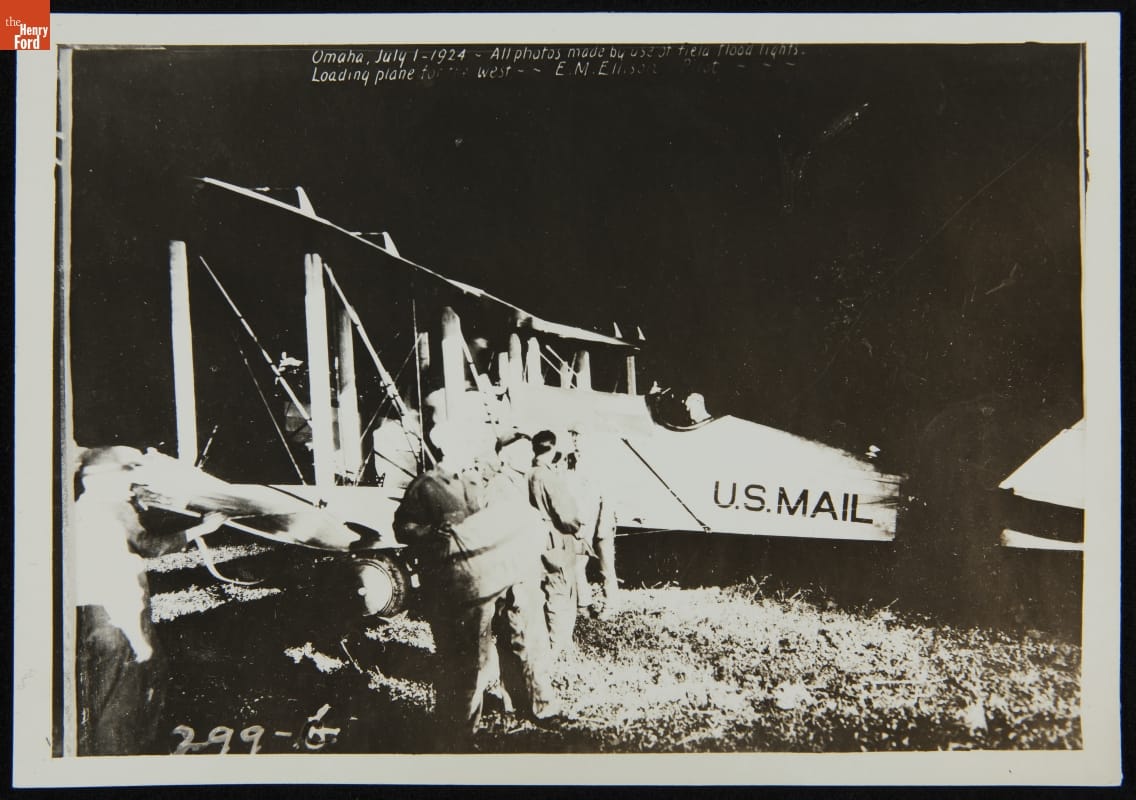
View ArtifactLoading Air Mail Plane Using Floodlights, Fort Crook near Omaha, Nebraska, 1924
Transcontinental air mail pilots relied on a string of powerful light beacons to navigate sections of the New York to San Francisco route at night. They flew night mail planes equipped with illuminated instrument panels, navigation lights, and landing lights. At airfields along the way, floodlights helped workers inspect the planes, refuel, and unload and load the mail.
View ArtifactNight Air Mail Plane Test Flight Lands in New York, 1924
In 1924, with the success of experimental night operations and increasing business interest in next-day mail, the U.S. Air Mail Service announced plans to establish regular overnight flights between New York and Chicago. Preparations included mounting floodlights and searchlights at airfields and constructing a series of routing beacons and emergency landing fields along the route. The first official flights departed from both terminal cities on July 1, 1925.
View Artifact"Cleveland Greets the First Night Mail Plane," July 1, 1924
Early pilots depended on visual landmarks, preventing reliable nighttime navigation. When the postal service took to the skies with transcontinental mail delivery, a lighted pathway was formed to guide pilots at night. Throughout the 1920s, a series of powerful light beacons was built, eventually stretching from New York to San Francisco. This image celebrates Cleveland's first night mail flight.
View ArtifactAeronautical Beacon in the Alleghenies, circa 1925
In 1924, with the success of experimental night operations and increasing business interest in next-day mail, the U.S. Air Mail Service announced plans to establish regular overnight flights between New York and Chicago. Preparations included mounting floodlights and searchlights at airfields and constructing a series of routing beacons and emergency landing fields along the route. The first official flights departed from both terminal cities on July 1, 1925.
View ArtifactAir Mail Plane Landing at Hadley Field at Night, New York to Chicago Route, July 1, 1925
In 1924, with the success of experimental night operations and increasing business interest in next-day mail, the U.S. Air Mail Service announced plans to establish regular overnight flights between New York and Chicago. Preparations included mounting floodlights and searchlights at airfields and constructing a series of routing beacons and emergency landing fields along the route. The first official flights departed from both terminal cities on July 1, 1925.
View ArtifactU.S. Air Mail Pilot Charles Ames Delivering First Overnight Mail Service, 1925
Federally subsidized air mail service encouraged commercial aviation. Pilots first navigated by visible landmarks, flying only in daylight. Lighted beacons, installed along flight paths, enabled night flights. It was dangerous work. Air mail pilot Charles Ames died when his plane crashed in central Pennsylvania, on the route from New York to Chicago, in 1925.
View Artifact

